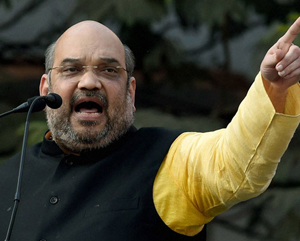
More lynching incidents happened under previous govts: Shah

Agencies
July 2, 2017

Panaji, Jul 2: BJP president Amit Shah has said that more incidents of lynching had occurred during the previous governments than during the three years of NDA rule, but no one had raised questions then.amitt

"I do not want to compare and undermine the current incidents of lynching. I am also serious about it. But there have been more lynching incidents in 2011, 2012 and 2013," Shah told a gathering of professionals in Goa last evening.

"There have been more lynchings each year in the past, compared to the total lynching incidents that have happened during our three-year-long tenure," the BJP leader said. The BJP-led government came to power at the Centre in May 2014.

Responding to a question about fears over the lynching incidents, he said there was no apprehension anywhere in the country.

"Do you know of any such incident where arrests have not been made? I do not have any answer to apprehensions. There is no apprehension anywhere in the country," he said.

Maintaining that law and order was a state subject, Shah said when Mohammad Akhlaq died, the Samajwadi Party-led government was in power in Uttar Pradesh, and it was its responsibility.

"But protests are held in Delhi in front of the Narendra Modi government. What is this fashion," he asked.

In September 2015, Akhlaq was dragged out of his house and killed by a mob at Dadri in UP on suspicion of storing and consuming beef.

Following several such lynching incidents, including those in Jharkhand, Haryana and UP, protests were held late last month at several cities across the country.

Comments

Ranjan shetty
 - 
Thursday, 6 Jul 2017

Chutiya bangladeshisare attacking Hindus in WB, where are those SOB's who did rally in the name of #notin my name ?

Umar Ashfaq
 - 
Thursday, 6 Jul 2017

Please qidmat k mauka de guzarish hogi

ABDUL AZIZ
 - 
Thursday, 6 Jul 2017

hang them till death , sharia law

Abdullah
 - 
Sunday, 2 Jul 2017

But who killed them????
You and your goons only.

Rikaz
 - 
Sunday, 2 Jul 2017

do not compare with previous government, it is your job to eliminate all sort of lynching around....take action on all who committed it as of now and make sure that it will not happen again....why it is happening only on muslims....there are people eating beef from other community.... and beef export factories exporting beef everyday basis with no problems...if you have guts stop it....

Thoushi
 - 
Sunday, 2 Jul 2017

True lynching was happening in previous government also and before since Gandhi's assassination , but Mr. Cha most all lynching was carried out by your OWN associated party(BJP) and wings (RSS)

Add new comment

  • Coastaldigest.com reserves the right to delete or block any comments.
  • Coastaldigset.com is not responsible for its readers’ comments.
  • Comments that are abusive, incendiary or irrelevant are strictly prohibited.
  • Please use a genuine email ID and provide your name to avoid reject.
News Network
April 24,2020

Kozhikode, Apr 24: A four-month-old baby girl, who had tested positive for COVID-19 and suffering from congenital heart disease, died in a hospital here in Kerala early Friday after suffering a cardiac arrest, officials said.

This is the third COVID-19 death and the first infant fatality in the state where two elderly people had succumbed to the disease earlier.

The baby was admitted to the Medical College Hospital here on April 21 with history of fever, cough, breathing difficulties and seizure after being treated at two other hospitals and the end came at 6 am, a medical bulletin said.

State Health Minister K K Shailaja said doctors had made maximum efforts to save the life of the child, whose family belonged to Payyanad near Manjeri in Malappuram district.

"Preliminary information which we have is that there has been some primary contact", she told reporters in Thiruvananthapuram.

The protocol for COVID-19 cases would be followed for the baby's last rites, the Minister added.

As of Thursday, the total active COVID-19 cases in the state stood at 129.

The bulletin said on arrival at the hospital on Tuesday the baby was in shock and had respiratory failure.

"She was resuscitated, mechanically ventilated and appropriate antibiotics for pneumonia and supportive measures to correct shock were started", it said adding the baby, however, continued to remain sick.

"Even though there was no history of any high or low risk contact or any epidemiological links as the child comes from SARI (Sever Acute Respiratory infection) criteria, she was admitted to the COVID-ICU and swab was taken and she tested positive", the bulletin said.

Contact tracing of those who had come in contact with the child was in progress.

Mallapuram District Medical Officer (Health) Dr Sakeena K said the child was having severe health issues from its birth itself and was admitted to a private hospital in Manjeri near here with breathing problem.

As her condition worsened, the baby was shifted to another hospital and later to the medical college hospital.

"The baby was having chest deformity and Atrial Septal Defect by birth which developed into severe health issues, the official added.

Comments

Add new comment

  • Coastaldigest.com reserves the right to delete or block any comments.
  • Coastaldigset.com is not responsible for its readers’ comments.
  • Comments that are abusive, incendiary or irrelevant are strictly prohibited.
  • Please use a genuine email ID and provide your name to avoid reject.
News Network
May 25,2020

New Delhi, May 25: Mahindra Group Chairman Anand Mahindra on Monday said lockdown extensions are not just economically disastrous but also create another medical crisis.

While acknowledging that choices are not easy for policymakers, he said a lockdown extension will not help.

"Lockdown extensions aren't just economically disastrous, as I had tweeted earlier, but also create another medical crisis," Mahindra said in a tweet.

He was referring to an article that highlighted "the dangerous psychological effects of lockdowns & the huge risk of neglecting non-COVID patients".

Mahindra, who had earlier proposed a comprehensive lifting after 49 days of lockdown, further said, "The choices aren't easy for policy makers but a lockdown extension won't help".

He said, "The numbers (coronavirus cases) will continue to rise & the focus must be on rapid expansion of field hospital beds with oxygen lines".

He further said, "The army has enormous expertise in this".

On March 22, before the government announced nationwide lockdown, Mahindra had proposed such a move expressing concerns over reports that India was likely to have already reached stage 3 of coronavirus transmission.

Comments

Add new comment

  • Coastaldigest.com reserves the right to delete or block any comments.
  • Coastaldigset.com is not responsible for its readers’ comments.
  • Comments that are abusive, incendiary or irrelevant are strictly prohibited.
  • Please use a genuine email ID and provide your name to avoid reject.
Agencies
June 6,2020

United Nations, Jun 6: The coronavirus disease has not "exploded" in India, but the risk of that happening remains as the country moves towards unlocking its nationwide lockdown that was imposed in March to contain the Covid-19, according to a top WHO expert.

WHO Health Emergencies Programme Executive Director Michael Ryan on Friday said the doubling time of the coronavirus cases in India is about three weeks at this stage.

“So the direction of travel of the epidemic is not exponential but it is still growing,” he said, adding that the impact of the pandemic is different in different parts of India and varies between urban and rural settings.

“In South Asia, not just in India but in Bangladesh and...in Pakistan, other countries in South Asia, with large dense populations, the disease has not exploded. But there is always the risk of that happening,” Ryan said in Geneva.

He stressed that as the disease generates and creates a foothold in communities, it can accelerate at any time as has been seen in a number of settings.

Ryan noted that measures taken in India such as the nationwide lockdown have had an impact in slowing transmission but the risk of an increase in cases looms as the country opens up.

“The measures taken in India certainly had an impact in dampening transmission and as India, as in other large countries, open up and as people begin to move again, there's always a risk of the disease bouncing back up,” he said.

He added that there are specific issues in India regarding the large amount of migration, the dense populations in the urban environment and the fact that many workers have no choice but to go to work every day.

India went past Italy to become the sixth worst-hit nation by the COVID-19 pandemic.

India saw a record single-day jump of 9,887 coronavirus cases and 294 deaths on Saturday, pushing the nationwide infection tally to 2,36,657 and the death toll to 6,642, according to the health ministry.

The lockdown in India, was first clamped on March 25 and spanned for 21 days, while the second phase of the curbs began on April 15 and stretched for 19 days till May 3. The third phase of the lockdown was in effect for 14 days and ended on May 17. The fourth phase ended on May 31.

The country had registered 512 coronavirus infection cases till March 24.

The nation-wide lockdown in containment zones will continue till June 30 in India but extensive relaxations in a phased manner from June 8 are listed in the Union home ministry's fresh guidelines on tackling the Covid-19 pandemic issued last week.

WHO Chief Scientist Soumya Swaminathan said the over 200,000 current coronavirus cases in India, a country of over 1.3 billion people, "look big but for a country of this size, it's still modest.”

She stressed that it is important for India to keep track of the growth rate, the doubling time of the virus and to make sure that that number doesn't get worse.

She said that India is a “heterogeneous and huge country” with very densely populated cities and much lower density in some rural areas and varying health systems in different states and these offer challenges to the control of Covid-19.

Swaminathan added that as the lockdown and restrictions are lifted, it must be ensured that all precautions are taken by people.

“We've been making this point repeatedly that really if you want behaviour change at a large level, people need to understand the rationale for asking them to do certain things (such as) wearing masks,” she said.

In many urban areas in India, it's impossible to maintain physical distancing, she said adding that it then becomes very important for people to wear appropriate face coverings when they are out, in office settings, in public transport and educational institutions.

“As some states are thinking about opening, every institution, organisation, industry and sector needs to think about what are the measures that need to be put in place before you can allow a functioning and it may never be back to normal.”

She said that in many professions working from home can be encouraged but in several jobs, people have to go to work and in such cases measures must be put in place that allow people to protect themselves and others.

“I think communication and behaviour change is a very large part of this whole exercise,” she added.


Comments

Add new comment

  • Coastaldigest.com reserves the right to delete or block any comments.
  • Coastaldigset.com is not responsible for its readers’ comments.
  • Comments that are abusive, incendiary or irrelevant are strictly prohibited.
  • Please use a genuine email ID and provide your name to avoid reject.