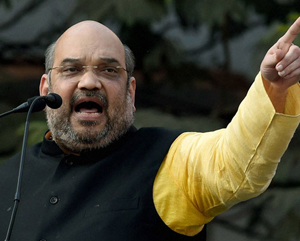
More lynching incidents happened under previous govts: Shah

Agencies
July 2, 2017

Panaji, Jul 2: BJP president Amit Shah has said that more incidents of lynching had occurred during the previous governments than during the three years of NDA rule, but no one had raised questions then.amitt

"I do not want to compare and undermine the current incidents of lynching. I am also serious about it. But there have been more lynching incidents in 2011, 2012 and 2013," Shah told a gathering of professionals in Goa last evening.

"There have been more lynchings each year in the past, compared to the total lynching incidents that have happened during our three-year-long tenure," the BJP leader said. The BJP-led government came to power at the Centre in May 2014.

Responding to a question about fears over the lynching incidents, he said there was no apprehension anywhere in the country.

"Do you know of any such incident where arrests have not been made? I do not have any answer to apprehensions. There is no apprehension anywhere in the country," he said.

Maintaining that law and order was a state subject, Shah said when Mohammad Akhlaq died, the Samajwadi Party-led government was in power in Uttar Pradesh, and it was its responsibility.

"But protests are held in Delhi in front of the Narendra Modi government. What is this fashion," he asked.

In September 2015, Akhlaq was dragged out of his house and killed by a mob at Dadri in UP on suspicion of storing and consuming beef.

Following several such lynching incidents, including those in Jharkhand, Haryana and UP, protests were held late last month at several cities across the country.

Comments

Ranjan shetty
 - 
Thursday, 6 Jul 2017

Chutiya bangladeshisare attacking Hindus in WB, where are those SOB's who did rally in the name of #notin my name ?

Umar Ashfaq
 - 
Thursday, 6 Jul 2017

Please qidmat k mauka de guzarish hogi

ABDUL AZIZ
 - 
Thursday, 6 Jul 2017

hang them till death , sharia law

Abdullah
 - 
Sunday, 2 Jul 2017

But who killed them????
You and your goons only.

Rikaz
 - 
Sunday, 2 Jul 2017

do not compare with previous government, it is your job to eliminate all sort of lynching around....take action on all who committed it as of now and make sure that it will not happen again....why it is happening only on muslims....there are people eating beef from other community.... and beef export factories exporting beef everyday basis with no problems...if you have guts stop it....

Thoushi
 - 
Sunday, 2 Jul 2017

True lynching was happening in previous government also and before since Gandhi's assassination , but Mr. Cha most all lynching was carried out by your OWN associated party(BJP) and wings (RSS)

Add new comment

  • Coastaldigest.com reserves the right to delete or block any comments.
  • Coastaldigset.com is not responsible for its readers’ comments.
  • Comments that are abusive, incendiary or irrelevant are strictly prohibited.
  • Please use a genuine email ID and provide your name to avoid reject.
Agencies
June 30,2020

United Nations, Jun 30: India accounts for 45.8 million of the world's 142.6 million "missing females" over the past 50 years, a report by the United Nations said on Tuesday, noting that the country along with China form the majority of such women globally.

The State of World Population 2020 report released on Tuesday by the United Nations Population Fund (UNFPA), the world organisation's sexual and reproductive health agency, said that the number of missing women has more than doubled over the past 50 years - from 61 million in 1970 to a cumulative 142.6 million in 2020.

Of this global figure, India accounted for 45.8 million missing females as of 2020 and China accounted for 72.3 million.

Missing females are women missing from the population at given dates due to the cumulative effect of postnatal and prenatal sex selection in the past, the agency said.

Between 2013 and 2017, about 460,000 girls in India were missing' at birth each year. According to one analysis, gender-biased sex selection accounts for about two-thirds of the total missing girls, and post-birth female mortality accounts for about one-third, the report said.

Citing data by experts, it said that China and India together account for about 90-95 per cent of the estimated 1.2 million to 1.5 million missing female births annually worldwide due to gender-biased (prenatal) sex selection.

The two countries also account for the largest number of births each year, it said.

The report cites data by Alkema, Leontine and others, 2014 National, Regional, and Global Sex Ratios of Infant, Child, and under-5 Mortality and Identification of Countries with Outlying Ratios: A Systematic Assessment' from The Lancet Global Health.

According to their analysis, India has the highest rate of excess female deaths, 13.5 per 1,000 female births, which suggests that an estimated one in nine deaths of females below the age of 5 may be attributed to postnatal sex selection.

The report notes that governments have also taken action to address the root causes of sex selection. India and Vietnam have included campaigns that target gender stereotypes to change attitudes and open the door to new norms and behaviours.

They spotlight the importance of daughters and highlight how girls and women have changed society for the better. Campaigns that celebrate women's progress and achievements may resonate more where daughter-only families can be shown to be prospering, it said.

The report said that successful education-related interventions include the provision of cash transfers conditional on school attendance; or support to cover the costs of school fees, books, uniforms and supplies, taking note of successful cash-transfer initiatives such as Apni Beti Apna Dhan' in India.

It said that preference for a male child manifested in sex selection has led to dramatic, long-term shifts in the proportions of women and men in the populations of some countries.

This demographic imbalance will have an inevitable impact on marriage systems. In countries where marriage is nearly universal, many men may need to delay or forego marriage because they will be unable to find a spouse, the report said.

This so-called "marriage squeeze", where prospective grooms outnumber prospective brides, has already been observed in some countries and affects mostly young men from lower economic strata.

"At the same time, the marriage squeeze could result in more child marriages, the report said citing experts.

Some studies suggest that the marriage squeeze will peak in India in 2055. The proportion of men who are still single at the age of 50 is forecast to rise after 2050 in India to 10 per cent, it said.

The UN report said that every year, millions of girls globally are subjected to practices that harm them physically and emotionally, with the full knowledge and consent of their families, friends and communities.

At least 19 harmful practices, ranging from breast ironing to virginity testing, are considered human rights violations, according to the UNFPA report, which focuses on the three most prevalent ones: female genital mutilation, child marriage, and extreme bias against daughters in favour of sons.

Harmful practices against girls cause profound and lasting trauma, robbing them of their right to reach their full potential, says UNFPA Executive Director Dr. Natalia Kanem.

This year, an estimated 4.1 million girls will be subjected to female genital mutilation. Today, 33,000 girls under age 18 will be forced into marriages, usually to much older men and an extreme preference for sons over daughters in some countries has fuelled gender-biased sex selection or extreme neglect that leads to their death as children, resulting in the 140 million missing females.

The report said that ending child marriage and female genital mutilation worldwide is possible within 10 years by scaling up efforts to keep girls in school longer and teach them life skills and to engage men and boys in social change.

Investments totalling USD 3.4 billion a year through 2030 would end these two harmful practices and end the suffering of an estimated 84 million girls, it said.

A recent analysis revealed that if services and programmes remain shuttered for six months due to the COVID-19 pandemic, an additional 13 million girls may be forced into marriage and 2 million more girls may be subjected to female genital mutilation between now and 2030.

The pandemic both makes our job harder and more urgent as so many more girls are now at risk, Kanem said.


Comments

Add new comment

  • Coastaldigest.com reserves the right to delete or block any comments.
  • Coastaldigset.com is not responsible for its readers’ comments.
  • Comments that are abusive, incendiary or irrelevant are strictly prohibited.
  • Please use a genuine email ID and provide your name to avoid reject.
News Network
July 16,2020

New Delhi, Jul 16: With India's economic growth sputtering, the Reserve Bank of India was expected to maintain a rate-cutting cycle, but an uptick in near-term inflation could give the central bank's Monetary Policy Committee reason to pause for now.

Having cut its key lending rate by an aggressive 115 basis points (bps) in 2020, on top of 135 bps cuts in 2019, the RBI so far has had little success in spurring credit growth amid varying degrees of lockdowns across India.

Some economists and market insiders argue it may be prudent for the MPC, the policy committee, to hold its fire when it meets early next month.

"It's probably too early to administer a demand stimulus. The RBI still has room to cut rates, but we probably want to be more cautious of the timing," said Venkat Pasupuleti, portfolio manager at Dalton Investments.

"Maybe they should wait a quarter to see how things pan out once the lockdown situation is eased further."

Market participants have factored in at least a 25 bps rate cut by the MPC on August 6 while analysts are predicting a total 50-75 bps cuts over the rest of the fiscal year that runs to March 31.

The spike in the retail inflation rate above the RBI's mandated 2%-4% target range is another reason for the central bank to take a breather, analysts say.

Annual retail inflation rose to 6.09% in June, compared to 5.84% in March and sharply above a 5.30% median forecast in a Reuters poll of economists.

Rahul Bajoria, an economist at Barclays, said the spike in both consumer and wholesale prices "could lead to a tempering in enthusiasm for material front-loaded policy support from here on."

Almost all economists however agreed the RBI cannot move away from its accommodative stance or call an end to the rate cutting cycle just yet.

India's economy grew at 3.1% in the March quarter - an eight year low - and some economists have predicted a contraction of more than 20% in the June quarter and a contraction of up to 5% in the fiscal year.

"Even in the event of a pause, we think the RBI and MPC would want to hold out the promise of more cuts," said A. Prasanna, economist with ICICI Securities.

RBI Governor Shaktikanta Das said in a recent speech the need of the hour is to restore confidence, preserve financial stability, revive growth and recover stronger, suggesting inflation concerns are unlikely to deter the downward trajectory for rates too soon.

"The August policy decision would boil down to a judgment call over whether RBI can maintain easy monetary and financial conditions without the aid of a token rate cut," Prasanna said. 

Comments

Add new comment

  • Coastaldigest.com reserves the right to delete or block any comments.
  • Coastaldigset.com is not responsible for its readers’ comments.
  • Comments that are abusive, incendiary or irrelevant are strictly prohibited.
  • Please use a genuine email ID and provide your name to avoid reject.
News Network
March 25,2020

Kolkata, Mar 25: Amid the countrywide lockdown in the wake of coronavirus outbreak, Chief Minister Mamata Banerjee on Wednesday said that all police stations will take responsibility to deliver food at doorsteps under the supervision of District Magistrates and Police Superintendents.
"As we have to ensure that there is no scarcity of food, all Police stations will take responsibility to deliver food at doorsteps and it will be monitored by District Magistrates and Police Superintendents," said Banerjee at a press conference here.
She also said that under the social pension schemes, the pension holders will get their pension of March and April together.
Speaking on local police blocking people involved in essential services, she said, "The Officer-in-charge will have to ensure that the local police know about the rules and exemptions during the lockdown."
"If any police official or an administrative official is found flouting the lockdown norms, then strict action will be taken against them," she added.
The Chief Minister also said, "If somebody needs to help us by giving materials then they need to contact health department official Sanjay Bansal, whose contact number is - 9051022000."
"The government has also launched a State emergency relief fund wherein people can donate. For donation, the account number is 628005501339, IFSC: ICIC0006280 and website: wb.gov.in," she said.
She also said that on March 31 the government will review the situation.
According to a recent update by the Ministry of Health and Family Welfare, a total of 562 positive cases for coronavirus have been confirmed in the country.

Comments

Add new comment

  • Coastaldigest.com reserves the right to delete or block any comments.
  • Coastaldigset.com is not responsible for its readers’ comments.
  • Comments that are abusive, incendiary or irrelevant are strictly prohibited.
  • Please use a genuine email ID and provide your name to avoid reject.