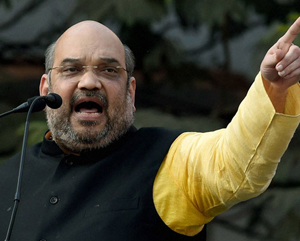
More lynching incidents happened under previous govts: Shah

Agencies
July 2, 2017

Panaji, Jul 2: BJP president Amit Shah has said that more incidents of lynching had occurred during the previous governments than during the three years of NDA rule, but no one had raised questions then.amitt

"I do not want to compare and undermine the current incidents of lynching. I am also serious about it. But there have been more lynching incidents in 2011, 2012 and 2013," Shah told a gathering of professionals in Goa last evening.

"There have been more lynchings each year in the past, compared to the total lynching incidents that have happened during our three-year-long tenure," the BJP leader said. The BJP-led government came to power at the Centre in May 2014.

Responding to a question about fears over the lynching incidents, he said there was no apprehension anywhere in the country.

"Do you know of any such incident where arrests have not been made? I do not have any answer to apprehensions. There is no apprehension anywhere in the country," he said.

Maintaining that law and order was a state subject, Shah said when Mohammad Akhlaq died, the Samajwadi Party-led government was in power in Uttar Pradesh, and it was its responsibility.

"But protests are held in Delhi in front of the Narendra Modi government. What is this fashion," he asked.

In September 2015, Akhlaq was dragged out of his house and killed by a mob at Dadri in UP on suspicion of storing and consuming beef.

Following several such lynching incidents, including those in Jharkhand, Haryana and UP, protests were held late last month at several cities across the country.

Comments

Ranjan shetty
 - 
Thursday, 6 Jul 2017

Chutiya bangladeshisare attacking Hindus in WB, where are those SOB's who did rally in the name of #notin my name ?

Umar Ashfaq
 - 
Thursday, 6 Jul 2017

Please qidmat k mauka de guzarish hogi

ABDUL AZIZ
 - 
Thursday, 6 Jul 2017

hang them till death , sharia law

Abdullah
 - 
Sunday, 2 Jul 2017

But who killed them????
You and your goons only.

Rikaz
 - 
Sunday, 2 Jul 2017

do not compare with previous government, it is your job to eliminate all sort of lynching around....take action on all who committed it as of now and make sure that it will not happen again....why it is happening only on muslims....there are people eating beef from other community.... and beef export factories exporting beef everyday basis with no problems...if you have guts stop it....

Thoushi
 - 
Sunday, 2 Jul 2017

True lynching was happening in previous government also and before since Gandhi's assassination , but Mr. Cha most all lynching was carried out by your OWN associated party(BJP) and wings (RSS)

Add new comment

  • Coastaldigest.com reserves the right to delete or block any comments.
  • Coastaldigset.com is not responsible for its readers’ comments.
  • Comments that are abusive, incendiary or irrelevant are strictly prohibited.
  • Please use a genuine email ID and provide your name to avoid reject.
Agencies
January 25,2020

Jammu, Jan 25: People in Jammu and Kashmir expressed happiness over the restoration of mobile data services and internet access through fixed-line across the Union Territory on Saturday.

Speaking to ANI Jitendra Sharma, a resident of Jammu said, "The government has taken a good decision. People had been facing hardship for a long period and I think it will improve further."

"It is a big relief to people. People can finish their pending work. I hope that 4G services will also be resumed soon," said a resident of Kashmir.

The internet speed is restricted to 2G only.

"Access shall be limited only to whitelisted sites and not to any social media applications allowing peer to peer communication and virtual private network applications. Directions shall be effective from January 25 and will remain in force till January 31," the statement by the government read.

Earlier on January 15, 2G services were reinstated in Jammu, Samba, Kathua, and Udhampur for white-listed sites.

The Central government had suspended the internet in the region following the abrogation of Article 370 of the Constitution on August 5 last year, which conferred special status to the erstwhile state of Jammu and Kashmir, and its bifurcation into two Union Territories -- Ladakh, and Jammu and Kashmir.

Comments

Add new comment

  • Coastaldigest.com reserves the right to delete or block any comments.
  • Coastaldigset.com is not responsible for its readers’ comments.
  • Comments that are abusive, incendiary or irrelevant are strictly prohibited.
  • Please use a genuine email ID and provide your name to avoid reject.
News Network
March 2,2020

New Delhi, Mar 2: As communal violence spiked in north-east Delhi earlier this week, Hindu, Muslim and Sikh residents of a colony came together and stood guard against frenzied mobs which ran riot in nearby areas vandalising homes, shops and torching cars.

They have not let their guard down even as the situation is limping back to normalcy following four days of violence that has claimed at least 42 lives and left over 200 injured.

The B-Block colony in Yamuna Vihar has a Hindu-dominated Bahjanpura on one side and Muslim populated Ghonda on the other.

People from all faiths in the locality sit outside their homes at night and deal with any suspected outsider, Arib, a dentist in his 30s, said.

"It is the sloganeering by mobs that causes panic in the dead of night. Such slogans are from both sides and we hear groups of people moving forward towards our area.

"This is where we let the Muslim locals deal with Muslim groups and Hindu residents deal with Hindu groups coming from outside," he said.

Businessmen, doctors and people working at government offices stuck together as violence reached its crest on Monday and Tuesday, and have been guarding the locality round the clock.

Earlier, the locals had claimed inadequate police deployment in the area, but were satisfied as patrolling by security personnel increased in the last two days.

Charanjeet Singh, a Sikh who owns a transport firm, said residents have ensured that not too many people gather to guard the colony at night. It has been decided not use sticks or rods, an idea which seems to have worked in maintaining peace, he said.

"I was 10 years old when we came to this locality from Uttar Pradesh's Meerut in 1982. There were riots in 1984 and tension in 2002, but even then our area remained peaceful. We have always been united and that is the way we have helped each other," Singh, who is now in his 50s, told PTI.

Faisal, a businessman in his 30s, said after two days of major violence, there was palpable tension in the area. "Nobody could sleep in the neighbourhood even on Wednesday and Thursday when the situation was brought under control," he said.

Faisal said around 4 am on Wednesday, three to four miscreants had torched a car, but were chased away by vigilant residents. They raised an alarm and others gathered, saving other vehicles parked nearby from being damaged, he added.

On the idea of not keeping sticks while guarding B-Block, Singh said, "Violence begets violence, crowd begets crowd. We thought if somebody would see sticks or rods in our hands from a distance and large crowds standing guard, it is likely they would want to come prepared. This could fuel violence."

"Now, if there is some young man returning late in the night, we identify if he belongs to our area. If not, we normally inform him about the situation and guide him to his destination, if required," he added.

Seventy-year-old V K Sharma said people in his colony never had any trouble with each other, as he blamed "outside elements" for the violence in north-east Delhi.

"Some people have some problem with symbols. If they find a particular religion's symbol on a shop, home or a car, they vandalise it.

"This is on both sides, Hindus as well as Muslims. But not all people in all religion are like that. There are good people who outnumber these handful people involved in violence," he said.

The violence happened for two days but it would take months for fear to subside, Sharma said, as he took out his two granddaughters, aged nine and two, out for ice cream.

"I cannot reduce the tension outside my home, but at least I can make these kids feel good by reducing their craving for ice cream,” he added.

Colony resident Shiv Kumar, a property consultant, and Wasim, a government official, said they too were members of this voluntary guards' team of the colony which stays up at night to fend off miscreants.


Comments

Add new comment

  • Coastaldigest.com reserves the right to delete or block any comments.
  • Coastaldigset.com is not responsible for its readers’ comments.
  • Comments that are abusive, incendiary or irrelevant are strictly prohibited.
  • Please use a genuine email ID and provide your name to avoid reject.
News Network
May 6,2020

May 6: The government on Tuesday said that the Food Corporation of India, the nodal agency for procurement and distribution of foodgrains, has sufficient stocks in its godowns, even after meeting the requirement of additional wheat and rice provided free of cost during the lockdown period.

Food Minister Ram Vilas Paswan has given detailed information about the various steps taken by the government and the total stocks of food grains and pulses available with the government and sent to the states till now, an official statement said.

"FCI currently has 276.61 lakh tonnes rice and 353.49 lakh tonnes wheat. Hence a total of 630.10 lakh tonnes food grain stock is available," it said.

As against this, about 60 lakh tonnes of food grains is required for a month under the NFSA (National Food Security Act) and other welfare schemes.

Paswan said FCI stocks are comfortable even after fulfilling extra commitments during the lockdown.

Under the 'Pradhan Mantri Garib Kalyan Ann Yojana', the Centre is providing 5 kg of free food grains per month to 80 crore ration card holders. This free of cost wheat and rice will be provided for three months. Besides, 1 kg of pulses will also be supplied per family.

This is over and above the normal quota of 5 kg of food grains provided per month per person to about 80 crore people under the food law.

The minister informed that since the lockdown, about 69.52 lakh tonnes of food grains have been transported through 2,483 rail rakes.

Apart from rail route, transportation was also done through roads and waterways. A total of 137.62 lakh tonnes has been transported.

During the lockdown, NGOs and social institutions running relief camps can purchase wheat and rice directly from FCI Depots at Open Market Sales Scheme (OMSS) rate.

The state governments can also purchase food grains directly from FCI. Under the OMSS, the rate of rice is fixed at Rs 22 per kg and wheat at Rs 21 per kg.

Under the 'Pradhan Mantri Garib Kalyan Ann Yojana', for the next 3 months a total of 104.4 lakh tonnes rice and 15.6 lakh tonnes of wheat is required of which 59.50 lakh tonnes rice and 8.14 lakh tonnes wheat have been lifted by various states and UTs.

The Government of India is bearing 100 per cent financial burden of approximately Rs 46,000 crore under the scheme, the statement said.

For pulses, the total requirement for the next three months is 5.82 lakh tonnes.

So far, 2,20,727 tonnes of pulses have been dispatched, while 1,47,165 tonnes of pulses have reached the states/UTs and 47,490 tonnes have been delivered, it said.

Comments

Add new comment

  • Coastaldigest.com reserves the right to delete or block any comments.
  • Coastaldigset.com is not responsible for its readers’ comments.
  • Comments that are abusive, incendiary or irrelevant are strictly prohibited.
  • Please use a genuine email ID and provide your name to avoid reject.