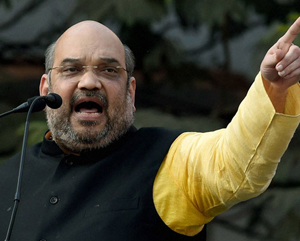
More lynching incidents happened under previous govts: Shah

Agencies
July 2, 2017

Panaji, Jul 2: BJP president Amit Shah has said that more incidents of lynching had occurred during the previous governments than during the three years of NDA rule, but no one had raised questions then.amitt

"I do not want to compare and undermine the current incidents of lynching. I am also serious about it. But there have been more lynching incidents in 2011, 2012 and 2013," Shah told a gathering of professionals in Goa last evening.

"There have been more lynchings each year in the past, compared to the total lynching incidents that have happened during our three-year-long tenure," the BJP leader said. The BJP-led government came to power at the Centre in May 2014.

Responding to a question about fears over the lynching incidents, he said there was no apprehension anywhere in the country.

"Do you know of any such incident where arrests have not been made? I do not have any answer to apprehensions. There is no apprehension anywhere in the country," he said.

Maintaining that law and order was a state subject, Shah said when Mohammad Akhlaq died, the Samajwadi Party-led government was in power in Uttar Pradesh, and it was its responsibility.

"But protests are held in Delhi in front of the Narendra Modi government. What is this fashion," he asked.

In September 2015, Akhlaq was dragged out of his house and killed by a mob at Dadri in UP on suspicion of storing and consuming beef.

Following several such lynching incidents, including those in Jharkhand, Haryana and UP, protests were held late last month at several cities across the country.

Comments

Ranjan shetty
 - 
Thursday, 6 Jul 2017

Chutiya bangladeshisare attacking Hindus in WB, where are those SOB's who did rally in the name of #notin my name ?

Umar Ashfaq
 - 
Thursday, 6 Jul 2017

Please qidmat k mauka de guzarish hogi

ABDUL AZIZ
 - 
Thursday, 6 Jul 2017

hang them till death , sharia law

Abdullah
 - 
Sunday, 2 Jul 2017

But who killed them????
You and your goons only.

Rikaz
 - 
Sunday, 2 Jul 2017

do not compare with previous government, it is your job to eliminate all sort of lynching around....take action on all who committed it as of now and make sure that it will not happen again....why it is happening only on muslims....there are people eating beef from other community.... and beef export factories exporting beef everyday basis with no problems...if you have guts stop it....

Thoushi
 - 
Sunday, 2 Jul 2017

True lynching was happening in previous government also and before since Gandhi's assassination , but Mr. Cha most all lynching was carried out by your OWN associated party(BJP) and wings (RSS)

Add new comment

  • Coastaldigest.com reserves the right to delete or block any comments.
  • Coastaldigset.com is not responsible for its readers’ comments.
  • Comments that are abusive, incendiary or irrelevant are strictly prohibited.
  • Please use a genuine email ID and provide your name to avoid reject.
News Network
March 11,2020

New Delhi, Mar 11: Jyotiraditya Scindia, the Madhya Pradesh politician whose surprise exit from the Congress has brought the Kamal Nath government to the brink of collapse, joined the Bharatiya Janata Party on Wednesday. Scindia joined the BJP at an event in national capital Delhi in the presence of party chief JP Nadda.

Scindia, who was warmly welcomed by Nadda, described 10 March, the day that he exited from the Congress as one of the two life-changing days of his life. The first, he said, was 30 September 2001 when he lost his father. Scindia underscored that the Congress was not the party that it had been and had been living in denial.

Scindia had ended his 18-year-old association with the Congress on Tuesday after meetings with Home Minister Amit Shah and Prime Minister Narendra Modi.

Scindia’s exit from the Congress was followed by resignation letters by about 22 MLAs who had been sequestered in Karnataka. The resignation letters were, however, sent to the Governor and not the assembly speaker, and threatens to upend the Kamal Nath government which has a wafer-thin majority.

If the resignations are accepted, the effective strength of the MP assembly will come down to 206, leaving the Bharatiya Janata Party (BJP) with a slender majority beyond the halfway mark of 103 with its 107 MLAs. For now, the Congress is trying to persuade the MLAs to not pull down the state government.

In his resignation letter to Congress chief Sonia Gandhi that Scindia put out on Twitter soon after, he alluded to his discomfort in the party over the last year or so. “...as you well know, this is a path that has been drawing itself out over the last year,” he had written in his letter.

It was seen as a reference to the Congress settling for Kamal Nath as the chief minister after the 2018 state elections though it was Scindia who had led from the front to oust the BJP from Madhya Pradesh. Scindia’s supporters had hoped that the Congress would tell Kamal Nath to give up his second charge - as the party chief in the state - but this also didn’t happen.

The first hint that something was amiss came in November last year when Scindia removed a reference to the Congress in his Twitter bio and instead wrote “public servant and cricket enthusiast”. He had then explained the change to an effort to make the Twitter bio shorter.

Jyotyiraditya Scindia’s aunt Yashodhara Raje Scindia appeared to declare soon after that the 49-year-old would join the BJP when she welcomed his resignation, calling it “ghar wapsi” or homecoming. “Jyotiraditya was being neglected in Congress,” Yashodhara Raje Scindia said.

Scindia’s grandmother, Vijaya Raje Scindia, was one of the founders of the Jana Sangh, the precursor to the BJP. His aunt Vasundhara Raje is a former Union minister and ex-chief minister of Rajasthan and another aunt Yashodhara Raje is a former minister in the Madhya Pradesh cabinet.

Comments

Add new comment

  • Coastaldigest.com reserves the right to delete or block any comments.
  • Coastaldigset.com is not responsible for its readers’ comments.
  • Comments that are abusive, incendiary or irrelevant are strictly prohibited.
  • Please use a genuine email ID and provide your name to avoid reject.
News Network
January 29,2020

New Delhi, Jan 29: The Supreme Court on Wednesday dismissed the plea by Mukesh Kumar Singh, one of the four death row convicts in the Nirbhaya gang rape and murder case, challenging the rejection of his mercy petition by the President.

A three-judge bench headed by Justice R Banumathi said that expeditious disposal of mercy plea by the President doesn't mean non-application of mind by him.

The court also said that alleged sufferings in prison can't be grounds to challenge the rejection of mercy petition.

The bench said all relevant material including judgments pronounced by trial court, high court and Supreme Court were placed before the President when he was considering the mercy plea of the convict.

The bench also comprising justices Ashok Bhushan and A S Bopanna rejected the contentions of the counsel appearing for Singh that entire materials of the case were not placed before the President when he was considering his mercy plea.

The bench, while referring to two files placed before it by the Centre on Tuesday, said that as per the January 15 covering letter which was sent by the Delhi government to the Ministry of Home Affairs, all relevant documents were sent.

The bench noted that detailed judgements of trial court, high court and the Supreme Court, curative petition filed by Singh, his past criminal history and his family background were sent to the Home Ministry by the Delhi government.

"All the documents were taken into consideration by the President while rejecting the mercy petition," the bench said.

The bench also dealt with submissions advanced by the convict's counsel, who had argued that the mercy plea was rejected at "lightning speed".

The bench said that if a mercy petition is expeditiously dealt with, it cannot be assumed that it has been adjudicated upon in a pre-conceived mind.

Comments

Add new comment

  • Coastaldigest.com reserves the right to delete or block any comments.
  • Coastaldigset.com is not responsible for its readers’ comments.
  • Comments that are abusive, incendiary or irrelevant are strictly prohibited.
  • Please use a genuine email ID and provide your name to avoid reject.
Agencies
January 9,2020

The World Bank says that a lack of credit and drop in private consumption have led to a gloomy growth outlook for India with a steep cut in growth rate for the current fiscal year and only a modest gain projected for the next year.

India's growth rate is forecast to be only 5 per cent for the current fiscal year, weighed down by a growth of only 4.5 per cent in the July-September quarter, according to the 2020 Global Economic Prospects report released on Wednesday.

"In India, [economic] activity was constrained by insufficient credit availability, as well as by subdued private consumption," the Bank said.

The growth rate is forecast by the Bank to pick up to 5.8 per cent in the next fiscal year and to 6.1 per cent in 2021-22.

India's growth rate was 6.8 per cent in 2018-19.

The 5 per cent growth rate projection for the current financial year is a sharp cut of 2.5 per cent from the 7.5 per cent forecast made by the Bank in January last year, toppling it from the rank of the world's fastest growing economy.

India's performance follows a global trend of lowered growth weighed down by developed economies.

The report estimated world economic growth rate to be only 2.4 per cent last year and forecast it to edge up 0.1 per cent to 2.5 per cent in the current year.

Even with the lower growth rate of 5 per cent in the current fiscal year and 5.8 per cent forecast for the next, India holds the second rank among large economies, behind only China with an estimated growth rate of 6.1 per cent for 2019 and 5.9 per cent this year.

The report blamed "weak confidence, liquidity issues in the financial sector" and "weakness in credit from non-bank financial companies" for India's slowdown.

The Bank predicated India's recovery to 5.8 per cent in the coming financial year for India but "on the monetary policy stance remaining accommodative" and the assumption that "the stimulative fiscal and structural measures already taken will begin to pay off."

It also warned that sharper-than-expected slowdown in major external markets such as United States and Europe, would affect South Asia through trade, financial, and confidence channels, especially for countries with strong trade links to these economies."

The Bank said that the growth of advanced economies was 1.6 per cent last year and "is anticipated to slip to 1.4 per cent in 2020 in part due to continued softness in manufacturing."

In contrast the growth of emerging market and developing countries is expected to accelerate from 3.5 per cent last year to 4.1 per cent this year, the report said.

In South Asia, Bangladesh is estimated to have the highest growth rate of 7.2 per cent in the current fiscal year, although down from 8.1 per cent last fiscal year.

But its higher regional growth rates are coming off a lower base with a per capital gross domestic product of $1,698 compared to $2,010 for India.

Bangladesh is expected to grow by 7.3 per cent in the next financial year.

Pakistan's growth rate is estimated at only 2.4 per cent in the current fiscal year and is projected to rise to 3 per cent in the next, according to the Bank.

The Bank blamed monetary tightening in Pakistan for a sharp deceleration in fixed investment and a considerable softening in private consumption for the fall in growth rate from 3.3 per cent in the 2018-19 fiscal year.

Sri Lanka's growth rate was estimated to be 2.7 per cent last year and forecast to grow to 3.3 per cent this year.

Nepal grew by an estimated 6.4 per cent in the current fiscal year and will rise to 6.5 per cent in the next.

Comments

Add new comment

  • Coastaldigest.com reserves the right to delete or block any comments.
  • Coastaldigset.com is not responsible for its readers’ comments.
  • Comments that are abusive, incendiary or irrelevant are strictly prohibited.
  • Please use a genuine email ID and provide your name to avoid reject.