Mother Teresa declared saint by Pope Francis

September 4, 2016

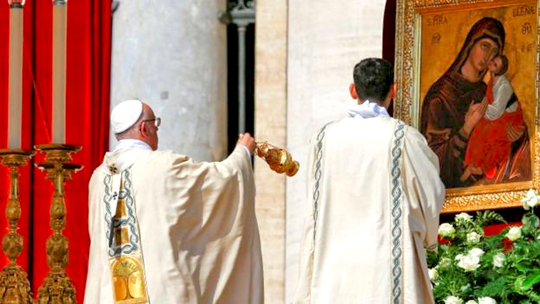
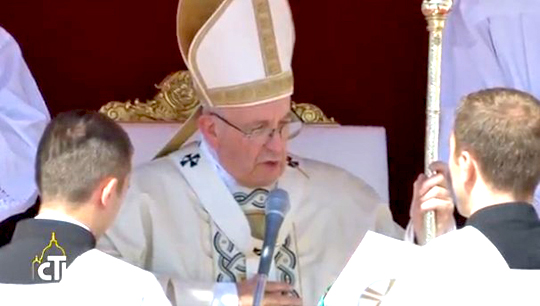
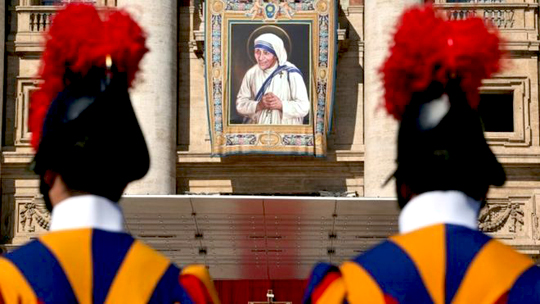
Vatican City, Sep 4: Pope Francis on Sunday declared revered nun Mother Teresa a saint in a canonization mass at St Peter's square.

"For the honour of the Blessed Trinity... we declare and define Blessed Teresa of Calcutta (Kolkata) to be a Saint and we enroll her among the Saints, decreeing that she is to be venerated as such by the whole Church," the pontiff said in Latin.
teresav 5

For Francis, Mother Teresa put into action his ideal of the church as a merciful "field hospital" for the poorest of the poor, those suffering both material and spiritual poverty.

The elevation of one of the icons of 20th Century Christianity came a day before the 19th anniversary of her death in Kolkata, where she spent nearly four decades working with the dying and the destitute.

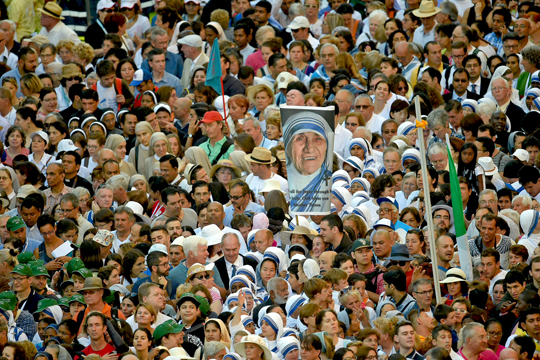
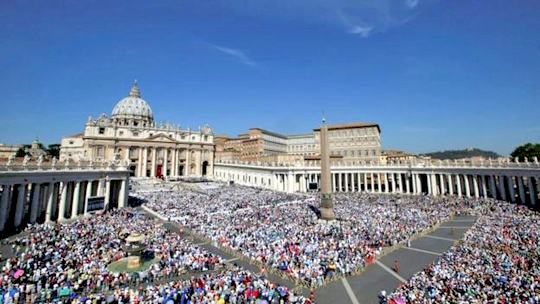
Tens of thousands of pilgrims — rich and poor, powerful and homeless — filled St. Peter's Square on Sunday for the canonization of Mother Teresa, the tiny nun who cared for the world's most destitute and became an icon of a Catholic Church that goes to the peripheries to find lost souls.

Throughout the night, pilgrims prayed at vigils in area churches and flocked before dawn to the Vatican to try to get a good spot for the Mass being celebrated under a searing hot sun and blue skies.

"Her heart, she gave it to the world," said Charlotte Samba, a 52-year-old mother of three who travelled with a church group from Gabon for the Mass. "Mercy, forgiveness, good works: It is the heart of a mother for the poor."

One group of 40 Indian nationals traveled from Macerata, Italy to honor a woman given India's highest civilian and humanitarian awards for her work in the slums of Kolkata. Another group of 100 drove from Kosovo toting a banner that read: "Mother Teresa: Pray for Us."

In addition, 13 heads of state and government led official delegations while 1,500 homeless people invited by Pope Francis had VIP seats and were going to be treated by the pope to a Neapolitan pizza lunch in the Vatican auditorium afterward.

While Francis is clearly keen to hold Mother Teresa up as a model for her joyful dedication to society's outcasts, he is also recognizing holiness in a nun who lived most of her adult life in spiritual agony sensing that God had abandoned her.

According to correspondence that came to light after she died in 1997, Mother Teresa experienced what the church calls a "dark night of the soul" — a period of spiritual doubt, despair and loneliness that many of the great mystics experienced. In Mother Teresa's case, it lasted for nearly 50 years — an almost unheard of trial.

For the Rev. Brian Kolodiejchuk, the Canadian priest who spearheaded Mother Teresa's saint-making campaign, the revelations were further confirmation of Mother Teresa's heroic saintliness. He said that by canonizing her, Francis is recognizing that Mother Teresa not only shared the material poverty of the poor but the spiritual poverty of those who feel "unloved, unwanted, uncared for."

"What she described as the greatest poverty in the world today (of feeling unloved) she herself was living in relationship with Jesus," he said in an interview on the eve of the canonization.

Francis has in many ways modeled his papacy on Mother Teresa's simple lifestyle and selfless service to the poor: He eschewed the Apostolic Palace for a hotel room, he has made welcoming migrants and the poor a hallmark and has fiercely denounced today's "throwaway" culture that discards the unborn, the sick and the elderly with ease.

Sunday's festivities honoring Mother Teresa weren't limited to Rome: In Kolkata, where Mother Teresa spent a lifetime dedicated to the poor, a special Sunday Mass was held at the order's Mother House. Volunteers and admirers converged on Mother House to watch the canonization ceremony, which was being broadcast on giant TV screens in Kolkata and elsewhere.

Sisters of Charity volunteers planned to distribute food to the poor nearby after the ceremony, and community meals were being served across Catholic parishes in India on Sunday — a symbolic reference to Mother Teresa's lifetime of service to humanity, said the Rev. Savarimuthu Sankar of the archdiocese of New Delhi.

"Let the example of Mother Teresa inspire all of us to dedicate ourselves to the welfare of mankind," said Indian President Pranab Mukherjee.

Ceremonies were also expected in Skopje, Macedonia, where Mother Teresa was born, and also in Albania and Kosovo, where people of her same ethnic Albanian background live.

Born Agnes Gonxhe Bojaxhiu on August 26, 1910, Mother Teresa came to India in 1929 as a sister of the Loreto order. In 1946, she received what she described as a "call within a call" to found a new order dedicated to caring for the most unloved and unwanted, the "poorest of the poor."
teresav 1

teresav 2

teresav 3

teresav 4

Comments

TRUE INDIAN
 - 
Sunday, 4 Sep 2016

Rss and sanghis exposed. Saint mother theresa and sita mata both used to wear hijab.

And hindus also put hijab on sita matas idols too.

MSS
 - 
Sunday, 4 Sep 2016

Recognizing sainthood is OK.

First of religion does not need innovation. Because the religion means to way of life as per the command of GOD(1 single God).

But why in the name of TRINITY, when there is only 1 God and none others have the capability of God. Jesus himself said, don't worship me. Then no question of duality of trinity. In trinity the other 2 for Christians are, Holy Spirirt and Jesus. Christians associated these 2 with the real God.
Both the 2 are most respected, but they don't at all equal to God.
Trinity is the invention of people, it is not by the God.

Therefore trinity does not deserve worship. They deserve definitely a worship. But one and only who deserve for worship is the God, who is the GOD for all religions.

Add new comment

  • Coastaldigest.com reserves the right to delete or block any comments.
  • Coastaldigset.com is not responsible for its readers’ comments.
  • Comments that are abusive, incendiary or irrelevant are strictly prohibited.
  • Please use a genuine email ID and provide your name to avoid reject.
News Network
April 5,2020

New Delhi, April 5: Former Karnataka chief minister HD Kumaraswamy on Sunday challenged Prime Minister Narendra Modi to offer a "credible scientific and rational" explanation for his candle-lighting call and said he is giving "meaningless tasks" to an already exhausted population.

The JD(S) leader questioned if the Prime Minister asked the nation to observe a candle-light vigil on the eve of foundation day of BJP.

"Has the PM slyly asked the nation to observe a candle light vigil on the eve of foundation day of BJP? April 6 being its foundation day, what else can explain the choice of date & time for this event? I challenge the PM to offer a credible scientific and rational explanation," Kumaraswamy tweeted.

"The government is yet to provide PPEs for doctors and make test kits affordable for the common man. Without telling the nation what concrete steps are being taken to combat COVID-19 menace, the prime minister is giving meaningless tasks to an already exhausted population," he tweeted.

"It is shameful to convert the national crisis into an event of self aggrandizement & it is beyond shameful to push the hidden agenda of his party in the face of global calamity. May sense prevail upon the PM," the JDS leader said in another tweet.

Amid a nationwide COVID-19 lockdown, Prime Minister Modi on Friday appealed to countrymen to light diyas and candles on April 5 at 9 pm to fight the darkness spread by the pandemic. He asked the people to turn off all the lights in their homes and stand at doors or balconies and light candles or diyas, torches or mobile flashlights for 9 minutes on April 5.

Last month, PM Modi had asked the people to come out in their balconies and clap and beat utensils to show appreciation for doctors, nurses and others helping fight coronavirus on 'Janata Curfew'.

Comments

Add new comment

  • Coastaldigest.com reserves the right to delete or block any comments.
  • Coastaldigset.com is not responsible for its readers’ comments.
  • Comments that are abusive, incendiary or irrelevant are strictly prohibited.
  • Please use a genuine email ID and provide your name to avoid reject.
Agencies
February 6,2020

Even more than three years after demonetisation and all-out efforts to make most transactions through electronic, cash is still king, as it thrives in a digital India, said fintech start-up Paytm founder Vijay Sekhar Sharma.

"While cashless economy is not possible in India, less cash economy will be in the future. Less cash is the only solution, not the elimination of cash," Sharma told IANS in an interview after unveiling an all-in-one payment gateway on Tuesday.

Asserting that it would take 5-10 years for India to make the transition to digital payments from the traditional mode of cash, Sharma, 41, said the e-payment industry benefitted more from the November 8, 2016 note ban and withdrawal of old Rs 1,000 and Rs 500 denominations.

"I think it (demonetisation) helped the industry despite lack of specific help. But the world has changed since then. It is about the scale of distribution of merchants that is what is propelling digital payments," said Sharma.

Most of the cash not only came back into circulation, but also remains as the mode of payment for the majority due to its convenience for the people used to such transactions.

Expounding Paytm's zero service charge, Sharma said the strategy is sustainable as it leads to acquiring more customers and merchants, enabling newer business opportunities.

Paytm also does not levy a service charge to small merchants for its payments services, unlike organised players like Uber.

"Though there is a monetisation model, the merchants who are small shopkeepers, become our financial services customers as they open a bank account, which is profitable."

Paytm secured a Payments Bank license from the Reserve Bank of India to offer a savings bank account, Rupay debit card and money transfer services.

"We are banking on payment services acquiring customers and merchants who avail banking, lending, insurance, wealth and software services like billing software and business ledger software services eventually," Sharma noted.

The mobile first bank services include zero balance and zero digital transaction charge accounts.

"Basically, payments, cloud, commerce and financial services are a cohort we follow. So, payments is our customer as well as merchant acquisition. If it breaks even, we are happy because other line items make more money, he affirmed.

Noting that in a market like India, one cannot price services at a premium unlike in a developed country like the US, the billionaire businessman said a consumer in a developing country would not be able to afford such a hefty charge.

Forbes ranked Sharma as India's youngest billionaire in 2017, with a net worth of $2.1 billion.

While several countries operate on the model of higher service charges, Sharma said newer business models have to be discovered in India, as customer lifecycle value is accounted for more stages than in other nations.

Asked about an upscale retailer like Zara not giving a wallet payment option during its recent end of season sale in Bengaluru, Sharma said Paytm was addressing such hiccups with its all-in-one payment solutions.

"It's an opportunity, because if the retailer has our all-in-one point of sale machine, where in they enter the amount, it shows both the Quick Response code (QR) and card payment options," he observed.

Sharma compared older swiping payment machine to feature phones and modern ones to feature-rich smartphones.

"If you notice, they look like feature phones and the modern day card machine is more a smartphone like. You can add the smatphone components, which can add the features," reiterated Sharma.

Though Paytm's all-in-one QR point of sale machine integrates the billing system, its chief executive said it was not ideal to have an independent QR feature.

Paytm has 16 million strong merchant user base, which Sharma aims to raise to 26 million base in the next one year.

Sharma has launched in this tech city an all-in-one payment gateway and Paytm Business Payments solution, which enable digital payments through multiple methods for small and medium enterprises (SMEs) and an Android point of sale machine.

With the new gateway solution, collecting digital payments through multiple methods can be achieved seamlessly while Paytm Business Payments solution enables automated vendor payments, including employee salaries and customer refunds among others.

The One97 Communications-owned Paytm aims to help SMEs streamline and digitise their business activities using its new solutions, which enhance the overall efficiency of both accepting and making payments.

Paytm has a data bank of over 200 million saved cards and bank accounts, a feature which enables partner apps to shorten transaction times and propel faster conversions while using the all-in-one payment gateway.

Complementing the two solutions, Sharma also launched an all-in-one Android point of sale machine, which can accept payments through all forms such as cards, wallets, UPI apps and even cash.

The device has a QR code that supports all contact and contactless payments, coming with integrated billing software customized solutions for different sectors such as catering, ticketing, parking and others.

The handheld Android device is equipped with an in-built printer, scanner and can also generate bills.

Valued at $16 billion, Paytm is not alone in the fiercely competitive Indian fintech space where a dozen players like PhonePe, MobiKwik, Kotak 811 and deep pocketed international giants Google Pay and Amazon Pay are in the fray.

Comments

Add new comment

  • Coastaldigest.com reserves the right to delete or block any comments.
  • Coastaldigset.com is not responsible for its readers’ comments.
  • Comments that are abusive, incendiary or irrelevant are strictly prohibited.
  • Please use a genuine email ID and provide your name to avoid reject.
News Network
April 12,2020

Tumakuru, Apr 12: Fearing the spread of COVID-19 in Muddenahalli village, the villagers shifted to living in tents in nearby fields with most of their belongings.

Kariyappa, one of the villagers said, "We were scared of the COVID-19 spread, so we came here."

Around 60 families of the village lived in tents for three days, before they returned to their houses on the advice of the Tehsildar.

So far, 214 COVID-19 cases, including six deaths, have been reported in the state of Karnataka.

With 34 deaths and 909 new positive COVID-19 cases in the last 24 hours, the total number of coronavirus cases in India on Sunday reached 8356, including 716 cured and discharged, according to the Ministry of Health and Family Welfare.

Comments

Add new comment

  • Coastaldigest.com reserves the right to delete or block any comments.
  • Coastaldigset.com is not responsible for its readers’ comments.
  • Comments that are abusive, incendiary or irrelevant are strictly prohibited.
  • Please use a genuine email ID and provide your name to avoid reject.