Mother Teresa declared saint by Pope Francis

September 4, 2016

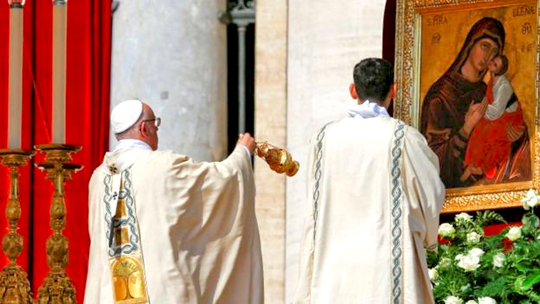
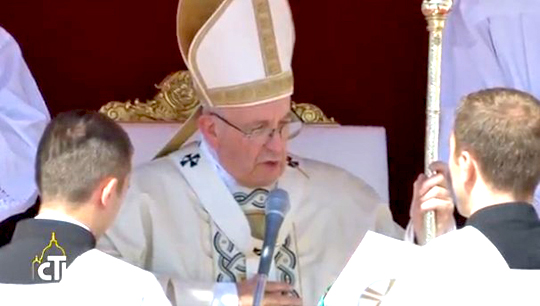
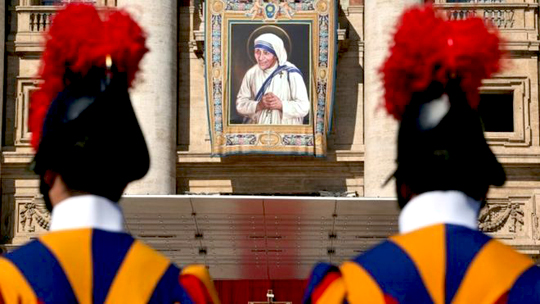
Vatican City, Sep 4: Pope Francis on Sunday declared revered nun Mother Teresa a saint in a canonization mass at St Peter's square.

"For the honour of the Blessed Trinity... we declare and define Blessed Teresa of Calcutta (Kolkata) to be a Saint and we enroll her among the Saints, decreeing that she is to be venerated as such by the whole Church," the pontiff said in Latin.
teresav 5

For Francis, Mother Teresa put into action his ideal of the church as a merciful "field hospital" for the poorest of the poor, those suffering both material and spiritual poverty.

The elevation of one of the icons of 20th Century Christianity came a day before the 19th anniversary of her death in Kolkata, where she spent nearly four decades working with the dying and the destitute.

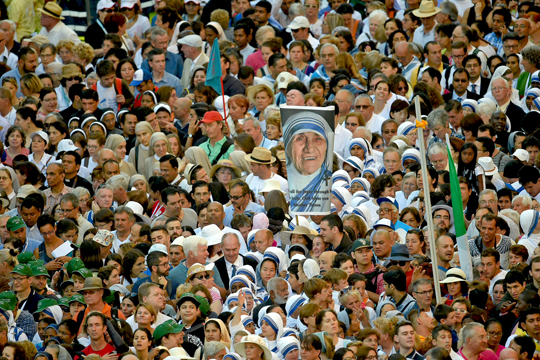
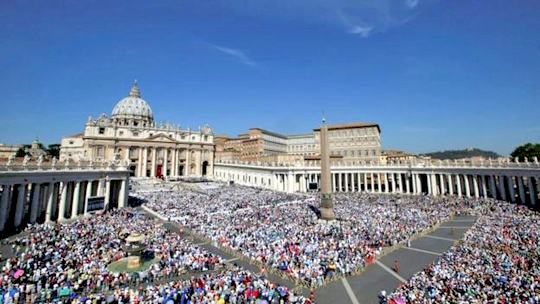
Tens of thousands of pilgrims — rich and poor, powerful and homeless — filled St. Peter's Square on Sunday for the canonization of Mother Teresa, the tiny nun who cared for the world's most destitute and became an icon of a Catholic Church that goes to the peripheries to find lost souls.

Throughout the night, pilgrims prayed at vigils in area churches and flocked before dawn to the Vatican to try to get a good spot for the Mass being celebrated under a searing hot sun and blue skies.

"Her heart, she gave it to the world," said Charlotte Samba, a 52-year-old mother of three who travelled with a church group from Gabon for the Mass. "Mercy, forgiveness, good works: It is the heart of a mother for the poor."

One group of 40 Indian nationals traveled from Macerata, Italy to honor a woman given India's highest civilian and humanitarian awards for her work in the slums of Kolkata. Another group of 100 drove from Kosovo toting a banner that read: "Mother Teresa: Pray for Us."

In addition, 13 heads of state and government led official delegations while 1,500 homeless people invited by Pope Francis had VIP seats and were going to be treated by the pope to a Neapolitan pizza lunch in the Vatican auditorium afterward.

While Francis is clearly keen to hold Mother Teresa up as a model for her joyful dedication to society's outcasts, he is also recognizing holiness in a nun who lived most of her adult life in spiritual agony sensing that God had abandoned her.

According to correspondence that came to light after she died in 1997, Mother Teresa experienced what the church calls a "dark night of the soul" — a period of spiritual doubt, despair and loneliness that many of the great mystics experienced. In Mother Teresa's case, it lasted for nearly 50 years — an almost unheard of trial.

For the Rev. Brian Kolodiejchuk, the Canadian priest who spearheaded Mother Teresa's saint-making campaign, the revelations were further confirmation of Mother Teresa's heroic saintliness. He said that by canonizing her, Francis is recognizing that Mother Teresa not only shared the material poverty of the poor but the spiritual poverty of those who feel "unloved, unwanted, uncared for."

"What she described as the greatest poverty in the world today (of feeling unloved) she herself was living in relationship with Jesus," he said in an interview on the eve of the canonization.

Francis has in many ways modeled his papacy on Mother Teresa's simple lifestyle and selfless service to the poor: He eschewed the Apostolic Palace for a hotel room, he has made welcoming migrants and the poor a hallmark and has fiercely denounced today's "throwaway" culture that discards the unborn, the sick and the elderly with ease.

Sunday's festivities honoring Mother Teresa weren't limited to Rome: In Kolkata, where Mother Teresa spent a lifetime dedicated to the poor, a special Sunday Mass was held at the order's Mother House. Volunteers and admirers converged on Mother House to watch the canonization ceremony, which was being broadcast on giant TV screens in Kolkata and elsewhere.

Sisters of Charity volunteers planned to distribute food to the poor nearby after the ceremony, and community meals were being served across Catholic parishes in India on Sunday — a symbolic reference to Mother Teresa's lifetime of service to humanity, said the Rev. Savarimuthu Sankar of the archdiocese of New Delhi.

"Let the example of Mother Teresa inspire all of us to dedicate ourselves to the welfare of mankind," said Indian President Pranab Mukherjee.

Ceremonies were also expected in Skopje, Macedonia, where Mother Teresa was born, and also in Albania and Kosovo, where people of her same ethnic Albanian background live.

Born Agnes Gonxhe Bojaxhiu on August 26, 1910, Mother Teresa came to India in 1929 as a sister of the Loreto order. In 1946, she received what she described as a "call within a call" to found a new order dedicated to caring for the most unloved and unwanted, the "poorest of the poor."
teresav 1

teresav 2

teresav 3

teresav 4

Comments

TRUE INDIAN
 - 
Sunday, 4 Sep 2016

Rss and sanghis exposed. Saint mother theresa and sita mata both used to wear hijab.

And hindus also put hijab on sita matas idols too.

MSS
 - 
Sunday, 4 Sep 2016

Recognizing sainthood is OK.

First of religion does not need innovation. Because the religion means to way of life as per the command of GOD(1 single God).

But why in the name of TRINITY, when there is only 1 God and none others have the capability of God. Jesus himself said, don't worship me. Then no question of duality of trinity. In trinity the other 2 for Christians are, Holy Spirirt and Jesus. Christians associated these 2 with the real God.
Both the 2 are most respected, but they don't at all equal to God.
Trinity is the invention of people, it is not by the God.

Therefore trinity does not deserve worship. They deserve definitely a worship. But one and only who deserve for worship is the God, who is the GOD for all religions.

Add new comment

  • Coastaldigest.com reserves the right to delete or block any comments.
  • Coastaldigset.com is not responsible for its readers’ comments.
  • Comments that are abusive, incendiary or irrelevant are strictly prohibited.
  • Please use a genuine email ID and provide your name to avoid reject.
News Network
March 8,2020

Bengaluru, Mar 8: Lieutenant General Milind Hemant Thakur, Director-General of Supply and Transport Corps of the Indian Army, unveiled the renovated Animal Memorial at Agram Grounds in ASC Centre and College here on Saturday.

The animal memorial signifies the contributions of mules and horses of the Indian Army. These animals belonging to the Army Service Corps, who have rendered their services relentlessly during the war in the Himalayas, often paying the highest price of sacrificing their lives in the line of duty have been chronicled in the Memorial.

To ensure that these hoof prints do not get obliterated, on approval by the Government of India, their saga was brought to life in the form of a sculptured monument in the Equestrian Training Area of the ASC Centre and College.

This animal transport memorial has now been extended by constructing two walls supported by Roman pillars on either side.

These walls highlight the role played by the animals in the Indian Army since the British Raj. It gives details of 637 gallantry awards won by the brave muleteers, 49 battle casualties since independence, 14 gallantry awards to mules since independence and 05 military recognitions bestowed by the Chief of the Army Staff and other Army Commanders on AT units, who have been relied upon heavily to fill an important niche in the logistics networks of the Indian Army.

Gen Thakur also declared that 26 September each year has been nominated as the AT Remembrance Day as it was on this day in 1914, that 9th mule Corps, as part of the Indian Expeditionary Force, landed at Marseilles in France, to a most hearty and enthusiastic welcome by the French to support the British and allied armies in World War One.

Comments

Add new comment

  • Coastaldigest.com reserves the right to delete or block any comments.
  • Coastaldigset.com is not responsible for its readers’ comments.
  • Comments that are abusive, incendiary or irrelevant are strictly prohibited.
  • Please use a genuine email ID and provide your name to avoid reject.
News Network
July 25,2020

Hubballi,  Jul 25: South Western Railway (SWR) inducted seven lady sub-inspectors (SI) in the Railway Protection Force (RPF), in a first, on Friday. Three more women SI undergoing training in Lucknow are expected to join SWR soon.

According to the Chief Public Relations Officer (CPRO) of SWR, the inducted sub-inspectors are part of 164 women SI cadets who passed out of the RPF training centre in Moula Ali, Hyderabad, after a rigorous training of nine months. They will take care of the security of railway passengers, Railway property, and Railway premises, after resuming their duties.

They will also be responsible for giving special care to the vulnerable sections of society, women, and children while discharging their duties, the CPRO said.

The CPRO also informed that the newly admitted female SIs will be posted to major stations on SWR for regular duties on completion of their two months of practical training over the Zone. Further 120 ladies are undergoing constables training for various training centres across India.

This move is considered a step forward into women empowerment in Railways.

Comments

Add new comment

  • Coastaldigest.com reserves the right to delete or block any comments.
  • Coastaldigset.com is not responsible for its readers’ comments.
  • Comments that are abusive, incendiary or irrelevant are strictly prohibited.
  • Please use a genuine email ID and provide your name to avoid reject.
Ram Puniyani
March 14,2020

In the wake of Citizenship Amendment Act (CAA) UN High Commissioner, Michele Bachelet, has filed an intervention in the Supreme Court petition challenging the constitutionality of the Citizenship Amendment Act, as she is critical of CAA. Responding to her, India’s Foreign Minister S. Jai Shanker strongly rebutted her criticism, saying that the body (UNHCR) has been wrong and is blind to the problem of cross border terrorism. The issue on hand is the possibility of scores of people, mainly Muslims, being declared as stateless. The problem at hand is the massive exercise of going through the responses/documents from over 120 crore of Indian population and screening documents, which as seen in Assam, yield result which are far from truthful or necessary.

The issue of CAA has been extensively debated and despite heavy critique of the same by large number of groups and despite the biggest mass opposition ever to any move in Independent India, the Government is determined on going ahead with an exercise which is reminiscent of the dreaded regimes which are sectarian and heartless to its citizens, which have indulged in extinction of large mass of people on grounds of citizenship, race etc. The Foreign minister’s assertion is that it is a matter internal to India, where India’s sovereignty is all that matters! As far as sovereignty is concerned we should be clear that in current times any sovereign power has to consider the need to uphold the citizenship as per the principle of non-discrimination which is stipulated in Art.26 of the International Covenant on Civil and Political (ICCPR) rights.

Can such policies, which affect large number of people and are likely to affect their citizenship be purely regarded as ‘internal’? With the World turning into a global village, some global norms have been formulated during last few decades. The norms relate to Human rights and migrations have been codified. India is also signatory to many such covenants in including ICCPR, which deals with the norms for dealing with refugees from other countries. One is not talking of Chicago speech of Swami Vivekanand, which said that India’s greatness has been in giving shelter to people from different parts of the World; one is also not talking of the Tattariaya Upanishad’s ‘Atithi Devovhav’ or ‘Vasudhaiva Kutumbkam’ from Mahaupanishad today.

What are being talked about are the values and opinions of organizations which want to ensure to preserve of Human rights of all people Worldwide. In this matter India is calling United Nations body as ‘foreign party’; having no locus standi in the case as it pertains to India’s sovereignty. The truth is that since various countries are signatories to UN covenants, UN bodies have been monitoring the moves of different states and intervening at legal level as Amicus (Friend of the Court) to the courts in different countries and different global bodies. Just to mention some of these, UN and High Commissioner for Human Rights has often submitted amicus briefs in different judicial platforms. Some examples are their intervention in US Supreme Court, European Court of Human Rights, International Criminal Court, and the Inter-American Court of Human Rights. These are meant to help the Courts in areas where UN bodies have expertise.

 Expertise on this has been jointly formulated by various nations. These interventions also remind the nations as to what global norms have been evolved and what are the obligations of individual states to the values which have evolved over a period of time. Arvind Narrain draws our attention to the fact that, “commission has intervened in the European Court of Human Rights in cases involving Spain and Italy to underscore the principle of non-refoulement, which bars compulsory expulsion of illegal migrants… Similarly, the UN has intervened in the International Criminal Court in a case against the Central African Republic to explicate on the international jurisprudence on rape as a war crime.”

From time to time organizations like Amnesty International and Human Rights Watch have been monitoring the status of Human rights of different countries. This puts those countries in uncomfortable situation and is not welcome by those establishments. How should this contradiction between ‘internal matter’, ‘sovereignty’ and the norms for Human rights be resolved? This is a tough question at the time when the freedom indices and democratic ethos are sliding downwards all over the world. In India too has slid down on the scale of these norms.

In India we can look at the intervention of UN body from the angle of equality and non discrimination. Democratic spirit should encourage us to have a rethink on the matters which have been decided by the state. In the face of the greatest mass movement of Shaheen bagh, the state does need to look inwards and give a thought to international morality, the spirit of global family to state the least.

The popular perception is that when Christians were being persecuted in Kandhmal the global Christian community’s voice was not strong enough. Currently in the face of Delhi carnage many a Muslim majority countries have spoken. While Mr. Modi claims that his good relations with Muslim countries are a matter of heartburn to the parties like Congress, he needs to relook at his self gloating. Currently Iran, Malaysia, Indonesia and many Muslim majority countries have spoken against what Modi regime is unleashing in India. Bangladesh, our neighbor, has also seen various protests against the plight of Muslims in India. More than the ‘internal matter’ etc. what needs to be thought out is the moral aspect of the whole issue. We pride ourselves in treading the path of morality. What does that say in present context when while large section of local media is servile to the state, section of global media has strongly brought forward what is happening to minorities in India.   

The hope is that Indian Government wakes up to its International obligations, to the worsening of India’s image in the World due to CAA and the horrific violence witnessed in Delhi.

Comments

Add new comment

  • Coastaldigest.com reserves the right to delete or block any comments.
  • Coastaldigset.com is not responsible for its readers’ comments.
  • Comments that are abusive, incendiary or irrelevant are strictly prohibited.
  • Please use a genuine email ID and provide your name to avoid reject.