MU toilet cam: NWF demands CID probe, stringent action against sadist'

[email protected] (CD Network | Suresh)
September 17, 2016

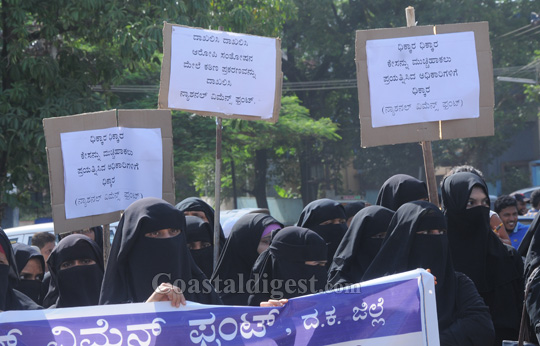
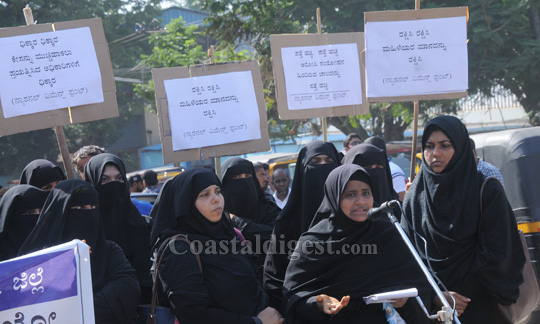
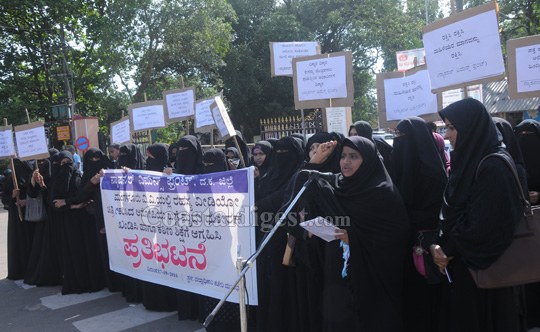
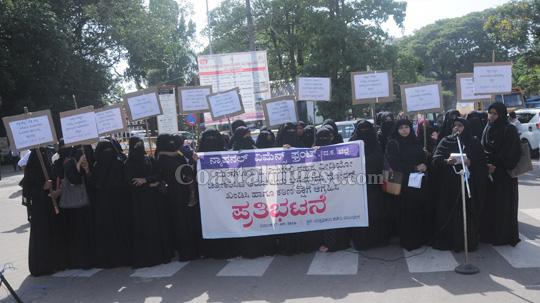
Mangaluru, Sep 17: The Dakshina Kannada district unit of the National Women's Front on Saturday staged a protest in the city demanding the government to hand over the case of placing hidden camera at the women's toilet on Mangalore University campus to Criminal Investigation Department.

protest 4

The protest comes two days after M.Sc. student Santosh M Acharya, the main accused in the case was granted bail by a local court within a day after his arrest by the Mangaluru city police.

The protesters lamented that the case was being taken lightly since the beginning. Even though a hidden mobile with its camera on was found in the women's toilet on August 24, the university lodged a formal police complaint only on September 1. The police managed to catch the accused after two weeks but they registered silly cases against him.

Santosh, a resident of Sullia, was charged under IT Act 66 and Section 354 C (voyeurism). However, the protesters demanded that the police should charge him of violence against women, as he has violated the privacy of the female students of the university and also posed a threat to their safety and security on the campus.

Speaking on the occasion, Shaida Tasnim, general secretary, Federation of Women's India Movement, said that if a sadist and pervert like Santosh can get bail within a day after his arrest, then it is an insult to all women. “This development has exposed the loopholes in the system,” she said.

Shahida Yusuf, general secretary of NWF, said that the system has indirectly shown green signal to a dangerous pervert' to commit more crimes by allowing him to walk free in spite of his confession. “Stringent action should be taken against him. The police should also investigate whether more people had involved behind the crime,” she said.

Also Read:

Accused in MU toilet camera case gets bail within a day; girl students unhappy

Hidden camera at women's toilet: M.Sc. student Santosh M arrested

protest 3

protest 5

protest 2

Comments

hmmi
 - 
Sunday, 18 Sep 2016

@ virean kotian

if this was happened to your relatiVES or sisters then this would be your action for this accuse..?

Rash
 - 
Sunday, 18 Sep 2016

Idiot, first show any case like this. See if there is a rape it would be done by non muslims, any pub attack its done by non muslims, any other communal disputes again non muslims, however if muslims raise a voice they should be remanded or Punished, Muslims just raised a voice saying the person should be punished, Who knows tomorrow your sister may be a victim, then would you say the same comment.

PK
 - 
Sunday, 18 Sep 2016

Its not Cow that Y we dont see durga vahini members are not in the protest . Cow is more important than women for cheddis.

Beary Abbu
 - 
Sunday, 18 Sep 2016

Viren @dont be frustrated man.

why there is no protest from other group (Those who protest only against Minorites).Viren clean your heart which is filled with communal thinking and come clean and try to be human being first.

Within one day bail?what going on .

nawaz thumbe
 - 
Saturday, 17 Sep 2016

good job..womens empowering....good job from NWF

HAMID
 - 
Saturday, 17 Sep 2016

this is the way how to react .. not like RSS damaging and destroying public properties.

HOFZ
 - 
Saturday, 17 Sep 2016

Wow he got the bail! Match fixing between culprit and authorities. Police are happy !! Digital india mera bharath ki camera mahan !!!

Viren Kotian
 - 
Saturday, 17 Sep 2016

These black cat commandos would not have staged protest if the accused was Abbu Beary. These people give communal tinge to each and every case. Nam desahada karma.

Add new comment

  • Coastaldigest.com reserves the right to delete or block any comments.
  • Coastaldigset.com is not responsible for its readers’ comments.
  • Comments that are abusive, incendiary or irrelevant are strictly prohibited.
  • Please use a genuine email ID and provide your name to avoid reject.
News Network
April 13,2020

Bengaluru, Apr 13: Karnataka chief minister B S Yediyurappa on Monday said the COVID-19 situation has thrown the state into a deep financial trouble and there is a need to to find ways to overcome the present crisis, as he announced certain measures aimed at resource mobalisation.

He said the state government was awaiting guidelines from the Centre regarding the implementation of lockdown during the next two weeks, and noted that discussions were on regarding relaxations on the sale of liquor and the decision will be taken after April 14.

Yediyurappa on Monday held a meeting with officials of various departments along with his cabinet colleagues and the chief secretary.

"The possible situation once the lockdown is released, was widely discussed in the meeting. Discussion was also held about the financial situation of the state government and how to mobilise resources. Many suggestions were given and it was decided to implement those suggestions," the Chief Minister said.

Speaking to reporters after the meeting, he said, "...the COVID-19 situation has thrown our state into deep financial trouble and there is a need to to find ways to overcome present financial crisis."

Yediyurappa said it was decided to speed up the disposal of cases related to regularisation of unauthorised constructions which are pending before the High Court and Supreme Court, during the meeting.

"If the court decides the matter, thousands of people who own unauthorised houses will be relieved," he said, adding that this will also help government in mobilising resources for fund starved development works.

He said in addition to this the government is planning to auction more than 12,000 corner sites lying idle in Bengaluru, and it was also decided to allow auction of corner and vacant sites in respective urban development authorities across the state.

"By auction of corner sites in Bengaluru, we plan to mobalise about Rs 14,000-15,000 crore. BDA is preparing for it, only if we get good market value we will sell or else no," he added.

It was also decided to amend the law governing permission to allow sites in private and co-operative housing societies, the Chief Minister further said, adding that hundreds of societies were waiting for approval from government for releasing the sites.

Yediyurappa said it was decided to use Rs 1,000 crore available in Rajiv Gandhi Health University to upgrade medical college hospitals.

It was also decided to distribute free milk to slums and poor for one more week, the Chief Minister said while appealing to sugar factory owners to clear the pending payment to the tune of Rs 2,834 crore to farmers in 11 districts.

The government has also released Rs 45 crore compensation for the loss of paddy crop in Raichur and Koppal District due to hailstorm based on report submitted by Deputy Commissioners, he added.

Responding to a question, Yediyurappa said, still no guidelines have come from the Centre on lockdown implementation for next two weeks, we are waiting for it.

Once the guidelines come it will help us to speed up the process of lockdown, and also relaxations if any.

Asked what plans does the government have if states are asked to decide on relaxation, he said, already Prime Minister has said that guidelines will be given, if they say on certain matters states can take decision, we will decide on what needs to be done to improve the state's economy.

To a question on relaxation on sale of liquor through Mysore Sales International Ltd (MSIL) outlets, he said, discussions are on, after April 14, we will take decision in this regard.

Comments

Add new comment

  • Coastaldigest.com reserves the right to delete or block any comments.
  • Coastaldigset.com is not responsible for its readers’ comments.
  • Comments that are abusive, incendiary or irrelevant are strictly prohibited.
  • Please use a genuine email ID and provide your name to avoid reject.
News Network
April 18,2020

Bengaluru, Apr 18: Amid fears that people from the unorganised sector are running out of cash to meet their daily expenses, the Karnataka government said there was no data available for such labourers, who can be provided financial assistance under the direct benefit transfer (DBT) scheme.

"The government does not have data of people in the unorganised sector such as drivers, farmers, domestic help and others. If we have to deposit directly into their account, we need data..," State Labour minister A Shivaram Hebbar told reporters.

The minister said a situation borne out of the COVID-19, where the entire nation has been lockdown was never anticipated.

To him, the pandemic has given an opportunity to gather information about the unorganised sector.

"This COVID-19 has taught the department and the workers a lesson that we should be prepared for a situation like this. We have learnt that all the information about labourers should be available with the labour department," Hebbar conceded.

The minister opined that the department should have had the list during the good times but nobody bothered to have it.

"During the good times nobody bothered about it -- neither they (beneficiaries) asked for it, nor we thought of it.," Hebbar said.

Now that the pandemic has struck, the government is focusing only on not letting anyone starve to death.

A three-level preparation has been made -- at the village level, Taluk level and the city level, the minister said.

Village anganwadis have been stuffed with food items to be cooked for the needy, whereas in Taluk level, government hostels have been turned into shelters for the labourers, he said, noting that lakhs of philanthropists in cities have come forward to feed the people from unorganised sector.

"The basic objective of our government is that no one should starve to death. The issue of organised or unorganised sector comes next," he explained.

On the fear of large-scale retrenchment, the minister said notices have been served on all the industries that no one should be expelled from the job.

However, Hebbar underlined that the industrialists today are as much in distress as the workers and his department was taking into account everyone's concern.

A decision will be taken in this connection by the government in the next two days, to provide assistance to small enterprises to keep them afloat.

Comments

Add new comment

  • Coastaldigest.com reserves the right to delete or block any comments.
  • Coastaldigset.com is not responsible for its readers’ comments.
  • Comments that are abusive, incendiary or irrelevant are strictly prohibited.
  • Please use a genuine email ID and provide your name to avoid reject.
Ram Puniyani
February 10,2020

Noam Chomsky is one of the leading peace workers in the world. In the wake of America’s attack on Vietnam, he brought out his classic formulation, ‘manufacturing consent’. The phrase explains the state manipulating public opinion to have the public approve of it policies—in this case, the attack of the American state on Vietnam, which was then struggling to free itself from French colonial rule.

In India, we are witness to manufactured hate against religious minorities. This hatred serves to enhance polarisation in society, which undermines India’s democracy and Constitution and promotes support for a Hindu nation. Hate is being manufactured through multiple mechanisms. For example, it manifests in violence against religious minorities. Some recent ghastly expressions of this manufactured hate was the massive communal violence witnessed in Mumbai (1992-93), Gujarat (2002), Kandhamal (2008) and Muzaffarnagar (2013). Its other manifestation was in the form of lynching of those accused of having killed a cow or consumed beef. A parallel phenomenon is the brutal flogging, often to death, of Dalits who deal with animal carcasses or leather.

Yet another form of this was seen when Shambhulal Regar, indoctrinated by the propaganda of Hindu nationalists, burned alive Afrazul Khan and shot the video of the heinous act. For his brutality, he was praised by many. Regar was incited into the act by the propaganda around love jihad. Lately, we have the same phenomenon of manufactured hate taking on even more dastardly proportions as youth related to Hindu nationalist organisations have been caught using pistols, while police authorities look on.

Anurag Thakur, a BJP minster in the central government recently incited a crowd in Delhi to complete his chant of what should happen to ‘traitors of the country...” with a “they should be shot”. Just two days later, a youth brought a pistol to the site of a protest at Jamia Millia Islamia university and shouted “take Azaadi!” and fired it. One bullet hit a student of Jamia. This happened on 30 January, the day Nathuram Godse had shot Mahatma Gandhi in 1948. A few days later, another youth fired near the site of protests against the CAA and NRC at Shaheen Bagh. Soon after, he said that in India, “only Hindus will rule”.

What is very obvious is that the shootings by those associated with Hindu nationalist organisations are the culmination of a long campaign of spreading hate against religious minorities in India in general and against Muslims in particular. The present phase is the outcome of a long and sustained hate campaign, the beginning of which lies in nationalism in the name of religion; Muslim nationalism and Hindu nationalism. This sectarian nationalism picked up the communal view of history and the communal historiography which the British introduced in order to pursue their ‘divide and rule’ policy.

In India what became part of “social common sense” was that Muslim kings had destroyed Hindu temples, that Islam was spread by force, and that it is a foreign religion, and so on. Campaigns, such as the one for a temple dedicated to the Hindu god Rama to be built at the site where the Babri masjid once stood, further deepened the idea of a Muslim as a “temple-destroyer”. Aurangzeb, Tipu Sultan and other Muslim kings were tarnished as the ones who spread Islam by force in the subcontinent. The tragic Partition, which was primarily due to British policies, and was well-supported by communal streams also, was entirely attributed to Muslims. The Kashmir conflict, which is the outcome of regional, ethnic and other historical issues, coupled with the American policy of supporting Pakistan’s ambitions of regional hegemony, (which also fostered the birth of Al-Qaeda), was also attributed to the Muslims.

With recurring incidents of communal violence, these falsehoods went on going deeper into the social thinking. Violence itself led to ghettoisation of Muslims and further broke inter-community social bonds. On the one hand, a ghettoised community is cut off from others and on the other hand the victims come to be presented as culprits. The percolation of this hate through word-of-mouth propaganda, media and re-writing of school curricula, had a strong impact on social attitudes towards the minorities.

In the last couple of decades, the process of manufacturing hate has been intensified by the social media platforms which are being cleverly used by the communal forces. Swati Chaturvedi’s book, I Am a Troll: Inside the Secret World of the BJP’s Digital Army, tells us how the BJP used social media to spread hate. Whatapp University became the source of understanding for large sections of society and hate for the ‘Other’, went up by leaps and bounds. To add on to this process, the phenomenon of fake news was shrewdly deployed to intensify divisiveness.

Currently, the Shaheen Bagh movement is a big uniting force for the country; but it is being demonised as a gathering of ‘anti-nationals’. Another BJP leader has said that these protesters will indulge in crimes like rape. This has intensified the prevalent hate.

While there is a general dominance of hate, the likes of Shambhulal Regar and the Jamia shooter do get taken in by the incitement and act out the violence that is constantly hinted at. The deeper issue involved is the prevalence of hate, misconceptions and biases, which have become the part of social thinking.

These misconceptions are undoing the amity between different religious communities which was built during the freedom movement. They are undoing the fraternity which emerged with the process of India as a nation in the making. The processes which brought these communities together broadly drew from Gandhi, Bhagat Singh and Ambedkar. It is these values which need to be rooted again in the society. The communal forces have resorted to false propaganda against the minorities, and that needs to be undone with sincerity.

Combating those foundational misconceptions which create hatred is a massive task which needs to be taken up by the social organisations and political parties which have faith in the Indian Constitution and values of freedom movement. It needs to be done right away as a priority issue in with a focus on cultivating Indian fraternity yet again.


Comments

Add new comment

  • Coastaldigest.com reserves the right to delete or block any comments.
  • Coastaldigset.com is not responsible for its readers’ comments.
  • Comments that are abusive, incendiary or irrelevant are strictly prohibited.
  • Please use a genuine email ID and provide your name to avoid reject.