Muhammad' Ali, the only STAR mounted on Walk of Fame wall, not on floor

[email protected] (CD Network)
June 4, 2016

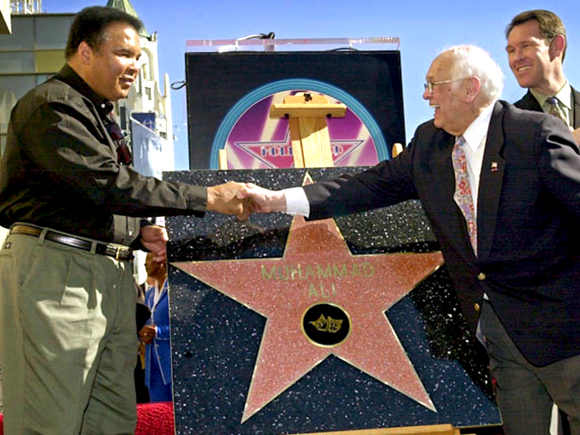
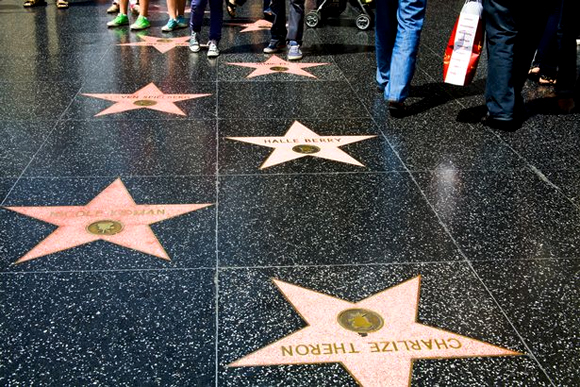
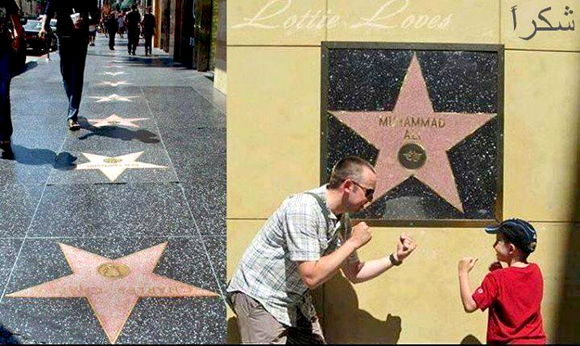
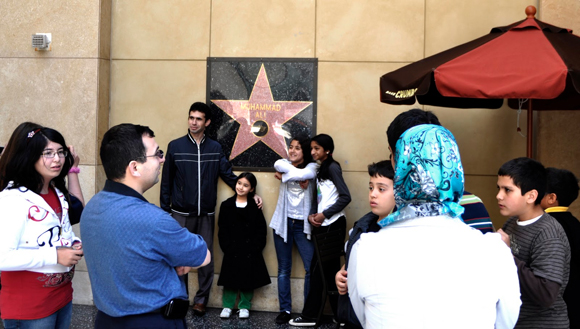
Boxing legend Muhammad Ali who passed away yesterday after a 32-year battle with Parkinson's disease, is in fact the only star' situated on a wall at Hollywood Walk of Fame and not the floor.

ali4

The Hollywood Walk of Fame comprises more than 2,500 five-pointed terrazzo and brass stars embedded in the sidewalks along 15 blocks of Hollywood Boulevard and three blocks of Vine Street in Hollywood, California.

The stars are permanent public monuments to achievement in the entertainment industry, bearing the names of a mix of actors, musicians, directors, producers, musical and theatrical groups, fictional characters, and others. The Walk of Fame is administered by the Hollywood Chamber of Commerce and maintained by the self-financing Hollywood Historic Trust. It is a popular tourist destination, with a reported 10 million visitors in 2003.

When Muhammad Ali was offered a star with his name on this Walk of Fame' he refused and said: “I bear the name of our honourable Prophet Muhammad (peace be upon him), and it is impossible that I allow people to trample on his name."

Muhammad Ali's star was granted after the committee decided that boxing could be considered a form of "live performance". Its placement, on a wall of the Dolby Theatre, makes it the only star mounted on a vertical surface, acceding to the legend's request that his name not be walked upon.

After accepting Islam decades ago, Muhammad Ali had motivated thousands of American Christians to embrace Islam. Mr Ali, who was called by Americans and the global fans as “the greatest”, had openly proclaimed that “Allah is the Greatest. We are just human beings.”

charlize1 

ali3

clay1

Comments

Yasir
 - 
Monday, 6 Jun 2016

A man of true faith, RIP

Satyameva Jayate
 - 
Sunday, 5 Jun 2016

See the respect for Islam on the height.....not on the floor..............
Great Muhammad Ali, he understood islam and came to the relegion of peace and see the respect of the name \Muhammad\" today where it is."

Mohamed Ali Uchil
 - 
Saturday, 4 Jun 2016

The legend of Legends,great human being,My heartfelt condolences,May Allah grant him Jannatul Firdouse

UMMAR
 - 
Saturday, 4 Jun 2016

GREAT PERSON WIL SHOW GREAT, HE IS LUCKY GUY HE CONVERTED TO ISLAM ..

Add new comment

  • Coastaldigest.com reserves the right to delete or block any comments.
  • Coastaldigset.com is not responsible for its readers’ comments.
  • Comments that are abusive, incendiary or irrelevant are strictly prohibited.
  • Please use a genuine email ID and provide your name to avoid reject.
News Network
February 21,2020

Bengaluru, Feb 21: The Supreme Court in its interim order on Thursday allowed the plea of the Karnataka government for implementation of the final award by a tribunal for sharing of water between Goa, Karnataka and Maharashtra from the Mahadayi river.

The interim order was passed by a bench comprising Justice D Y Chandrachud and Justice Hemant Gupta after hearing the counsel from the three states. The bench said the final hearing in the matter will take place in July.

It also said the interim order is subject to the final outcome of the petitions filed by the three states against the tribunal's award.

The Mahadayi Water Dispute tribunal had passed the order on August 14, 2018, allocating 13.42 TMC ( Thousand Million Cubic Feet.) water (including 3.9 TMC for diversion into the depleted Malaprabha river basin) from the Mahadayi river basin to Karnataka.

Maharashtra was allotted 1.33 TMC water while Goa was given 24 TMC in the final decision of the tribunal. The UPA-2 government had constituted Mahadayi Water Disputes Tribunal in 2010.

Karnataka government, which has locked horns with the neighbouring Goa on the larger issue of sharing Mahadayi River water between both the states, had petitioned the tribunal seeking the release of 7.56 tmcft of water for the Kalasa-Banduri Nala project.

The Kalasa-Banduri Nala (diversion) project, which will utilise 7.56 tmcft of water from the inter-state Mahadayi river, is being undertaken by Karnataka to improve drinking water supply to the twin cities of Hubballi-Dharwad and the districts of Belagavi and Gadag.

It involves building barrages across Kalasa and Banduri, the tributaries of the Mahadayi River, to divert 7.56 tmc water to the Malaprabha river which fulfils the drinking water needs of the twin cities.

Comments

Add new comment

  • Coastaldigest.com reserves the right to delete or block any comments.
  • Coastaldigset.com is not responsible for its readers’ comments.
  • Comments that are abusive, incendiary or irrelevant are strictly prohibited.
  • Please use a genuine email ID and provide your name to avoid reject.
Wafa Sultana
April 4,2020

Over the last couple of days when the world was occupied with unifying efforts to fight the deadly Covid19 pandemic, sections of Indian media provided viewers a familiar scapegoat – the Indian Muslims – who are often stereotyped as a community being constantly at loggerheads with the citizenry and the State. Biased media channels were quick to resort to blaming the entire Muslim community for the spread of the disease in the country, thanks to an ill-timed Tablighi Jamaat gathering at its international headquarters in Delhi’s Nizamuddin. Unsurprisingly, the opprobrium was also marked by a sudden spike in WhatsApp forwards of videos with people wearing skullcaps licking spoons and performing Sufi breathing rituals, suggesting some sort of wild conspiracy on the part of the community to spread the virus.  Some media channels were quick to formulate, hypothesize and provide loose definitions of a newly discovered form of Jihad i.e. ‘Corona Jihad ’ thereby vilifying the Islamic faith and its followers.

While the investigation on the culpability of the organizers of the Nizamuddin event is still ongoing, there is enough information to suggest that the meeting was held before any lockdown was in force, and the problem began when there was no way of getting people out once the curfew was announced. Be that as it may, there is little doubt that organizing a meet of such a scale when there is a global pandemic smacks of gross misjudgment, and definitely the organizers should be held accountable if laws or public orders were defied. Attendees who attempt to defy quarantine measures must be dealt with strictly. However, what is alarming is that the focus and narrative have now shifted from the unfortunate event at Nizamuddin to the Tablighi Jamaat itself.

For those not familiar with the Tablighi Jamaat, the organization was founded in 1926 in Mewat by scholar Maulana Mohammad Ilyas. The Jamaat’s main objective was to get Muslim youth to learn and practice pristine Islam shorn of external influences. This is achieved through individuals dedicating time for moral and spiritual upliftment secluded from the rest of the world for a brief period of time. There is no formal membership process. More senior and experienced participants typically travel from one mosque to other delivering talks on religious topics, inviting local youth to attend and then volunteer for a spiritual retreat for a fixed number of days to a mosque in a nearby town or village to present the message to their co-religionists. Contrary to ongoing Islamophobic rhetoric, the movement does not actively proselytize. The focus is rather on getting Muslims to learn the teachings and practices of Islam.  This grassroots India-based movement has now grown to almost all countries with substantial Muslim populations. Its annual meets, or ‘ijtemas’ are among the largest Islamic congregations in the world after the annual Haj. One of the reasons for its popularity and wide network in the subcontinent and wordwide is the fact that it has eschewed the need for scholarly intervention, focusing on peer learning of fundamental beliefs and practice rather than high-falutin ideological debates. The Tablighi Jamaat also distinguishes itself from other Islamic movements through its strictly apolitical nature, with a focus on individual self-improvement rather than political mobilization. Hardships and difficulty in the world are expected to be face through ‘sabr’ (patience) and ‘dua’ (supplication),  than through quest for political power or influence. In terms of ideology, it is very much based on mainstream Sunni Islamic principles derived from the Deobandi school.

So, why is all this background important in the current context? While biased media entities have expectedly brought out their Islamophobic paraphernalia out for full display, more neutral commentators have tried to paint the Tablighi Jamaat as a fringe group and have tried to distance it from 'mainstream Muslims'. While the intent is no doubt innocent, this is a trap we must not fall into. This narrative, unfortunately, is also gaining ground due to apathy some Muslims have for the group, accusing it of being “disconnected from the realities of the world”. Unlike other Muslim organizations and movements, the Tablighi Jamat, by virtue of its political indifference, does not boast of high-profile advocates and savvy spokespersons who can defend it in mainstream or social media.  The use of adjectives such as 'outdated' and 'orthodox' by liberal columnists to describe the Jamaat feeds into the malignant attempt to change the narrative from the control of the spread of the pandemic due to the Nizamuddin gathering to 'raison d'etre' of the organization itself.

A large mainstream religious group like the Tablighi Jamaat with nearly a hundred-year history, normally considered to be peaceful, apolitical and minding its own business is now suddenly being villainized owing to unfortunate circumstances. Biased media reactions filled with disgust and hate seem to feed the Indian public conscience with a danngerous misconception - to be a nominal Muslim is okay but being a practicing one is not.  For those committed to the truth and fighting the spread of Islamophobia, the temptation to throw the entire Tablighi Jamaat under the bus must be resisted.

The writer is a lawyer and research scholar at Qatar University. Her research interests include Islamic law and politics.


Comments

zahoorahmed
 - 
Saturday, 4 Apr 2020

great article! provides a great perspective on tableeg jamat

Add new comment

  • Coastaldigest.com reserves the right to delete or block any comments.
  • Coastaldigset.com is not responsible for its readers’ comments.
  • Comments that are abusive, incendiary or irrelevant are strictly prohibited.
  • Please use a genuine email ID and provide your name to avoid reject.
coastaldigest.com news network
August 2,2020

Mangaluru/Udupi, Aug 2: The twin coastal districts of Dakshina Kannada and Udupi witnessed sporadic movement of vehicles and relatively less commercial activities today in spite of the withdrawal of ‘Sunday lockdown’ by the state government. 

After the central government announced guidelines under Unlock 3.0, the Karnataka government has removed the complete lockdown concept on Sundays and done away with the night curfews too. So from today (August 2), there will be no lockdown on Sundays.

KSRTC operated its buses as usually. However, compared to other days, today the number of private and city buses on the roads in Dakshina Kannada was limited. 

In Udupi, city buses remained off the roads as the number of passengers was less. However, KSRTC and NARM buses were seen transporting passengers.

In containment zones ban on movement of people will continue till August 31 in Udupi. The Santhekatte market used to function on Saturdays, as there was Sunday lockdown on earlier Sundays. Now the market will be open on Sundays only.

Comments

Add new comment

  • Coastaldigest.com reserves the right to delete or block any comments.
  • Coastaldigset.com is not responsible for its readers’ comments.
  • Comments that are abusive, incendiary or irrelevant are strictly prohibited.
  • Please use a genuine email ID and provide your name to avoid reject.