


Muharram flag triggers communal clash: 2 corporators among 31 arrested

[email protected] (CD Network)
October 13, 2016

Belagavi, Oct 13: A tense atmosphere prevailed in the city after hoisting of green flags near Shetty Galli area as part of Muharram celebration led to communal clashes in the region.
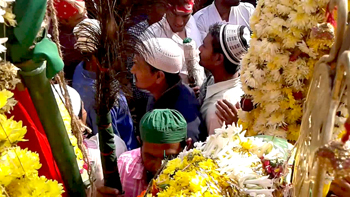
MuharramNearly a dozen vehicles, including a police jeep were damaged in the incidents of stone pelting and arson. Miscreants damaged three auto-rickshaws, set another on fire, stoned four four-wheelers and a police jeep.

Following a heated arguments, the two groups belonging to different religious communities took to stone throwing at Shetty Galli. The violence spread to other sensitive areas of the city such as Bhadkal Galli, Chavat Galli, Khadak Galli and Darbar Galli on Tuesday night, the police said.

The trouble began when a group of people belonging to hardline Hindutva outfits staged protest and pelted stones when the Muharram flags were hoisted at the Shetty Galli corner. Sad part is, the clash took place when people celebrating holy festivals Dasara and Muharram.

Now the situation is under control with the heavy police security has deployed in the tensed areas including KSRP platoons. Police have taken 31 people belonging to both communities in to the custody including two corporators of Belagavi City Corporation - Mujmil Ahamad Doni of Ward 35 and Amtin Shaikh Ali of Ward 37.

According to local sources, stone pelting started on top roofs at 11.30pm at Chaval Galli, Shetty Galli and Jalagar Galli, and continued for few minutes. At the time, people coming out of homes, police led by DCP Radhika reached the spot and arrested miscreants engaged in creating disturbance. According to police sources, stone pelting began after few minutes of the meeting held by both councillors.

Women stage protest

In the backdrop of incident, women from Chavat Galli and Shetty Galli stage protest in the premises of city police commissioner's office blaming the police for taking innocents into custody. Women also alleged that police entered their houses breaking the doors at midnight and took the family members into custody who were innocent and nothing to do with riot. They urged the commissioner immediate release of innocents.

BJP leaders including MP Suresh Angadi, former MLA Abhay Patil, advocate Anil Benake and Kiran Jadhav visited the areas stone pelting occurred. Speaking on the occasion, Suresh Angadi blamed police for taking biased action. "It looks police are targeting people of one particular community bowing to the political pressure and arresting innocent youths" he said and urged immediate release of innocents.

On Wednesday morning, Belagavi North MLA Feroz Sait and Congress city unit President Asif (Raju) Sait rushed to the police commissioners office and held closed-door discussions with senior officers.

Comments

shaji
 - 
Thursday, 13 Oct 2016

Media report on closed door discussin between police commissiner and congress leaders is nothing but bias and completely false. Everyone knows that Media belongs to, managed by and working for sangh parivar. As real terrorists of sangh parivar are arrested, their leaders are shivering due to fear that real culprits behind the planned attack on Muharram procession will be brought to notice.

shaji
 - 
Thursday, 13 Oct 2016

It is clear that the trouble and goondagiri started by the terrorists of Sangh Parivar and when police caught the real culprits sangh parivar is blaming police. What a shame. Chore ulta kotwal ko dante. Police should not bow to political pressure from bjp leaders and arrest the terrorists under goonda act. It was well planned attack by Sangh parivar goondas/terrorists.

Add new comment

  • Coastaldigest.com reserves the right to delete or block any comments.
  • Coastaldigset.com is not responsible for its readers’ comments.
  • Comments that are abusive, incendiary or irrelevant are strictly prohibited.
  • Please use a genuine email ID and provide your name to avoid reject.
News Network
June 9,2020

Bengaluru, Jun 9: Two grassroots level workers of the Bharatiya Janata Party (BJP) on Tuesday filed their nominations for the Rajya Sabha elections from Karnataka, Chief Minister and senior BJP leader BS Yediyurappa said.

"Eranna Kadadi and Ashok Gasti have filed nominations for the Rajya Sabha elections from Karnataka. It is only in BJP that grassroots level workers are given recognition," Yediyurappa told reporters here.

The elections to fill the vacant 18 Rajya Sabha seats from seven states are scheduled to be held on June 19. Elections to four Rajya Sabha seats will be held in Karnataka.

"The core committee of the party had recommended a few names. Afterwards, the party's all-India president consulted with me. Finally, these two names were finalised," Yediyurappa said.

The nominations will be scrutinised on Wednesday and the last date for withdrawal of nomination is June 12.

Notably, the Janata Dal (Secular) on Monday announced that party supremo and former Prime Minister HD Deve Gowda has decided to contest the forthcoming Rajya Sabha elections.

Comments

Add new comment

  • Coastaldigest.com reserves the right to delete or block any comments.
  • Coastaldigset.com is not responsible for its readers’ comments.
  • Comments that are abusive, incendiary or irrelevant are strictly prohibited.
  • Please use a genuine email ID and provide your name to avoid reject.
News Network
March 28,2020

Bengaluru, Mar 28: Sun Tsu, in 'The Art of War' speaks of a skilful general who can subdue his enemy without any fighting. This constitutes the ultimate triumph which is referred to as stratagem. Today, we would need one such when we are faced with the '21-day corona challenge' for India.
Nearly four weeks back, Dr Jyothsna Rao, Dr Gururaj Rao and I sat across the OPD in the afternoon at HCG Bengaluru discussing our ongoing cancer immunology research. While on this topic, we drifted into the discussion on the coronavirus. During this engaging discussion, we wondered the similarity of the enigma between the virus and cancer. I paused to ask Dr Jyothsna and Dr Guru - how we wish we could do something against this virus.
Dr Jyothsna is a PhD from NCBS and had worked under Dr Ralph Steinman, physician and researcher from Rockefeller University, who won the Nobel Prize for his discovery of the dendritic cell and its role in adaptive immunity in 2011. Dr Gururaj is a molecular and cell biologist who did his PhD at the Chapel Hill, University of North Carolina and is the Director of iCrest.
Jyothsna while hearing our perplexing conversation on the covid intervened, "Yes, surely. I think we should take a break from cancer and focus on the innate and adaptive immunity role in COVID-19."
Thus began this sincere attempt to relook the human immune system from the eyes of the COVID-19.
We have 10 types of immune cells at the least which are widely dispersed in millions across the body. When our body is invaded by a foreign organism (bacteria, fungi or virus), these cells work with each other to destroy the invader.
Now, the question is - how do the immune cells talk to each other? They use small-molecule substances called cytokines (cyto means cells; kine means movement). There are many cytokines that are involved in work on the immune system. The most relevant for viruses are interferons.
Interferons (IFN) as the name reflects have an ability to interfere with the viral activity and stop their multiplication. These specialised signal proteins are released by our cells in response to a viral attack to forewarn other cells. They help build the antiviral proteins within the cells to kill the virus as it tries to invade the new cells.
Historically, interferons are a group of cytokines known to be potent antiviral agents against viruses and a hallmark cytokine induced by the host upon viral infections. Interferons possess unique immunoregulatory activities and are signature cytokines released by (TH1) T immune cells, which are crucial in viral infections.
As the outbreak of COVID-19 grapples us, an urgent need for finding strategies to combat the virus is growing. Coronaviruses (CoVs) are a group of RNA viruses. In patients infected with coronavirus, it was indicated that the activation of the IFN does not occur until 48 hours post-infection. Thus the delayed IFN-related antiviral response by the healthy cells leads to coronavirus evade the immune response.
Numerous studies have presented the success in defeating CoVs by the direct administration of IFNs. In a combination as a concoction, it was shown to synergistically inhibit the virus replication in vitro.
Moreover, it is understood that the earlier induction of IFNs in children although they have a less developed immune system could be the reason behind the children being least affected.
The key to success in reducing the disease fatality might be the stimulation of the immune responses to trigger IFN production at the very early stages of the disease, which might be done through the administration of IFN. Despite the evidence for the efficacy of IFNs in treating CoV-induced infections, the proper dosing and ideal timing for such interventions needs to be verified in clinical trials.
For the later stages of the diseases in advance stages where patients are on ventilator and have developed respiratory distress, we propose to utilise the mesenchymal cells derived from donor bone marrow that have been known to treat acute respiratory syndrome. Mesenchymal cells are known to possess anti-inflammatory activity and thus used often in autoimmune diseases.
With this scientific background, we have activated T cells from healthy donors, in a cGMP facility at iCrest - HCG hospital with an enriched cocktail of cytokines rich in Interferons. Injections of this cocktail we believe will result in a surge of cytokines in the body of the infected person and will boost his ability to fight the virus in the early phases. We are in the initial phases of this study and hope to be ready in the coming weeks with meaningful data on its potential utility.
Currently, it awaits government approvals (Union and state) and we have applied to central drugs authority for their initial evaluation and further directions.
As my Guru often expounded the philosophy of 'Seva' - the goal of education is knowledge, the end goal of knowledge is service. In this attempt to serve our fellow humans at this brink of unprecedented crisis, medical fraternity stands with you and promises to do our best for your safety.
We assure to exhaust every bit of our spirit in this fight against coronavirus. We have lost the sight of shores and travelled thus far, but that is the mandatory first step to cross the ocean. Are we going to succeed in this battle, is something only time will answer. 

Comments

Add new comment

  • Coastaldigest.com reserves the right to delete or block any comments.
  • Coastaldigset.com is not responsible for its readers’ comments.
  • Comments that are abusive, incendiary or irrelevant are strictly prohibited.
  • Please use a genuine email ID and provide your name to avoid reject.
News Network
April 12,2020

New Delhi, Apr 12: Ramping up efforts to "stamp out" coronavirus cases in the state, Kerala Finance Minister Thomas Isaac has said that not only lockdown but intense testing of people and tracing of their contacts are also equally important in the fight against the outbreak.

Kerala, which was the first state in the country to report a coronavirus infection in late January, has also prepared a time table for coming out of the lockdown and there would be district-specific strategies to tackle the situation while the number of cases are on the decline.

In efforts to curb spreading of coronavirus infections, the country is under a 21-day lockdown till April 14 and many states have sought an extension amid rising number of cases. Kerala has proposed extending the lockdown and gradual phasing out after proper assessment.

"Lockdown should go on till we stamp out entire infections. Now, it is not enough to have lockdown. Equally important is that we should have intense testing, tracing and isolating (of people with coronavirus infections)," he said in a telephonic interview.

The government is closely monitoring the situation and there would be region-specific or district-specific strategies in place to tackle the outbreak, he said.

Against the backdrop of the lockdown that has also disrupted economic activities, Isaac said an exit strategy is being prepared and restrictions are being relaxed in certain segments, including agriculture.

Coronavirus India update: State-wise total number of confirmed cases, deaths on April 12

"The number of patients is coming down (in the state). We hope that in the coming days, the decline will be much more faster," he said during the interview late Friday.

On Saturday, the Kerala government said there were a total of 373 confirmed cases of coronavirus infections and 228 patients were under treatment in various hospitals in the state.

Keeping the trend in the last few days, the number of people under observation has come down to 1,23,490. So far, 14,613 samples from people with symptoms were sent for testing and the results of 12,818 samples have come negative, the government said in a statement on Saturday.

Indicating that there would be a calibrated exit from the lockdown, Isaac said the withdrawal would depend on three main factors, including the count of cases and the percentage of people who are under observation.

While emphasising that people must also be fed during the lockdown period, Isaac also said a time table is being prepared by the state to come out of the lockdown.

Even as strict measures are being implemented to deal with the current situation, the state is also preparing for a possible third wave of coronavirus cases.

Three students, who had returned from the Chinese city of Wuhan, were tested positive. They were also the first such cases, to be reported in January-February period, and have recovered. Wuhan was the epicentre of coronavirus infections before it spread to other countries.

Later, there was a second wave of infections in Kerala.

According to the minister, the possibility of a third wave has also been considered for the exit strategy.

"A lot of Malayalees are expected to come back from outside the state. We will welcome them... before that, we want to stamp out all Covid cases in Kerala. Flatten the curve completely so that when these people from outside, they will be quarantined, they will be tested and only then they will be able to integrate with the rest of the community," he said.

The Kerala government's measures, including extensive testing and efforts to trace people who came in contact with coronavirus-infected persons, have helped in curbing spreading of infections.

The state's public healthcare system has also been appreciated in various quarters.

"People are health conscious. There is a demand for quality healthcare services and the response to this demand has been strengthening of the public healthcare system. We have a robust public healthcare system," the minister emphasised.

On April 9, Isaac tweeted about low level of coronavirus spreading in the state.

"International norm for Covid spread is 2.6 per 1 Covid patient. Total number of primary Covid infected who arrived in Kerala from abroad is 254. The secondary spread has been limited to 91. The international mortality rate is 5.75. With just 2 deaths, rate in Kerala is 0.58," he had tweeted.

Death toll due to the coronavirus increased to 273 and the number of cases to 8,356 in the country on Sunday.

Comments

Add new comment

  • Coastaldigest.com reserves the right to delete or block any comments.
  • Coastaldigset.com is not responsible for its readers’ comments.
  • Comments that are abusive, incendiary or irrelevant are strictly prohibited.
  • Please use a genuine email ID and provide your name to avoid reject.