Mukesh Ambani loses Asia wealth crown to Jack Ma in $5.8 billion rout

News Network
March 10, 2020

Mar 10: Indian energy tycoon Mukesh Ambani is no longer Asia’s richest man, relinquishing the title to Jack Ma after oil prices collapsed along with global stocks.

The rout, exacerbated by mounting fears that the spread of the novel coronavirus will thrust the world into a recession, erased $5.8 billion from Ambani’s net worth on Monday and pushed him to No. 2 on the list of Asia’s richest people, according to the Bloomberg Billionaires Index. Ma, the Alibaba Group Holding Ltd. founder who relinquished the No. 1 ranking in mid-2018, is back on top with a $44.5 billion fortune, about $2.6 billion more than Ambani.

Oil plunged the most in 29 years on Monday as Saudi Arabia and Russia vowed to pump more in a struggle for market share. The slump comes just as the coronavirus is spurring the first decline in demand in more than a decade. That raises questions about whether Ambani’s flagship Reliance Industries Ltd. will be able to cut net debt to zero by early 2021, as he has pledged. The plan hinges on a proposal to sell a stake in the group’s oil and petrochemicals division to Saudi Arabian Oil Co., the world’s biggest crude producer.

While the coronavirus has curtailed some of tech giant Alibaba’s businesses, the damage has been mitigated by increased demand for its cloud computing services and mobile apps.

Reliance Industries, by comparison, has no such silver lining. The Indian conglomerate’s shares plunged 12% on Monday, the most since 2009, extending this year’s decline to 26%. Alibaba’s American depositary receipts have slipped 6.8% so far in 2020.

Ma reclaims crown after Reliance shares were pummeled in 2020.

Few of the world’s billionaires fared well in Monday’s collapse as the S&P 500 Index and Dow Jones Industrial Average each plunged more than 7.5%, the most since the 2008 financial crisis, threatening to end the longest bull market in history. But no one did worse than those whose fortunes are underpinned by oil. Wildcatter Harold Hamm’s fortune was cut almost in half to $2.4 billion and fellow oil magnate Jeff Hildebrand lost $3 billion, bumping both from Bloomberg’s 500-member wealth ranking.

In a pivot toward new businesses such as telecommunications, technology and retail, Ambani’s Reliance Industries has piled on billions of dollars of debt over the years.

It spent almost $50 billion -- most of it funded by borrowings -- to build Reliance Jio Infocomm Ltd., which became India’s No. 1 wireless carrier within about three years of its debut. As the mobile venture took off, Ambani also unveiled plans for an e-commerce empire to rival Amazon.com Inc. in India.

Addressing concerns over the liabilities, Ambani pledged in August to cut the group’s net debt to zero from about $21 billion as of last March. The Aramco deal is crucial to that plan for which Reliance Industries has valued its oil-to-chemicals division at $75 billion including debt, implying a $15 billion valuation for the 20% stake that’s for sale.

Signs of a potential delay to that deal unnerved some investors, hammering the stock since it touched a record high on Dec. 19.

Reliance Industries expected the Aramco transaction to be completed by March, but people familiar with the matter said in February that talks were still ongoing to bridge differences between the two parties over the deal’s structure.

Adding to the uncertainty, Indian Prime Minister Narendra Modi’s administration has petitioned a court to halt the proposed stake sale, threatening a key source of funds needed to pare net debt.

But Ambani, 62, may soon bounce back from the setback, said Harish H.V., managing partner at ECube Investment Advisors in Bengaluru, India.

“The game isn’t over,” he said. “Ambani has successfully built a robust business model which would keep him in the game. Moreover, his telecom business will start yielding results in coming years.”

Comments

SmR
 - 
Tuesday, 10 Mar 2020

The curses of the bank depositors savings which vanished with collapsing economy and fraudlent seems to have gradully affecting riches of Ambani's.


AU
 - 
Tuesday, 10 Mar 2020

in Holy Quran Allah says; but they plan and Allah plans, and Allah is the best planners..(Surah Al Anfal 8:30)

Add new comment

  • Coastaldigest.com reserves the right to delete or block any comments.
  • Coastaldigset.com is not responsible for its readers’ comments.
  • Comments that are abusive, incendiary or irrelevant are strictly prohibited.
  • Please use a genuine email ID and provide your name to avoid reject.
News Network
January 19,2020

Shirdi, Jan 19: Shirdi in Maharashtra will remain closed for an indefinite period from today in the wake of state Chief Minister Uddhav Thackeray's decision to develop Pathri town in Parbhani district as Sai Baba's birthplace.

However, Deepak Madukar Muglikar, Chief Executive Officer of Shri Saibaba Sansthan Trust, has said that Sai Baba Temple in Shirdi will remain open today and will not be impacted by the closure of the city.

"There are some reports in media that Sai Temple in Shirdi will remain closed on January 19. I want to clarify that it is just a rumor. Temple will remain open on January 19," Mr Muglikar said.

A call has been given for indefinite closure of Shirdi after Mr Thackeray's reported comment terming Pathri in Parbhani as Sai Baba's birthplace.

"Devotees will not face any difficulty if they come to Shirdi," said B Wakchaure, member of Saibaba Sansthan Trust.

Uddhav Thackeray has recently announced that Pathri will be developed as the birthplace of Sai Baba for religious tourism and also took a review meeting of the development plans in the Parbhani district.

One of the most popular religious destinations in the country, Saibaba Temple in Shirdi witnesses lakh of devotees visiting the holy site every year.

Comments

Add new comment

  • Coastaldigest.com reserves the right to delete or block any comments.
  • Coastaldigset.com is not responsible for its readers’ comments.
  • Comments that are abusive, incendiary or irrelevant are strictly prohibited.
  • Please use a genuine email ID and provide your name to avoid reject.
Agencies
August 8,2020

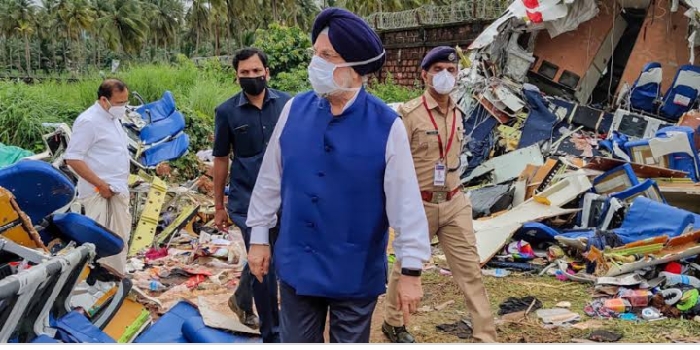
The Civil Aviation Ministry announced an initial assistance of Rs 10 lakh to the dependents of the deceased in the Kozhikode AIE plane crash, while the Kerala government also announced a compensation of Rs 10 lakh each.

Minister of Civil Aviation, Hardeep Singh Puri, who visited the mishap spot on Saturday, said that a detailed probe is already on and the pilot and co-pilot were highly experienced.

He also announced a compensation of Rs 2 lakh each to the injured and Rs. 50,000 each to those who suffered minor injuries. The other normal compensations would be decided in due course.

Puri said that Captain Deepak Vasant Sathe, aged 59, who commandeered the AIE flight, had a flying experience of 10,848 hours, while co-pilot Akhilesh Kumar, aged 32, had a flying experience of 1,723 hours.

"Deepak was one of the most distinguished and experienced pilots. He had a commanding experience of 6,662 hours and was commander of B-737 aircraft for 4,244 hours. He had also operated to Kozhikode international airport 27 times. He joined AIE in 2013 and prior to that he served with the IAF and HAL. He was a figher pilot and a recipient of prestigious sword of honour and a gold medalist," said Puri.

Puri said that even as the flight slipped down to around 35 feet, a major disaster was averted due to timely rescue operations. Local people played an exemplary role and the fire brigade's timely action of cutting the plane body and rescuing the passengers minimised the casualties, he said.

Chief Minister Pinarayi Vijayan also said that the local people and all rescue and relief agencies did a well co-ordinated job. The state government would also meet the entire treatment expenses of the injured.

Till Saturday afternoon, the total number of deaths was 18. While 149 were still in hospitals, 23 were discharged.

Comments

Add new comment

  • Coastaldigest.com reserves the right to delete or block any comments.
  • Coastaldigset.com is not responsible for its readers’ comments.
  • Comments that are abusive, incendiary or irrelevant are strictly prohibited.
  • Please use a genuine email ID and provide your name to avoid reject.
News Network
February 9,2020

Mumbai, Feb 9: Given the slow progress on the ongoing Rs 38,000-crore capacity expansion at the four largest metro airports, and also the surging traffic, the snaky queues will continue at least till 2023, warns a report.

The four largest airports -- New Delhi, Mumbai, Bengaluru and Hyderabad -- handle more than half of the traffic and are operating at 130 per cent of their installed capacity. These airports are under a record Rs 38,000-crore capex but the capacity will not come up before end-2023, says a Crisil report.

“With the dip in traffic growth largely behind, we expect congestion at the top four airports of New Delhi, Mumbai, Bengaluru and Hyderabad, which handle more than half of the load, to continue till about FY23,” says the report.

Already these airports are operating at over 130 percent of installed capacity, and the ongoing healthy traffic growth this operating rate is expected to rise further in the next 12 months.

“Operationalising of capacities in the following two fiscals will bring down utilisation levels albeit still high at over 90 per cent by fiscal 2023 and that is despite an unprecedented Rs 38,000 crore capex being undertaken by the operators of these airports over five fiscals 2020-24,” says the report.

Despite this unprecedented capex that is debt-funded, ratings are likely to be stable given the strong cash flows expected due to healthy traffic growth, low project risks associated with the capex and improving regulatory environment, notes the report.

“Capacity at these four airports will increase a cumulative 65 per cent to 228 million annually (from 138 million now) by fiscal 2023. However, traffic is expected to grow strong at up to 10 per cent per annum over the same period. Since additional capacities will become operational in phases only by fiscal 2023, high passenger growth will add to congestion till then,” warn the report.

High utilisation will ride on pent-up demand (accumulated in 2019 as traffic was impacted with the grounding of Jet Airways) and one-off issues with new aircraft of certain airlines.

Further impetus will also come from improving connectivity to lower-tier cities and reducing fare difference between air and rail. Increasing footfalls at airports provide a leg-up to non-aero streams such as advertising, rentals, food and beverage and parking, which comprise around half of the revenue of airports already.

These are expected to grow strongly at over 10-12 per cent, also supported by higher monetisation avenue coming along with current capex. The other half of revenue (aero revenue) is an entitlement approved by the regulator, providing a pre-determined, fixed return over the asset base and a pass-through of costs.

Aero revenue is also expected to get a bump up during fiscals 2022-24, when a new tariff order for airports is likely. Overall aggregate cash flows are likely to double by fiscal 2024 and provide a healthy cushion against servicing of debt contracted for capex, the report concludes.

Comments

Add new comment

  • Coastaldigest.com reserves the right to delete or block any comments.
  • Coastaldigset.com is not responsible for its readers’ comments.
  • Comments that are abusive, incendiary or irrelevant are strictly prohibited.
  • Please use a genuine email ID and provide your name to avoid reject.