



Mumbai blasts convict Mustafa Dossa dies of cardiac arrest

Agencies
June 28, 2017

Mumbai, Jun 28: Mustafa Dossa, one of the six convicts in the 1993 Mumbai serial blasts case, has died hours after he was admitted to the JJ Hospital in Mumbai after complaining of chest pain.
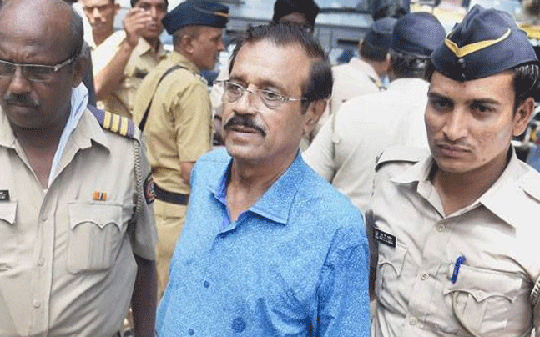
mustafa

The channel quoted Mumbai Police as saying that Dossa succumbed to hypertension and chest pain at around 2.30 pm on Wednesday.

JJ Hospital dean Dr TP Lahane confirmed the news and told Firstpost, "Dossa died of a cardiac arrest. The post-mortem is at underway under the supervision of a three-doctor panel. It is being conducted as per the jail manual. Further details will only emerge after post-mortem is complete."

Early in the morning, Dossa was admitted to JJ Hospital after he complained of chest pain and hypertension.

"Dossa was admitted to the jail ward of the hospital at 3 am," Lahane said. Dossa (lodged in Arthur Road Jail) complained of chest pain and had hypertension, diabetes and infection, Lahane added.

Dossa also informed the special Terrorist and Disruptive Activities (Prevention) Act (TADA) court about his heart condition and said he wanted to undergo a bypass surgery. On Tuesday, the CBI sought capital punishment for Dossa, arguing that his role in the blasts was "more severe" than that of hanged convict Yakub Memon.

In fact, the family of the deceased feared for his life after he was convicted by the TADA court. Reacting to the verdict, Dossa's son, Shahnawaz said, “Everything is over... My dad is not going to come back now.”

Special CBI counsel Deepak Salvi told the special TADA court that Dossa was one of the "brains" behind the conspiracy and that his degree of responsibility towards the commission of the crime was the highest. "If not for him (and other absconding accused), the crime would never have taken place," Salvi had told the court.

He told the court that first conspiracy meeting held at Dossa's Dubai residence had sowed the first seeds of the conspiracy. Salvi had argued that Dossa was one of the masterminds and was in a position of authority.

"Dossa was from among the prime conspirators giving instructions to others," the counsel had told the court. He had argued that Dossa financed for landing of arms and explosives and sending people to Pakistan for arms training etc.

Dossa had the effective control over the incident and he was one of the architects of the blasts, he had said.

"Just like the supreme court had held that Yakub Memon's deeds cannot be viewed distinct from the act of Tiger Memon (a wanted accused in the blasts case), the same can be attributed to Dossa and other suggestion would be futile and worth discarding at the first glance," Salvi argued.

He had said Dossa was among the "archers wearing the quiver and releasing arrows and one of the principal perpetrators who got the work done through others."

"The offence could have been averted had it not been hatched by the absconders (including Dossa) or if he had not initiated it by sending the first consignment of arms," Salvi said.

The CBI counsel had said that from the execution of the conspiracy, there is a clear instigation by Dossa and he was directly responsible for the blasts as he was one of the brains behind plotting the attacks.

"The crime of terrorism is in itself the aggravating circumstances as it carries a special stigmatisation due to the deliberate form of inhuman treatment it represents and the severity of the pain and suffering inflicted," Salvi had argued.

He had said Dossa was a known smuggler and has criminal antecedents.

"The crime committed by him is of the utmost gravity, heinous, dastardly, diabolical and demonic with no regard towards the country and her citizens, and was carried out pruriently relishing the act of spilling the blood and slaughtering," Salvi had argued.

In the second installment of the trial, the court had on 16 June convicted five accused, including Dossa and extradited gangster Abu Salem, under the charges of murder, conspiracy and sections of now repealed TADA, while the sixth accused Riyaz Siddiqui was convicted only under TADA Act.

As many as 257 people were killed in the coordinated blasts that ripped through the city on 12 March, 1993.

The trial of the seven accused — Abu Salem, Mustafa Dossa, Karimullah Khan, Firoz Abdul Rashid Khan, Riyaz Siddiqui, Tahir Merchant and Abdul Quayyum — was separated from the main case as they were arrested at the time of conclusion of the main trial. The court had acquitted Abdul Quayyum of all the charges.

Comments

Add new comment

  • Coastaldigest.com reserves the right to delete or block any comments.
  • Coastaldigset.com is not responsible for its readers’ comments.
  • Comments that are abusive, incendiary or irrelevant are strictly prohibited.
  • Please use a genuine email ID and provide your name to avoid reject.
News Network
June 16,2020

New Delhi, June 16: Tensions along the Line of Control border between India and China have spiked with an Indian army officer and two soldiers killed in the Galwan area of Ladakh, the Indian army said in a statement on Tuesday.

This is the first time in decades that a clash involving casualties has taken place on the 3,488 kilometre border between India and China.

"During the de-escalation process underway in the Galwan Valley, a violent face-off took place yesterday night with casualties. The loss of lives on the Indian side includes an officer and two soldiers. Senior military officials of the two sides are currently meeting at the venue to defuse the situation," said an official statement.

The two sides had made headway in talks last week with army chief General MM Naravane saying disengagement was in progress. The development had come after weeks of tension, including an incident in which patrolling soldiers from the two sides came to blows on the banks of Pangong Lake, resulting in injuries.

The two armies have since thinned out some forces in a positive signal but soldiers, tanks and other armoured carriers remained heavily deployed in the high-altitude region, an official had said.

India and China fought a brief border war in 1962 and have not been able to settle their border despite two decades of talks. Both claim thousands of kilometres of territory and patrols along the undemarcated Line of Actual Control - the de-facto border - often run into each other, leading to tensions. 

Comments

Angry Indian
 - 
Tuesday, 16 Jun 2020

where is our angry desh bakth RSS and sanghi...hiding in rat hole or @%#hole...now you can show your 56 inch chest to chinese...when pakistan destroyed our two fighter jet that time i relised we are making an monkey army not indian army...still time exist, still we have courage army...but we lack leader...we have maron PM...and some dog follower..they only know to bark in media and whatsapp...in reality they are just real na pustak...

Add new comment

  • Coastaldigest.com reserves the right to delete or block any comments.
  • Coastaldigset.com is not responsible for its readers’ comments.
  • Comments that are abusive, incendiary or irrelevant are strictly prohibited.
  • Please use a genuine email ID and provide your name to avoid reject.
News Network
May 8,2020

New Delhi, May 8: The Supreme Court on Friday suggested that states should consider indirect sale and home delivery of liquor as per its statute and law to avoid crowding at liquor shops amid the ongoing coronavirus-induced lockdown.

A bench headed by Justice Ashok Bhushan refused to pass any orders on a public interest litigation (PIL) seeking clarity on the sale of liquor and to ensure social distancing while it is being sold in liquor shops during the lockdown.

"We will not pass any order but the states should consider indirect sale/home delivery of liquor to maintain social distancing norms and standards," Justice Ashok Bhushan said while disposing of the petition.

The PIL, filed by one Sai Deepak, sought directions for closure of liquor shops for failing to enforce social distancing, which is essential to prevent the spread of coronavirus.

The petitioner told the apex court that he only wants that the life of common people is not affected because of crowding at liquor shops during COVID-19.

Justice Sanjay Kishan Kaul, another judge in the bench, said that discussion on home delivery is already going on.

The top court, after hearing the petition complaining about flouting of safety norms at liquor shops, observed that it cannot pass any orders to different states but they should consider online sale and home delivery of liquor.

Comments

Add new comment

  • Coastaldigest.com reserves the right to delete or block any comments.
  • Coastaldigset.com is not responsible for its readers’ comments.
  • Comments that are abusive, incendiary or irrelevant are strictly prohibited.
  • Please use a genuine email ID and provide your name to avoid reject.
News Network
March 16,2020

New Delhi, Mar 16: A total of 110 cases of coronavirus, including 17 foreign nationals have been confirmed across India, Union Ministry of Health and Family Welfare said on Sunday.

The maximum positive cases have been reported from Maharashtra (32), followed by Kerala (22).

The total number of passengers screened at airports is 12,76,046, the ministry said.

The World Health Organisation (WHO) has declared that Europe has become the new 'epicentre' of the coronavirus pandemic that has infected more than 15 lakh people with over 6,000 deaths globally.

The virus had first emerged in China's Wuhan city in December last year.

Comments

Add new comment

  • Coastaldigest.com reserves the right to delete or block any comments.
  • Coastaldigset.com is not responsible for its readers’ comments.
  • Comments that are abusive, incendiary or irrelevant are strictly prohibited.
  • Please use a genuine email ID and provide your name to avoid reject.