



Mumbai serial blasts:Abu Salem, Mustafa Dossa among six convicted, one acquitted

News Network
June 16, 2017

Mumbai, Jun 16: A special anti-terrorism court on Friday convicted notorious criminal Abu Salem Abdul Qayoom Ansari and dreaded smuggler Mustafa Dossa alias Mustafa Majnu and four others in connection with the 12 March 1993 serial blasts case.
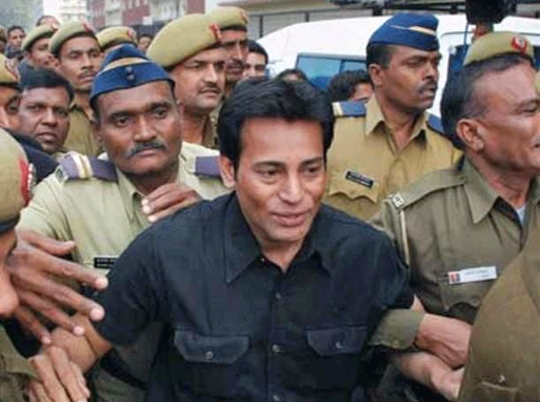
AbuSalem 2

The verdict was delivered by a special court set up under the Terrorist and Disruptive Activities (Prevention) Act (TADA) which is presided over by Additional Sessions Judge GA Sanap. A total of seven accused faced the trial, that is, part II of the Bombay Bomb Blasts Case (BBC-II).

The other accused convicted are Mohammed Tahir Merchant alias Tahir Taklya, Firoz Abdul Rashid Khan, Karimullah Khan, and Riyaz Siddiqui. However, the seventh accused, Abdul Qayoom, was acquitted for lack of evidence. Of the six convicted except for Riyaz Siddiqui, had been convicted under Section 120 B (criminal conspiracy) of the IPC and sections of TADA.

Salem has extradited from Portugal and one of the cause was 'no death penalty' and hence he does not face capital punishment. "We would decide after reading the details," CBI lawyer Deepak Salve said when asked if the prosecution would seek the death sentence.

He also refused to comment whether they would challenge the acquittal of Qayoom. "The government would decide on that..to early to say anything," he said. All accused, however, had been acquitted on charges of waging war against the nation. The hearing on the quantum of punishment would commence from Monday.

On 12 March 1993, a dozen bombs went off at several locations in the city, killing 257 people, and injuring 713, while destroying property worth Rs. 27 crores. Some of the places where the blasts took place are The prime targeted locations included the Air India Building, Bombay Stock Exchange, Zaveri Bazar, then existing five-star hotels, Hotel SeaRock and Hotel Juhu Centaur.

Salem was one of the key persons of Dawood, however, fell out with him and Chhota Shakeel, after the murder of Gulshan Kumar. This is one of the reasons why Salem and Dossa had several fights inside the jail.

As far as the role of Dossa is concerned, he had attended the conspiracy meetings, help some of the accused go to Pakistan for training and arrange for the landing of RDX and AK-47 rifles along the Raigad coast.

Salem too was part of the core team of Dawood and it was he who had supplied the Kalashnikov rifle to Bollywood actor Sanjay Dutt. He was part of the group that visited Dutt's Bandra bungalow and delivered the weapons.

Salem was arrested in Portugal in 2002 and was extradited to India 11 November 2005 along with his companion and actress Monica Bedi. He is standing trial in a total of nine cases in India. In 2015, he was sentenced to life imprisonment by a TADA court for the murder of builder Pradeep Jain. Dossa was deported from the United Arab Emirates and face the grave charge of the landing of arms and ammunition.

Of the 123 who faced trial as part of BBC-I, 100 were convicted and 23 were acquitted by the then TADA judge P D Kode, who later retired as a judge of Bombay High Court. These convicts include Yakub Memon, who in 2015 was hanged to death in Nagpur prison.

Comments

Add new comment

  • Coastaldigest.com reserves the right to delete or block any comments.
  • Coastaldigset.com is not responsible for its readers’ comments.
  • Comments that are abusive, incendiary or irrelevant are strictly prohibited.
  • Please use a genuine email ID and provide your name to avoid reject.
News Network
February 9,2020

Panaji, Feb 9: Archbishop of Goa and Daman, Rev Filipe Neri Ferrao, has urged the central government to "immediately and unconditionally revoke the Citizenship Amendment Act" and stop quashing the "right to dissent".

He also appealed to the government not to implement the proposed countrywide National Register of Citizens (NRC) and the National Population Register (NPR).

Diocesan Centre for Social Communications Media, a wing of the Goa Church, in a statement on Saturday said, "The Archbishop and the Catholic community of Goa would like to appeal to the government to listen to the voice of millions in India, to stop quashing the right to dissent and, above all, to immediately and unconditionally revoke the CAA and desist from implementing the NRC and the NPR."

The CAA, NRC and NPR are "divisive and discriminatory" and will certainly have a "negative and damaging effect" on a multi-cultural democracy like ours, the church said.

There is serious concern that NRC and NPR will result in "direct victimisation of the underprivileged classes, particularly Dalits, adivasis, migrant labourers, nomadic communities and the countless undocumented people who, after having been recognised as worthy citizens and voters for more than 70 years, will suddenly run the risk of becoming stateless and candidates for detention camps," it said.

There has been widespread discontent and open protests throughout the country and even abroad against the CAA, NRC and NPR, which are "forecasting a systematic erosion of values, principles and rights" that have been guaranteed to all citizens in the Constitution, the release said.

Eminent citizens, including top intellectuals and legal luminaries, have taken a studied and unequivocal stand against the CAA, NRC and NPR, it noted.

Goa also witnessed several protests, which transcended the confines of religious and caste affiliation and brought people from all walks of life together on one united platform, said the statement.

It said Christians in India have always been a peace-loving community and deeply committed to the ideals of justice, liberty, equality and fraternity, enshrined in the Constitution.

"We have always taken great pride that our beloved country is a secular, sovereign, socialist, pluralistic and democratic republic," the church said.

The very fact that CAA uses religion goes against the secular fabric of the country, it said. "It goes against the spirit and heritage of our land which, since times immemorial, has been a welcoming home to

all, founded on the belief that the whole world is one big family," the church said.

"We pray for our beloved country, that good sense, justice and peace prevail in the hearts and minds of all," it added.

Comments

Add new comment

  • Coastaldigest.com reserves the right to delete or block any comments.
  • Coastaldigset.com is not responsible for its readers’ comments.
  • Comments that are abusive, incendiary or irrelevant are strictly prohibited.
  • Please use a genuine email ID and provide your name to avoid reject.
News Network
May 29,2020

New Delhi, May 29: Union Home Minister Amit Shah on Friday met Prime Minister Narendra Modi and informed him about the views of all chief ministers on the extension of the ongoing nationwide lockdown beyond May 31, officials said.

During the meeting, Shah briefed Modi about the suggestions and the feedback he received from the chief ministers during his telephonic conversations on Thursday, a government official said.

The nationwide curbs were first announced by Prime Minister Narendra Modi on March 24 for 21 days in a bid to contain the spread of novel coronavirus. It was first extended till May 3 and then again till May 17. The lockdown was further extended till May 31.

The home minister's telephonic conversations with the chief ministers came just three days before the end of the fourth phase of the lockdown.

During his talks with the chief ministers, Shah sought to know the areas of concern of the states and the sectors they want to open up further from June 1, the official said.

Interestingly, till now, it was Modi who had interacted with all chief ministers through video conference before the extension of each phase of the coronavirus-induced lockdown and sought their views.

This was for the first time that the home minister spoke to the chief ministers individually before the end of another phase of the lockdown.

Shah was present in all the conferences of chief ministers along with the prime minister. It is understood that the majority of the chief ministers wanted the lockdown to continue in some form but also favoured opening up of the economic activities and gradual return of the normal life, another official said.

The central government is expected to announce its decision on the lockdown within the next two days.

The number of COVID-19 cases in India has climbed to 1,65,799 on Friday, making it the world's ninth worst-hit country by the coronavirus pandemic.

The Health Ministry said the death toll due to COVID-19 rose to 4,706 in the country. While extending the fourth phase of the lockdown till May 31, the central government had announced the continuation of the prohibition on the opening of schools, colleges and malls but allowed the opening of shops and markets.

It said hotels, restaurants, cinema halls, malls, swimming pools, gyms will remain shut even as all social, political, religious functions, and places of worship will remain closed till May 31.

The government, however, allowed limited operations of the train and domestic flights. The Indian Railways is also running special trains since May 1 for transportation of migrant workers from different parts of the country to their native states.

Comments

Add new comment

  • Coastaldigest.com reserves the right to delete or block any comments.
  • Coastaldigset.com is not responsible for its readers’ comments.
  • Comments that are abusive, incendiary or irrelevant are strictly prohibited.
  • Please use a genuine email ID and provide your name to avoid reject.
News Network
March 16,2020

Mar 16: An investigation into Coffee Day Enterprises Ltd., initiated by its board after the death of founder V.G. Siddhartha, is likely to conclude that at least Rs 2,000 crore is missing from its accounts, according to people familiar with the matter.

The months-long probe following the suicide of Siddhartha in July examined the financial transactions of India’s largest coffee chain and its dealings with dozens of private companies owned by the entrepreneur. The draft report, running more than a hundred pages, points to thousands of rupees that have gone missing, said the people, asking not to be named because the details aren’t public. It also details hundreds of transactions between the founder’s listed and personal businesses that were not conducted at arm’s length, they said.

Though the report is in its final stages, the precise details could change before its release, expected as early as this week, the people said. The missing funds could total more than Rs 2500 crore, one person said.

“The investigation report is still a work in progress, and not finalized,” a spokesman for the company said. “The board of directors and the company are unaware of its content at this point of time. Hence it would be premature to speculate on the investigation findings.”

The priority for management and Siddhartha’s family “is to keep the business running in a challenging environment and meet all stakeholder commitments, including 30,000 jobs associated with the group,” the spokesman added.

The disappearance of the 59-year-old founder last year stunned India’s business community. He had last been seen telling his driver he was going for an evening walk along a bridge in southern India; his body was found by local fishermen two days later. A letter delivered to Coffee Day’s board and employees, which appeared to be signed by Siddhartha, described massive debts and complained of pressure from lenders and tax authorities. It claimed he bore sole responsibility for the company’s financial transactions.

The probe began about a month later when the company brought in Ashok Kumar Malhotra, a retired senior official from India’s federal enforcement agency, to investigate. A senior lawyer practicing in India’s top court is assisting, the company said in a regulatory filing at the time.

The publicly traded Coffee Day was supposed to be India’s answer to Starbucks Corp. More than 1,500 of its Café Coffee Day outlets blanketed cities and highways, with affordable options for the country’s aspiring middle classes. The chain’s tagline: “A lot can happen over coffee.”

But the empire has been battered since the founder’s death. Its shares plummeted about 90% and its market value dropped to about $80 million. Trading was suspended in February.

India’s regulators are tracking the situation and may use the company’s final report as part of a deeper dive into its internal affairs, the people said. Coffee Day showed about Rs 2400 crore in cash and cash equivalents on its balance sheet as of March 2019, the most recent figures the company has issued.

After the death of Siddhartha however, the company faced a severe liquidity crunch and had “zero cash in the bank,” according to one of the people. It struggled with day-to-day expenses and paying salaries has been a strain, the person said.

The draft report details personal guarantees by Siddhartha for loans taken by Coffee Day, and his unsecured loans at high interest rates from local money lenders, the people said. It also probes Coffee Day’s defaults to coffee growers and other vendors, they said.

A related issue is that coffee estates owned by Siddhartha and several employees had been used as collateral for bank loans. The report found that valuations for properties were inflated to get the loans, one person said.

Investigators have examined several theories about what happened to the company’s money, including whether Coffee Day was manipulating its finances to show cash and profit and whether Siddhartha was taking cash out of the listed company to pay off a large investor to whom he had guaranteed a return, the person said. From the filings of his listed and private companies, the entrepreneur’s loans had totaled more than Rs 10,000 crore, and he had been squeezed by borrowing to repay interest on earlier loans, the person said.

In the letter purportedly from Siddhartha, the entrepreneur said he had tried his best but failed as an entrepreneur. “I am solely responsible for all mistakes,” the letter read. “Every financial transaction is my responsibility. My team, auditors and senior management are totally unaware of all my transactions. The law should hold me and only me accountable, as I have withheld this information from everybody including my family.”

As the report nears release, Coffee Day is finalizing a deal with Blackstone Group Inc. for real estate assets. A large tranche of the payment is due in about a week, one person said.

Coffee Day said it is working to reduce its debt load by divesting non-core enterprises.

“The aim is to save employment and preserve this iconic Indian brand,” the spokesman said.

Comments

Add new comment

  • Coastaldigest.com reserves the right to delete or block any comments.
  • Coastaldigset.com is not responsible for its readers’ comments.
  • Comments that are abusive, incendiary or irrelevant are strictly prohibited.
  • Please use a genuine email ID and provide your name to avoid reject.