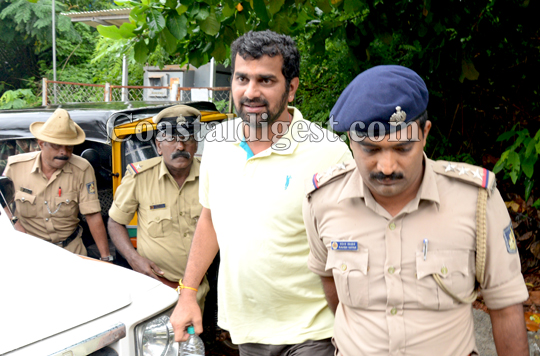
Murder accused Naresh Shenoy gets VIP pass for PM Modi’s DK programme

coastaldigest.com news network
October 29, 2017

Mangaluru, Oct 29: Believe it or not! Naresh Shenoy, aka NaMo Naresh, the prime accused in Mangaluru RTI activist Vinayak Baliga murder case, is one of the VIPs during Prime Minister Narendra Modi’s programmes in Dakshina Kannada on Sunday.

A photo of the official VIP pass issued to Shenoy though Sri Kshetra Dharmasthala Rural Development Project (SKDRDP) has gone viral on social media. Interestingly, the pass is jointly issued by Dakshina Kannada district police and SKDRDP.

Shenoy, a Manglauru based businessman and leader of Yuva Brigade (erstwhile NaMo Brigade), is the prime accused in the murder case of Vinayak Baliga, who was hacked to death near his house in Managluru on March 21, 2016 after raised voice against alleged corruption in a city-based temple. 

After three months of manhunt, Mangaluru police had arrested Shenoy on June 26, 2016. However, he managed to get bail on September 15, 2016.

The Prime Minister on Sunday visited in Dakshina Kannada to address a public programme at Ujjire town near Dharmasthala and hand over RuPay cards to the Pradhan Mantri Jan Dhan Yojana (PMJDY) account holders.

Also Read: Narendra Modi becomes first sitting PM to visit Dharmasthala

Comments

ahmed
 - 
Monday, 30 Oct 2017

Criminal Allowed to  meet criminal tiz is BJP policy....ha.haaa

Wellwisher
 - 
Sunday, 29 Oct 2017

This is what india is moving to after communal bjp paty's rule.  How such a respected Hegde organization supporting these criminals. A question stands on all Mangaloreans mind.  


Add new comment

  • Coastaldigest.com reserves the right to delete or block any comments.
  • Coastaldigset.com is not responsible for its readers’ comments.
  • Comments that are abusive, incendiary or irrelevant are strictly prohibited.
  • Please use a genuine email ID and provide your name to avoid reject.
News Network
July 12,2020

Thiruvananthapuram, Jul 12: At least 66 children have ended their lives in Kerala since the Covid-19 lockdown began on March 25 with youngsters facing stress unable to bear the unprecedented situation where schools are shut and friends are out of reach to share their woes.

According to Chief Minister Pinarayi Vijayan, there has been an increasing instance of suicidal tendencies among children in the state due to various reasons, including parents scolding them over mobile phone use and failure to attend online classes.

This has prompted the government to launch a teleconsultation facility for children facing stress and also cautioning parents against hurting their sentiments while being concerned about welfare of their wards. It has also ordered a study into the issue. "Among the children an increasing instance of suicidal tendency is being witnessed which will become an extremely serious social issue.

Since March 25, when the national lockdown was imposed, 66 children, below 18 years of age, have ended their lives due to various reasons", Vijayan said. A mother scolding her child for not attending the ongoing online classes, or a parent questioning a child for downloading a sleazy video on the smartphone or the constant rift between the parents were among the reasons which triggered the suicidal tendency, he said on Saturday.

As the schools have not yet re-opened due to the lockdown, the children are unable to meet their friends and share their problems. Vijayan said though the parents were intervening keeping in mind their child's welfare, it was essential to ensure that the young minds were not hurt in the process. To helpthe children facing issues relating to mental pressures, 'Chiri'atele-counselling initiative has been started by the government under its Our Responsibility to Children Programme (ORC), a planned community intervention that connects with people between the age of 12-18 years. The state health department has also launched "Ottakalla Oppamundu" (You are not alone,we are with you) programmeto help children facing any kind of mental distress and to prevent the suicidal tendencies among them.

Health Minister K K Shailaja said under the psychosocial support assistance, her department has so far reached out to 68,814 children and 10,890 children have been given counselling. The changes in the behaviour of their children should be noted by the family members and if they find something amiss, the district psychosocial help desk should be informed, she said. A 15-member team of Students Police Cadets will be constituted in each of the 14 districts to help the children needing any assistance,police sources said. Education should not be a competition, but a means to gain knowledge, Vijayan said.

A society's future lies with the children and it is the duty of the society and the government to ensure their physical and mental well being. Taking a serious view of the situation, the state government has constituteda committee headed byFire and Rescue Services DGP R Sreelekha to conduct a study on child suicides in the state. The aim of the ORC was also to create a multi collaborative platform for government and professional agencies, parents and teachers to equip youth with appropriate know-how to face challenges, officials said. 

Comments

Add new comment

  • Coastaldigest.com reserves the right to delete or block any comments.
  • Coastaldigset.com is not responsible for its readers’ comments.
  • Comments that are abusive, incendiary or irrelevant are strictly prohibited.
  • Please use a genuine email ID and provide your name to avoid reject.
News Network
January 3,2020

Bengaluru, Jan 3: Prime Minister Narendra Modi on Friday called on young scientists of India to "Innovate, Patent, Produce and Prosper," and said these four steps would lead our country towards faster development. The Prime Minister also stressed on the need to transform the landscape of Indian science, technology and innovation.

"The growth story of India depends on its success in the science and technology sector. There is a need to transform the landscape of Indian science, technology and innovation," Modi said.

Speaking after inaugurating the 107th Session of Indian Science Congress, he said, "My motto for the young scientists in this country is -Innovate, Patent, Produce and Prosper. These four steps will lead our country towards faster development."

"If we innovate we will patent and that in turn will make our production smoother and when we take these products to the people of our country, I'm sure they will prosper," he said, adding that innovation for the people and by the people is the direction of our new India. The Prime Minister also said he was happy to learn that India's ranking has improved in the Global Innovation Index to 52.

"Our programmes have created more technology business incubators in the last five years than in the previous 50 years. I congratulate our scientists for this achievement," he added.

Comments

Add new comment

  • Coastaldigest.com reserves the right to delete or block any comments.
  • Coastaldigset.com is not responsible for its readers’ comments.
  • Comments that are abusive, incendiary or irrelevant are strictly prohibited.
  • Please use a genuine email ID and provide your name to avoid reject.
Agencies
February 20,2020

India ranked 77th on a sustainability index that takes into account per capita carbon emissions and ability of children in a nation to live healthy lives and secures 131st spot on a flourishing ranking that measures the best chance at survival and well-being for children, according to a UN-backed report.

The report was released on Wednesday by a commission of over 40 child and adolescent health experts from around the world. It was commissioned by the World Health Organization (WHO), UN Children's Fund (UNICEF) and The Lancet medical journal.

In the report assessing the capacity of 180 countries to ensure that their youngsters can survive and thrive, India ranks 77th on the Sustainability Index and 131 on the Flourishing Index, it said.

Flourishing is the geometric mean of Surviving and Thriving. For Surviving, the authors selected maternal survival, survival in children younger than 5 years old, suicide, access to maternal and child health services, basic hygiene and sanitation, and lack of extreme poverty.

For Thriving, the domains were educational achievement, growth and nutrition, reproductive freedom, and protection from violence.

Under the Sustainability Index, the authors noted that promoting today's national conditions for children to survive and thrive must not come at the cost of eroding future global conditions for children's ability to flourish.

The Sustainability Index ranks countries on excess carbon emissions compared with the 2030 target. This provides a convenient and available proxy for a country's contribution to sustainability in future.

The report noted that under realistic assumptions about possible trajectories towards sustainable greenhouse gas emissions, models predict that global carbon emissions need to be reduced from 39·7 giga­ tonnes to 22·8 gigatonnes per year by 2030 to maintain even a 66 per cent chance of keeping global warming below 1·5°C.

It said that the world's survival depended on children being able to flourish, but no country is doing enough to give them a sustainable future.

"No country in the world is currently providing the conditions we need to support every child to grow up and have a healthy future," said Anthony Costello, Professor of Global Health and Sustainability at University College London, one of the lead authors of the report.

"Especially, they're under immediate threat from climate change and from commercial marketing, which has grown hugely in the last decade," said Costello – former WHO Director of Mother, Child and Adolescent health.

Norway leads the table for survival, health, education and nutrition rates - followed by South Korea and the Netherlands. Central African Republic, Chad and Somalia come at the bottom.

However, when taking into account per capita CO2 emissions, these top countries trail behind, with Norway 156th, the Republic of Korea 166th and the Netherlands 160th.

Each of the three emits 210 per cent more CO2 per capita than their 2030 target, the data shows, while the US, Australia, and Saudi Arabia are among the 10 worst emitters. The lowest emitters are Burundi, Chad and Somalia.

According to the report, the only countries on track to beat CO2 emission per capita targets by 2030, while also performing fairly – within the top 70 – on child flourishing measures are: Albania, Armenia, Grenada, Jordan, Moldova, Sri Lanka, Tunisia, Uruguay and Vietnam.

"More than 2 billion people live in countries where development is hampered by humanitarian crises, conflicts, and natural disasters, problems increasingly linked with climate change," said Minister Awa Coll-Seck from Senegal, Co-Chair of the commission.

The report also highlights the distinct threat posed to children from harmful marketing.

Evidence suggests that children in some countries see as many as 30,000 advertisements on television alone in a single year, while youth exposure to vaping (e-cigarettes) advertisements increased by more than 250 per cent in the US over two years, reaching more than 24 million young people.

Studies in Australia, Canada, Mexico, New Zealand and the US – among many others – have shown that self-regulation has not hampered commercial ability to advertise to children.

Children's exposure to commercial marketing of junk food and sugary beverages is associated with purchase of unhealthy foods and overweight and obesity, linking predatory marketing to the alarming rise in childhood obesity, it said.

The number of obese children and adolescents increased from 11 million in 1975 to 124 million in 2016 – an 11-fold increase, with dire individual and societal costs, the report said.

To protect children, the authors call for a new global movement driven by and for children.

Specific recommendations include stopping CO2 emissions with the utmost urgency, to ensure children have a future on this planet; placing children and adolescents at the centre of global efforts to achieve sustainable development, the report said.

New policies and investment in all sectors to work towards child health and rights; incorporating children's voices into policy decisions and tightening national regulation of harmful commercial marketing, supported by a new Optional Protocol to the UN Convention on the Rights of the Child, it said.


Comments

Add new comment

  • Coastaldigest.com reserves the right to delete or block any comments.
  • Coastaldigset.com is not responsible for its readers’ comments.
  • Comments that are abusive, incendiary or irrelevant are strictly prohibited.
  • Please use a genuine email ID and provide your name to avoid reject.