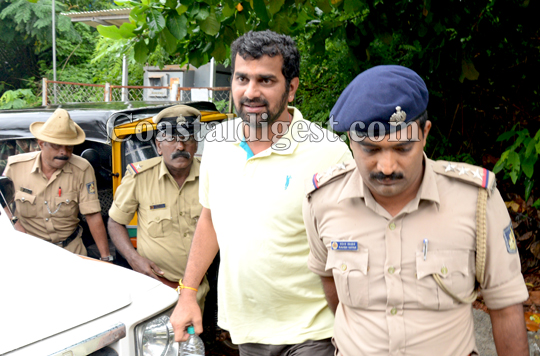
Murder accused Naresh Shenoy gets VIP pass for PM Modi’s DK programme

coastaldigest.com news network
October 29, 2017

Mangaluru, Oct 29: Believe it or not! Naresh Shenoy, aka NaMo Naresh, the prime accused in Mangaluru RTI activist Vinayak Baliga murder case, is one of the VIPs during Prime Minister Narendra Modi’s programmes in Dakshina Kannada on Sunday.

A photo of the official VIP pass issued to Shenoy though Sri Kshetra Dharmasthala Rural Development Project (SKDRDP) has gone viral on social media. Interestingly, the pass is jointly issued by Dakshina Kannada district police and SKDRDP.

Shenoy, a Manglauru based businessman and leader of Yuva Brigade (erstwhile NaMo Brigade), is the prime accused in the murder case of Vinayak Baliga, who was hacked to death near his house in Managluru on March 21, 2016 after raised voice against alleged corruption in a city-based temple. 

After three months of manhunt, Mangaluru police had arrested Shenoy on June 26, 2016. However, he managed to get bail on September 15, 2016.

The Prime Minister on Sunday visited in Dakshina Kannada to address a public programme at Ujjire town near Dharmasthala and hand over RuPay cards to the Pradhan Mantri Jan Dhan Yojana (PMJDY) account holders.

Also Read: Narendra Modi becomes first sitting PM to visit Dharmasthala

Comments

ahmed
 - 
Monday, 30 Oct 2017

Criminal Allowed to  meet criminal tiz is BJP policy....ha.haaa

Wellwisher
 - 
Sunday, 29 Oct 2017

This is what india is moving to after communal bjp paty's rule.  How such a respected Hegde organization supporting these criminals. A question stands on all Mangaloreans mind.  


Add new comment

  • Coastaldigest.com reserves the right to delete or block any comments.
  • Coastaldigset.com is not responsible for its readers’ comments.
  • Comments that are abusive, incendiary or irrelevant are strictly prohibited.
  • Please use a genuine email ID and provide your name to avoid reject.
News Network
March 24,2020

Mangaluru, Mar 24: Seven people were arrested on Tuesday for violating prohibitory orders imposed under Section 144 of CrPC in Mangaluru during the lockdown in Karnataka, Commissioner of Police PS Harsha said.

Chief Minister BS Yediyurappa on Monday had announced a complete lockdown in the state till April 1.
"In the wake of the coronavirus outbreak, the entire state will be locked down from 12 am of March 23 to April 1. People are requested to strictly follow it to contain the coronavirus spread," he said.
Earlier, the state government had ordered the suspending of all public and private transport services.
According to the data compiled by the Indian Council of Medical Research (ICMR), the total number of the infection-related death toll in the country rose to nine on Tuesday, while the total number of active cases reached 482.

Comments

Add new comment

  • Coastaldigest.com reserves the right to delete or block any comments.
  • Coastaldigset.com is not responsible for its readers’ comments.
  • Comments that are abusive, incendiary or irrelevant are strictly prohibited.
  • Please use a genuine email ID and provide your name to avoid reject.
News Network
April 2,2020

The current physical distancing guidelines provided by the World Health Organisation (WHO) and by the US Centers for Disease Control and Prevention (CDC) may not be adequate to curb the coronavirus spread, according to a research which says the gas cloud from a cough or sneeze may help virus particles travel up to 8 metres. The research, published in the Journal of the American Medical Association, noted that the the current guidelines issued by the WHO and CDC are based on outdated models from the 1930s of how gas clouds from a cough, sneeze, or exhalation spread.

Study author, MIT associate professor Lydia Bourouiba, warned that droplets of all sizes can travel 23 to 27 feet, or 7-8 metres, carrying the pathogen.

According to Bourouiba, the current guidelines are based on "arbitrary" assumptions of droplet size, "overly simplified", and "may limit the effectiveness of the proposed interventions" against the deadly pandemic.

 She explained that the old guidelines assume droplets to be one of two categories, small or large, taking short-range semi-ballistic trajectories when a person exhales, coughs, or sneezes.

However based on more recent discoveries, the MIT scientist said, sneezes and coughs are made of a puff cloud that carries ambient air, transporting within it clusters of droplets of a wide range of sizes.

Bourouiba warned that this puff cloud, with ambient air entrapped in it, can offer the droplets moisture and warmth that can prevent it from evaporation in the outer environment.

"The locally moist and warm atmosphere within the turbulent gas cloud allows the contained droplets to evade evaporation for much longer than occurs with isolated droplets," she said.

"Under these conditions, the lifetime of a droplet could be considerably extended by a factor of up to 1000, from a fraction of a second to minutes," the researcher explained in the study.

The MIT scientist, who has researched the dynamics of coughs and sneezes for years, added that these droplets settle along the trajectory of a cough or sneeze contaminating surfaces, with their residues staying suspended in the air for hours.

"Even when maximum containment policies were enforced, the rapid international spread of COVID-19 suggests that using arbitrary droplet size cutoffs may not accurately reflect what actually occurs with respiratory emissions, possibly contributing to the ineffectiveness of some procedures used to limit the spread of respiratory disease," Bourouiba wrote in the study


Comments

Add new comment

  • Coastaldigest.com reserves the right to delete or block any comments.
  • Coastaldigset.com is not responsible for its readers’ comments.
  • Comments that are abusive, incendiary or irrelevant are strictly prohibited.
  • Please use a genuine email ID and provide your name to avoid reject.
News Network
April 22,2020

Bengaluru, Apr 22:  Karnataka Women and Child Welfare Department has warned of action against those raising funds for Covid relief works, by using photos of children.

In a release here on Wednesday, the department said that several non-governmental organisations and voluntary groups were using the photographs of children to collect donations.

It has come to notice that several NGOs are using photos of children to raise donations to meet their food, health and other expenditure during the lockdown. However, this is against the Juvenile Justice (Care and Protection of Children) Act," the Director of the ICDS scheme stated in a release.

Comments

Add new comment

  • Coastaldigest.com reserves the right to delete or block any comments.
  • Coastaldigset.com is not responsible for its readers’ comments.
  • Comments that are abusive, incendiary or irrelevant are strictly prohibited.
  • Please use a genuine email ID and provide your name to avoid reject.