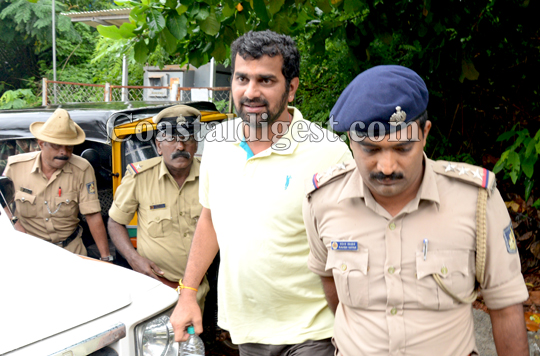
Murder accused Naresh Shenoy gets VIP pass for PM Modi’s DK programme

coastaldigest.com news network
October 29, 2017

Mangaluru, Oct 29: Believe it or not! Naresh Shenoy, aka NaMo Naresh, the prime accused in Mangaluru RTI activist Vinayak Baliga murder case, is one of the VIPs during Prime Minister Narendra Modi’s programmes in Dakshina Kannada on Sunday.

A photo of the official VIP pass issued to Shenoy though Sri Kshetra Dharmasthala Rural Development Project (SKDRDP) has gone viral on social media. Interestingly, the pass is jointly issued by Dakshina Kannada district police and SKDRDP.

Shenoy, a Manglauru based businessman and leader of Yuva Brigade (erstwhile NaMo Brigade), is the prime accused in the murder case of Vinayak Baliga, who was hacked to death near his house in Managluru on March 21, 2016 after raised voice against alleged corruption in a city-based temple. 

After three months of manhunt, Mangaluru police had arrested Shenoy on June 26, 2016. However, he managed to get bail on September 15, 2016.

The Prime Minister on Sunday visited in Dakshina Kannada to address a public programme at Ujjire town near Dharmasthala and hand over RuPay cards to the Pradhan Mantri Jan Dhan Yojana (PMJDY) account holders.

Also Read: Narendra Modi becomes first sitting PM to visit Dharmasthala

Comments

ahmed
 - 
Monday, 30 Oct 2017

Criminal Allowed to  meet criminal tiz is BJP policy....ha.haaa

Wellwisher
 - 
Sunday, 29 Oct 2017

This is what india is moving to after communal bjp paty's rule.  How such a respected Hegde organization supporting these criminals. A question stands on all Mangaloreans mind.  


Add new comment

  • Coastaldigest.com reserves the right to delete or block any comments.
  • Coastaldigset.com is not responsible for its readers’ comments.
  • Comments that are abusive, incendiary or irrelevant are strictly prohibited.
  • Please use a genuine email ID and provide your name to avoid reject.
News Network
April 7,2020

Wayanad, April 7: The Kerala government has allowed people from border villages of Karnataka and Tamil Nadu to use medical facilities at Wayanad.

"We have opened our borders to people from neighbouring states who require medical facilities in Kerala. Twenty-nine people from Bairakuppa in Karnataka have used medical facilities in Wayanad and 44 from Tamil Nadu," Kerala Chief Minister Pinarayi Vijayan said on Monday.

Bairakuppa, a small village in Karnataka, is separated by the river Kabini from Wayanad district and the residents there depend on the healthcare facilities available in Wayanad.

Speaking to news agency, Adeela Abdulla, District Collector of Wayanad, said that instructions have been issued to allow people from neighbouring states of Karnataka and Tamil Nadu, who need medical facilities, to cross the border.

"Right from the start of the lockdown, we have not restricted individuals from Bairakuppa region in Mysore district to use the medical facilities in Wayanad as people in that region depend on medical facilities in Wayanad," she said.

Comments

Add new comment

  • Coastaldigest.com reserves the right to delete or block any comments.
  • Coastaldigset.com is not responsible for its readers’ comments.
  • Comments that are abusive, incendiary or irrelevant are strictly prohibited.
  • Please use a genuine email ID and provide your name to avoid reject.
News Network
March 29,2020

Thiruvananthapuram, Mar 29: Twenty more people were

detected with coronavirus in Kerala on Saturday, taking the total number of those undergoing treatment for the deadly infection to 181, Health Minister K K Shailaja said.

While Kannur reported eight cases, Kasaragod 7, Thiruvananthapuram, Ernkulam, Thrissur, Palakad and Malappuram reported one case each, Shailaja said in a statement here.

Of the 20 people, 18 had come from abroad and two others had been infected through contact.

The man found positive here was in the isolation ICU of the Thiruvananthapuram Medical College hospital, while one positive case from Ernakulam was a health worker.

The samples of four persons who were under treatment at Pathnamthitta were found negative.

At least, 1,41,211 people are under observation across the state, the Minister addd.

Comments

Add new comment

  • Coastaldigest.com reserves the right to delete or block any comments.
  • Coastaldigset.com is not responsible for its readers’ comments.
  • Comments that are abusive, incendiary or irrelevant are strictly prohibited.
  • Please use a genuine email ID and provide your name to avoid reject.
Agencies
May 8,2020

Washington D.C., May 8: The prime time for brain development in a child's life is the first year, where the infant spends most of the time asleep. It is the time when neural connections form and sensory memories are encoded.

However, when sleep is disrupted, as occurs more often among children with autism, brain development may be affected, too.

New research led by the University of Washington finds that sleep problems in a baby's first 12 months may not only precede an autism diagnosis but also may be associated with altered growth trajectory in a key part of the brain, the hippocampus.

The study, which was published in the American Journal of Psychiatry, researchers report that in a sample of more than 400 taken of 6- to 12-month-old infants, those who were later diagnosed with autism were more likely to have had difficulty falling asleep.

It also states that this sleep difficulty was associated with altered growth trajectories in the hippocampus.

"The hippocampus is critical for learning and memory, and changes in the size of the hippocampus have been associated with poor sleep in adults and older children.

As many as 80 per cent of the children with autism spectrum disorder have sleep problems," said Annette Estes, director of the UW Autism Center and senior author of the study.

"In our clinical experience, parents have a lot of concerns about their children's sleep, and in our work on early autism intervention, we observed that sleep problems were holding children and families back," added Estes, who is also a UW professor of speech and hearing sciences.

"It could be that altered sleep is part-and-parcel of autism for some children. One clue is that behavioural interventions to improve sleep don't work for all children with autism, even when their parents are doing everything just right. This suggests that there may be a biological component to sleep problems for some children with autism," said Estes.

To consider links among sleep, brain development, and autism, researchers at the IBIS Network looked at MRI scans of 432 infants, surveyed parents about sleep patterns, and measured cognitive functioning using a standardized assessment.

At the outset of the study, infants were classified according to their risk for developing autism: Those who were at higher risk of developing autism -- about two-thirds of the study sample -- had an older sibling who had already been diagnosed.

Infant siblings of children with autism have a 20 per cent chance of developing autism spectrum disorder -- a much higher risk than children in the general population.

In the current study, 127 of the 432 infants were identified as "low risk" at the time the MRI scans were taken because they had no family history of autism.

They later evaluated all the participants at 24 months of age to determine whether they had developed autism. Of the roughly 300 children originally considered "high familial risk," 71 were diagnosed with autism spectrum disorder at that age.

Problems with sleep were more common among the infants later diagnosed with an autism spectrum disorder, as were larger hippocampi. No other subcortical brain structures were affected, including the amygdala, which is responsible for certain emotions and aspects of memory, or the thalamus, a signal transmitter from the spinal cord to the cerebral cortex.

The authors note that while parents reported more sleep difficulties among infants who developed autism compared to those who did not, the differences were very subtle and only observed when looking at group averages across hundreds of infants.

Sleep patterns in the first years of life change rapidly as infants transition from sleeping around the clock to a more adult-like sleep/wake cycle. Until further research is completed, Estes said, it is not possible to interpret challenges with sleep as an early sign of increased risk for autism.


Comments

Add new comment

  • Coastaldigest.com reserves the right to delete or block any comments.
  • Coastaldigset.com is not responsible for its readers’ comments.
  • Comments that are abusive, incendiary or irrelevant are strictly prohibited.
  • Please use a genuine email ID and provide your name to avoid reject.