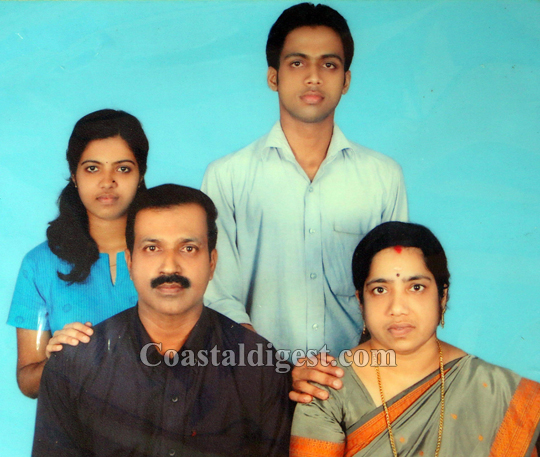
Murdered techie laid to rest; Infosys promises Rs 1 cr, job for her family

February 1, 2017

Kozhikode, Feb 1: The body of slain software engineer Rasila Raju, 25, was cremated on the premises of her house at Payimbra, near Kuruvattoor, Kozhikode, on Tuesday.

Rasila3

She was found murdered at the Infosys office in Pune on Sunday and the police had arrested security guard Bhaben Saikia from Assam for the crime.

Infosys offered the Rasila family a compensation of Rs 1 crore and a job for one of her relatives.

"In the tragic event of the demise of any employee under unfortunate circumstances, as happened in this instance with our employee, OP Rasila, in Pune, Infosys ensures that the next of kin of the deceased employee does not suffer financially in any way," Infosys said in a statement issued tonight.

The statement said that towards ensuring financial stability for the family, Infosys takes into account the statutory payments to be made as per the company policy.

"The company also considers ex-gratia payments based on the circumstances. Infosys also endeavours to make every effort at a suitable employment opportunity for the next of kin who qualify its recruitment criteria," it said.

Meanwhile, a senior office-bearer of the 'Pune Kerala Samaj' has claimed Infosys has issued a letter to the family of Rasila, agreeing to pay "Rs one crore as ex-gratia" to her nominee.

Repeated calls to Infosys officials for reaction on the claims regarding issuance of the letter remained unanswered.

Rasila's father Raju OP along with Malyali community members had visited Infosys officials on Pune campus on Monday night.

Her mortal remains were cremated today at her village in Kozhikode district in presence of a large number of people.

Meanwhile, Congress in Kerala on Tuesday demanded a comprehensive probe into the techie's murder.

In a letter to Maharashtra Chief Minister Devandra Fadnavis, Leader of the Opposition in the Kerala assembly, Ramesh Chennithala, said he had visited the relatives of Rasila at Kozhikode this morning.

"There is some mystery in the murder and some others had a role in her death, Rasila's relatives informed me. Besides, the family also complained that there was a serious lapse on the part of the company," he said.

Police had on Monday arrested Bhaben Saikia, a security guard from a private security services firm deployed at the Infosys campus, in connection with the murder.

According to police, Rasila had chided Saikia for "staring" at her and threatened to complain against him.

Comments

Rikaz
 - 
Wednesday, 1 Feb 2017

Money cannot bring back that soul....but still it was Infosys did not provide security for that lone employee...disgusting...need to take care while working for this type of big companies...they just don't care.....

Skazi
 - 
Wednesday, 1 Feb 2017

RIP..... Condolences to the family ..... well done Infosys... May Allah shower his blessings on the company for such noble acts .....

Add new comment

  • Coastaldigest.com reserves the right to delete or block any comments.
  • Coastaldigset.com is not responsible for its readers’ comments.
  • Comments that are abusive, incendiary or irrelevant are strictly prohibited.
  • Please use a genuine email ID and provide your name to avoid reject.
Ram Puniyani
January 14,2020

In the beginning of January 2020 two very disturbing events were reported from Pakistan. One was the attack on Nankana Sahib, the holy shrine where Sant Guru Nanak was born. While one report said that the place has been desecrated, the other stated that it was a fight between two Muslim groups. Prime Minister of Pakistan Imran Khan condemned the incident and the main accused Imran Chisti was arrested. The matter related to abduction and conversion of a Sikh girl Jagjit Kaur, daughter of Pathi (One who reads Holy Guru Granth Sahib in Gurudwara) of the Gurudwara. In another incident one Sikh youth Ravinder Singh, who was out on shopping for his marriage, was shot dead in Peshawar.

While these condemnable attacks took place on the Sikh minority in Pakistan, BJP was quick enough to jump to state that it is events like this which justify the Citizenship Amendment Act (CAA). Incidentally CAA is the Act which is discriminatory and relates to citizenship with Religion, which is not as per the norms of Indian constitution. There are constant debates and propaganda that population of Hindus has come down drastically in Pakistan and Bangla Desh. Amit Shah, the Home minister stated that in Pakistan the population of Hindus has come down from 23% at the time of partition to 3.7% at present. And in Bangla Desh it has come down from 22% to present 8%.

While not denying the fact that the religious minorities are getting a rough deal in both these countries, the figures which are presented are totally off the mark. These figures don’t take into consideration the painful migrations, which took place at the time of partition and formation of Bangla Desh later. Pakistan census figures tell a different tale. Their first census was held in 1951. As per this census the overall percentage of Non Muslim in Pakistan (East and West together) was 14.2%, of this in West Pakistan (Now Pakistan) it was 3.44 and in Eat Pakistan it was 23.2. In the census held in Pakistan 1998 it became 3.72%. As far as Bangla Desh is concerned the share of Non Muslims has gone down from 23.2 (1951) to 9.6% in 2011.

The largest minority of Pakistan is Ahmadis, (https://minorityrights.org/country/pakistan/) who are close to 4 Million and are not recognised as Muslims in Pakistan. In Bangla Desh the major migrations of Hindus from Bangla Desh took place in the backdrop of Pakistan army’s atrocities in the then East Pakistan.

As far as UN data on refugees in India it went up by 17% between 2016-2019 and largest numbers were from Tibet and Sri Lanka.  (https://www.un.org/en/development/desa/population/migration/publication…)

The state of minorities is in a way the index of strength of democracy. Most South Asian Countries have not been able to sustain democratic values properly. In Pakistan, the Republic began with Jinnah’s classic speech where secularism was to be central credo of Pakistan. This 11th August speech was in a way what the state policy should be, as per which people of all faiths are free to practice their religion. Soon enough the logic of ‘Two Nation theory” and formation of Pakistan, a separate state for Muslim took over. Army stepped in and dictatorship was to reign there intermittently. Democratic elements were suppressed and the worst came when Zia Ul Haq Islamized the state in collusion with Maulanas. The army was already a strong presence in Pakistan. The popular formulation for Pakistan was that it is ruled by three A’s, Army, America and Allah (Mullah).

Bangla Desh had a different trajectory. Its very formation was a nail in the coffin of ‘two nation theory’; that religion can be the basis of a state. Bangla Desh did begin as a secular republic but communal forces and secular forces kept struggling for their dominance and in 1988 it also became Islamic republic. At another level Myanmar, in the grip of military dictatorship, with democratic elements trying to retain their presence is also seeing a hard battle. Democracy or not, the army and Sanghas (Buddhist Sang has) are strong, in Myanmar as well. The most visible result is persecution of Rohingya Muslims.

Similar phenomenon is dominating in Sri Lanka also where Budhhist Sanghas and army have strong say in the political affairs, irrespective of which Government is ruling. Muslim and Christian minorities are a big victim there, while Tamils (Hindus, Christians etc.) suffered the biggest damage as ethnic and religious minorities. India had the best prospect of democracy, pluralism and secularism flourishing here. The secular constitution, the outcome of India’s freedom struggle, the leadership of Gandhi and Nehru did ensure the rooting of democracy and secularism in a strong way.

India so far had best democratic credentials amongst all the south Asian countries. Despite that though the population of minorities rose mainly due to poverty and illiteracy, their overall marginalisation was order of the day, it went on worsening with the rise of communal forces, with communal forces resorting to identity issues, and indulging in propaganda against minorities.

While other South Asian countries should had followed India to focus more on infrastructure and political culture of liberalism, today India is following the footsteps of Pakistan. The retrograde march of India is most visible in the issues which have dominated the political space during last few years. Issues like Ram Temple, Ghar Wapasi, Love Jihad, Beef-Cow are now finding their peak in CAA.

India’s reversal towards a polity with religion’s identity dominating the political scene was nicely presented by the late Pakistani poetess Fahmida Riaz in her poem, Tum bhi Hum Jaise Nikle (You also turned out to be like us). While trying to resist communal forces has been an arduous task, it is becoming more difficult by the day. This phenomenon has been variously called, Fundamentalism, Communalism or religious nationalism among others. Surely it has nothing to do with the religion as practiced by the great Saint and Sufi traditions of India; it resorts mainly to political mobilization by using religion as a tool.


Comments

Ashi
 - 
Tuesday, 14 Jan 2020

If Malaysia implement similar NRC/CAA, India and China are the loser.

Add new comment

  • Coastaldigest.com reserves the right to delete or block any comments.
  • Coastaldigset.com is not responsible for its readers’ comments.
  • Comments that are abusive, incendiary or irrelevant are strictly prohibited.
  • Please use a genuine email ID and provide your name to avoid reject.
News Network
May 9,2020

Bengaluru, May 9: The Karnataka government may not extend the daily working hours from 8 to 12, with Labour Minister A Shivaram Hebbar saying on Saturday that the move would neither benefit the industries nor workers.

Hebbar said that the proposal has not been discussed and it may come for final deliberations next week. He also noted that some States have already extended the working hours. More than extending working hours, there should be employment to be given. If there are no jobs what can be done by extending working hours? If it is done (working hours extended to 12 hours), it would neither benefit workers nor industries. Let's see what happens, he said.

Asked if the government was in favour of the extension, he said, "I don't think it will be ready for the (12 hour) proposal." Meanwhile, the Minister also said that their top priority now was to see that all MSMEs start operating again, salaries are paid to employees and there are no job losses for any reason. If industries don't reopen, how can workers get their employment? We should think in parallel, Hebbar said adding, the government was keeping the interests of both MSMEs and workers in mind.

He urged the Centre to offer a relief package to the MSME sector, saying it is facing very difficult times due to the adverse impact of the COVID-19-induced lockdown, and also noting its role in generating large-scale employment and feeding large industries.

The BJP-led government has done whatever within its limitations to help the MSMEs, he said. Earlier this week, the Chief Minister B S Yediyurappa announced that the monthly fixed charges of electricity bills of MSMEs would be waived for two months. MSMEs have suffered huge production losses due to the lockdown. It takes some time for them to revive, Yediyurappa had said. The Chief Minister had also said payment of fixed charges in the electricity bills of the large industries will be deferred without penalty and interest for a period of two months.

Comments

Add new comment

  • Coastaldigest.com reserves the right to delete or block any comments.
  • Coastaldigset.com is not responsible for its readers’ comments.
  • Comments that are abusive, incendiary or irrelevant are strictly prohibited.
  • Please use a genuine email ID and provide your name to avoid reject.
News Network
February 23,2020

Bengaluru, Feb 23: The sleuths of Custom Department have seized ephedrine worth Rs 5 Crore in courier terminal of Air Cargo complex in Kempegowda International Airport (KIA), the department said on Sunday.

Customs Joint Commissioner M J Chethan, in a statement, said that Central Intelligence Unit, Air Cargo Complex, scanned the package while verifying export consignments and found concealment of some powder. 5.04 kg of Ephedrine worth Rs 5 crore was packed in polythene pouches and concealed between cardboard layers of wedding invitation cards.

Detailed examination of the Wedding cards revealed banned drugs hidden between 43 wedding invitation cards in the package that also contained a few clothes.

Comments

Add new comment

  • Coastaldigest.com reserves the right to delete or block any comments.
  • Coastaldigset.com is not responsible for its readers’ comments.
  • Comments that are abusive, incendiary or irrelevant are strictly prohibited.
  • Please use a genuine email ID and provide your name to avoid reject.