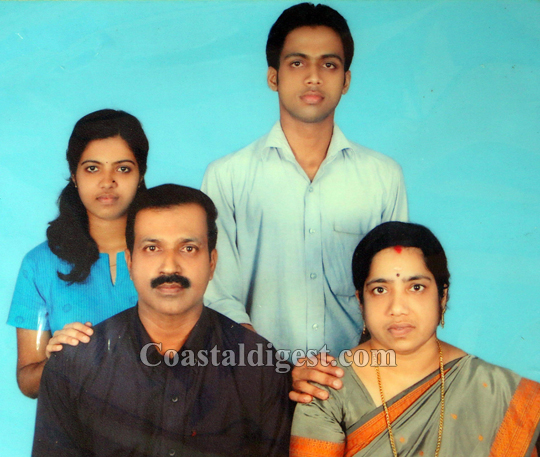
Murdered techie laid to rest; Infosys promises Rs 1 cr, job for her family

February 1, 2017

Kozhikode, Feb 1: The body of slain software engineer Rasila Raju, 25, was cremated on the premises of her house at Payimbra, near Kuruvattoor, Kozhikode, on Tuesday.

Rasila3

She was found murdered at the Infosys office in Pune on Sunday and the police had arrested security guard Bhaben Saikia from Assam for the crime.

Infosys offered the Rasila family a compensation of Rs 1 crore and a job for one of her relatives.

"In the tragic event of the demise of any employee under unfortunate circumstances, as happened in this instance with our employee, OP Rasila, in Pune, Infosys ensures that the next of kin of the deceased employee does not suffer financially in any way," Infosys said in a statement issued tonight.

The statement said that towards ensuring financial stability for the family, Infosys takes into account the statutory payments to be made as per the company policy.

"The company also considers ex-gratia payments based on the circumstances. Infosys also endeavours to make every effort at a suitable employment opportunity for the next of kin who qualify its recruitment criteria," it said.

Meanwhile, a senior office-bearer of the 'Pune Kerala Samaj' has claimed Infosys has issued a letter to the family of Rasila, agreeing to pay "Rs one crore as ex-gratia" to her nominee.

Repeated calls to Infosys officials for reaction on the claims regarding issuance of the letter remained unanswered.

Rasila's father Raju OP along with Malyali community members had visited Infosys officials on Pune campus on Monday night.

Her mortal remains were cremated today at her village in Kozhikode district in presence of a large number of people.

Meanwhile, Congress in Kerala on Tuesday demanded a comprehensive probe into the techie's murder.

In a letter to Maharashtra Chief Minister Devandra Fadnavis, Leader of the Opposition in the Kerala assembly, Ramesh Chennithala, said he had visited the relatives of Rasila at Kozhikode this morning.

"There is some mystery in the murder and some others had a role in her death, Rasila's relatives informed me. Besides, the family also complained that there was a serious lapse on the part of the company," he said.

Police had on Monday arrested Bhaben Saikia, a security guard from a private security services firm deployed at the Infosys campus, in connection with the murder.

According to police, Rasila had chided Saikia for "staring" at her and threatened to complain against him.

Comments

Rikaz
 - 
Wednesday, 1 Feb 2017

Money cannot bring back that soul....but still it was Infosys did not provide security for that lone employee...disgusting...need to take care while working for this type of big companies...they just don't care.....

Skazi
 - 
Wednesday, 1 Feb 2017

RIP..... Condolences to the family ..... well done Infosys... May Allah shower his blessings on the company for such noble acts .....

Add new comment

  • Coastaldigest.com reserves the right to delete or block any comments.
  • Coastaldigset.com is not responsible for its readers’ comments.
  • Comments that are abusive, incendiary or irrelevant are strictly prohibited.
  • Please use a genuine email ID and provide your name to avoid reject.
News Network
January 31,2020

Mangaluru, Jan 31: Mahesh Vikram Hegde, the co-founder of website 'Postcard News', known for spreading fake news on behalf of Sangh Parivar, was taken aback when he was asked to sing 'Vande Mataram' to prove his patriotism by a group of women activists at Mangaluru International Airport.

The video of the incident which occurred on Friday, days after editor-in-chief and co-founder of Republic TV Arnab Goswami was heckled by comedian Kunal Kamra on a flight, went viral on social media within hours.

Hegde was spotted by social activist Kavitha Reddy, and other young orators – Najma Nazeer and Amulya Leona – at the airport where he was waiting to board a plane to Bengaluru.

In a video, the three women are seen coercing Hegde to sing 'Vande Mataram' and prove his patriotism. In another video being circulated, the women are heard telling the journalist that he is getting an opportunity to become a 'hero' from 'zero' if he sings 'Vande Mataram.' However, he refused to open his mouth.

Reddy is seen asking Hegde whether he knew the time when Nathuram Godse assassinated Mahatma Gandhi.

Hegde was arrested in 2018 for posting a fake news aimed at creating communal conflict.

Comments

Add new comment

  • Coastaldigest.com reserves the right to delete or block any comments.
  • Coastaldigset.com is not responsible for its readers’ comments.
  • Comments that are abusive, incendiary or irrelevant are strictly prohibited.
  • Please use a genuine email ID and provide your name to avoid reject.
News Network
March 5,2020

Mar 5: The Karnataka government on Thursday proposed to increase rate of tax on petrol and diesel by three per cent which would make the fuel dearer by Rs 1.60 and Rs 1.59 per litre, respectively.

Presenting the 2020-21 budget in the Legislative Assembly, Chief Minister B S Yediyurappa proposed to increase rate of tax on petrol from 32 per cent to 35 per cent and diesel from 21 per cent to 24 per cent, as part of additional resource mobilisation measures.

Yediyurappa, who also holds the finance portfolio, increased excise duty on Indian Made Liquor (KML) across 18 slabs by six per cent.

However, to promote affordable housing, the government proposed to reduce stamp duty on first time registration of new apartments/flats costing less than Rs 20 lakh from existing five per cent to two per cent.

This is the first budget of the BJP government after coming to power last year; it's the seventh presented by Yediyurappa.

"For the year 2020-21, a total amount of Rs 55,732 crore is provided for stimulating economic growth sector", the Chief Minister said.

He said the revenue collection target for the Commercial Taxes department for the year 2020-21 is fixed at Rs 82,443 crore.

Stating the government had fixed a revenue target of Rs 20,950 crore for the excise department for the year 2019- 20, he said at the end of February Rs 19,701 crore had been collected.

"We hope to achieve the budget target."

He also hoped with the increase in rates and effective enforcement and regulatory measures, the Excise department would be achieving the target of Rs 22,700 crore fixed for the financial year 2020-21.

On the transport sector, Yediyurappa said it is proposed to levy motor vehicle tax on contract carriages having seating capacity to carry more than 12 passengers, but not more than 20 passengers at the rate of Rs 900 per seat per quarter.

He said it is also proposed to levy vehicle tax on new model sleeper coaches which are granted permits under section 88 (9) of MV Act 1988 at the rate of Rs 4,000 per sleeper per quarter.

Noting that a target of Rs 7,100 crore revenue collection is expected to be achieved in 2019-20 in transport sector, he said for 2020-21 revenue collection target has been fixed at Rs 7,115 crore.

He said the revenue collection target for 2019-20 under stamps and registration was fixed at Rs 11,828 crore and against this Rs 10,248 crore has been collected till the end of February 2020 which is 87 per cent of full year target.

While the revenue collection target for 2020-21 under stamps and registration is fixed at Rs 12,655 crore.

Comments

Add new comment

  • Coastaldigest.com reserves the right to delete or block any comments.
  • Coastaldigset.com is not responsible for its readers’ comments.
  • Comments that are abusive, incendiary or irrelevant are strictly prohibited.
  • Please use a genuine email ID and provide your name to avoid reject.
Ram Puniyani
February 10,2020

Noam Chomsky is one of the leading peace workers in the world. In the wake of America’s attack on Vietnam, he brought out his classic formulation, ‘manufacturing consent’. The phrase explains the state manipulating public opinion to have the public approve of it policies—in this case, the attack of the American state on Vietnam, which was then struggling to free itself from French colonial rule.

In India, we are witness to manufactured hate against religious minorities. This hatred serves to enhance polarisation in society, which undermines India’s democracy and Constitution and promotes support for a Hindu nation. Hate is being manufactured through multiple mechanisms. For example, it manifests in violence against religious minorities. Some recent ghastly expressions of this manufactured hate was the massive communal violence witnessed in Mumbai (1992-93), Gujarat (2002), Kandhamal (2008) and Muzaffarnagar (2013). Its other manifestation was in the form of lynching of those accused of having killed a cow or consumed beef. A parallel phenomenon is the brutal flogging, often to death, of Dalits who deal with animal carcasses or leather.

Yet another form of this was seen when Shambhulal Regar, indoctrinated by the propaganda of Hindu nationalists, burned alive Afrazul Khan and shot the video of the heinous act. For his brutality, he was praised by many. Regar was incited into the act by the propaganda around love jihad. Lately, we have the same phenomenon of manufactured hate taking on even more dastardly proportions as youth related to Hindu nationalist organisations have been caught using pistols, while police authorities look on.

Anurag Thakur, a BJP minster in the central government recently incited a crowd in Delhi to complete his chant of what should happen to ‘traitors of the country...” with a “they should be shot”. Just two days later, a youth brought a pistol to the site of a protest at Jamia Millia Islamia university and shouted “take Azaadi!” and fired it. One bullet hit a student of Jamia. This happened on 30 January, the day Nathuram Godse had shot Mahatma Gandhi in 1948. A few days later, another youth fired near the site of protests against the CAA and NRC at Shaheen Bagh. Soon after, he said that in India, “only Hindus will rule”.

What is very obvious is that the shootings by those associated with Hindu nationalist organisations are the culmination of a long campaign of spreading hate against religious minorities in India in general and against Muslims in particular. The present phase is the outcome of a long and sustained hate campaign, the beginning of which lies in nationalism in the name of religion; Muslim nationalism and Hindu nationalism. This sectarian nationalism picked up the communal view of history and the communal historiography which the British introduced in order to pursue their ‘divide and rule’ policy.

In India what became part of “social common sense” was that Muslim kings had destroyed Hindu temples, that Islam was spread by force, and that it is a foreign religion, and so on. Campaigns, such as the one for a temple dedicated to the Hindu god Rama to be built at the site where the Babri masjid once stood, further deepened the idea of a Muslim as a “temple-destroyer”. Aurangzeb, Tipu Sultan and other Muslim kings were tarnished as the ones who spread Islam by force in the subcontinent. The tragic Partition, which was primarily due to British policies, and was well-supported by communal streams also, was entirely attributed to Muslims. The Kashmir conflict, which is the outcome of regional, ethnic and other historical issues, coupled with the American policy of supporting Pakistan’s ambitions of regional hegemony, (which also fostered the birth of Al-Qaeda), was also attributed to the Muslims.

With recurring incidents of communal violence, these falsehoods went on going deeper into the social thinking. Violence itself led to ghettoisation of Muslims and further broke inter-community social bonds. On the one hand, a ghettoised community is cut off from others and on the other hand the victims come to be presented as culprits. The percolation of this hate through word-of-mouth propaganda, media and re-writing of school curricula, had a strong impact on social attitudes towards the minorities.

In the last couple of decades, the process of manufacturing hate has been intensified by the social media platforms which are being cleverly used by the communal forces. Swati Chaturvedi’s book, I Am a Troll: Inside the Secret World of the BJP’s Digital Army, tells us how the BJP used social media to spread hate. Whatapp University became the source of understanding for large sections of society and hate for the ‘Other’, went up by leaps and bounds. To add on to this process, the phenomenon of fake news was shrewdly deployed to intensify divisiveness.

Currently, the Shaheen Bagh movement is a big uniting force for the country; but it is being demonised as a gathering of ‘anti-nationals’. Another BJP leader has said that these protesters will indulge in crimes like rape. This has intensified the prevalent hate.

While there is a general dominance of hate, the likes of Shambhulal Regar and the Jamia shooter do get taken in by the incitement and act out the violence that is constantly hinted at. The deeper issue involved is the prevalence of hate, misconceptions and biases, which have become the part of social thinking.

These misconceptions are undoing the amity between different religious communities which was built during the freedom movement. They are undoing the fraternity which emerged with the process of India as a nation in the making. The processes which brought these communities together broadly drew from Gandhi, Bhagat Singh and Ambedkar. It is these values which need to be rooted again in the society. The communal forces have resorted to false propaganda against the minorities, and that needs to be undone with sincerity.

Combating those foundational misconceptions which create hatred is a massive task which needs to be taken up by the social organisations and political parties which have faith in the Indian Constitution and values of freedom movement. It needs to be done right away as a priority issue in with a focus on cultivating Indian fraternity yet again.


Comments

Add new comment

  • Coastaldigest.com reserves the right to delete or block any comments.
  • Coastaldigset.com is not responsible for its readers’ comments.
  • Comments that are abusive, incendiary or irrelevant are strictly prohibited.
  • Please use a genuine email ID and provide your name to avoid reject.