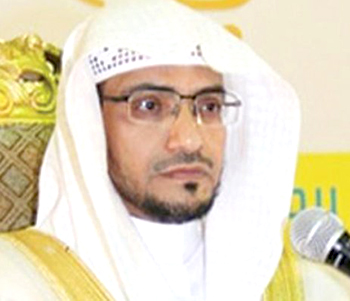
Music not haram, singing is: Quba Mosque imam

May 29, 2016

Jeddah, May 29: The imam and preacher of the Quba Mosque in Madinah has said that music is not haram or forbidden.

Sheikh Saleh Al-Maghamsi clarified that he was referring to music, not singing, which he said is haram.

saleh“The nation is in bad need of novelty and modernization, and I strongly believe in this, whether people accept my views or not,” he said during a talk show on MBC channel hosted by Yasser Amr and reported by local media.

Al-Maghamsi addressed a number of issues, including music, during the show. “I am not obliged to respond to any criticism on this issue. As for music, three Muslim scholars have said different things, although most of them agreed it is singing, not music, that is mentioned in the Holy Qur’an. Music is not talk, it is instruments, which is not specifically mentioned in the Holy Qur’an.”

He said that singing nowadays mostly involve men and women together, and this is forbidden. “I was asked about music in mobile phones and the main issue here is criminalizing people and making the issue of music as if it is our main or primary cause.”

On the issue of building mosques, Al-Maghamsi said: “There are other areas also that we need to focus on. Mosques are everywhere, thanks to Allah the Almighty ... every rich man builds a villa and a mosque in front of it.”

He added: “Building a mosque is good and recommended but building health facilities to treat poor patients and places for the displaced and other welfare services for the community are also important.”

Comments

bilal
 - 
Sunday, 29 May 2016

5000 ruling on music singing and dancing
since the period of sahaba [ r a a ] only 0.01% had this opinion

bilal
 - 
Sunday, 29 May 2016

There are more than 5000 ruling on music singing and dancing from the period of sahaba [ r a a]
where one can find such ruling .01 % only

ASI
 - 
Sunday, 29 May 2016

lol..... These wahabys adjust their religion according to their will....Shame on you mister wahaby....

Arif
 - 
Sunday, 29 May 2016

I give benefit of doubt to him. I assume that when he meant music, it is traditional daff, sound of water, birds and not the modern music instruments like harmonium, guitar etc. And when he said singing is haram, I assume that he is referring to modern singing involving words/verses that are vulgar. May Allah (swt) help us to be steadfast in the deen of Allah(swt).

Indian,
 - 
Sunday, 29 May 2016

This is his personnel opinion!
He will answer in the day of judgement!!
He is opening \DOOR TO SHAITAN\"
Islam is based on Qur'an and Sunnah!!!"

Add new comment

  • Coastaldigest.com reserves the right to delete or block any comments.
  • Coastaldigset.com is not responsible for its readers’ comments.
  • Comments that are abusive, incendiary or irrelevant are strictly prohibited.
  • Please use a genuine email ID and provide your name to avoid reject.
News Network
May 11,2020

May 11: Saudi Arabia will triple its value-added tax rate and suspend a cost of living allowance for state workers, it said on Monday, seeking to shield finances hit by low oil prices and a slump in demand for its lifeline export worsened by the new coronavirus.

Historic oil output cuts agreed by Riyadh and other major producers have given only limited support to prices after they sank on oversupply caused by a war for petroleum market share between the kingdom and its fellow oil titan Russia.

Saudi Arabia, the world's largest oil exporter, is also being hit hard by measures to fight the new coronavirus, which are likely to curb the pace and scale of economic reforms launched by Crown Prince Mohammed bin Salman.

"The cost of living allowance will be suspended as of June 1, and the value added tax will be increased to 15% from 5% as of July 1," Finance Minister Mohammed al-Jadaan said in a statement reported by the state news agency. "These measures are painful but necessary to maintain financial and economic stability over the medium to long term...and to overcome the unprecedented coronavirus crisis with the least damage possible."

The austerity measures come after the kingdom posted a $9 billion budget deficit in the first quarter.

The minister said non-oil revenues were affected by the suspension and decline in economic activity, while spending had risen due to unplanned strains on the healthcare sector and the initiatives taken to support the economy.

"All these challenges have cut state revenues, pressured public finances to a level that is hard to deal with going forward without affecting the overall economy in the medium to long term, which requires more spending cuts and measures to support non-oil revenues stability," he added.

The government has cancelled and put on hold some operating and capital expenditures for some government agencies, and cut allocations for some reform initiatives and projects worth a total 100 billion riyals ($26.6 billion), the statement said.

Central bank foreign reserves fell in March at their fastest rate in at least 20 years and to their lowest since 2011, while oil revenues in the first three months of the year fell 24% from a year earlier to $34 billion, pulling total revenues down 22%.

"The reforms are positive from a fiscal side as greater adjustment is essential. However, the tripling of VAT is unlikely to help that much in 2020 revenue wise with the expected fall in consumption," said Monica Malik, chief economist at Abu Dhabi Commercial Bank.

She said she kept unchanged her deficit forecast of 16.3% of GDP for this year, which already factors in a greater than previously announced spending cut.

About 1.5 million Saudis are employed in the government sector, according to official figures released in December.

In 2018, Saudi Arabia's King Salman ordered a monthly payment of 1,000 riyals ($267) to every state employee to compensate them for the rising living costs after the government hiked domestic gas prices and introduced value-added tax.

DIFFICULT TIMES

A committee has been formed to study all financial benefits paid to public sector employees and contractors, and will submit recommendations within 30 days, the statement said.

In late 2015, when oil prices fell from record highs, the kingdom slashed lavish bonuses, overtime payments and other benefits once considered routine perks in the public sector.

In a country without elections and with political legitimacy resting partly on distribution of oil revenue, the ability of citizens to adapt to such reforms is crucial for stability.

"Tripling the VAT will test the limits of the balance between revenues and consumption as the economy dives into a deep recession. The move will impact consumption and could also lower the expected revenues," said John Sfakianakis, a Gulf expert at the University of Cambridge.

"These are pro-austerity and pro-revenue moves rather than pro-growth ones," he said.

Hasnain Malik, head of equity strategy at Tellimer, said the VAT rise could bring about $24-$26.5 billion in additional non-oil fiscal revenue. The rise would hit consumer spending further but was a needed step towards fiscal sustainability, he said.


Comments

Add new comment

  • Coastaldigest.com reserves the right to delete or block any comments.
  • Coastaldigset.com is not responsible for its readers’ comments.
  • Comments that are abusive, incendiary or irrelevant are strictly prohibited.
  • Please use a genuine email ID and provide your name to avoid reject.
News Network
May 10,2020

Dubai, May 10: Kuwait will enact a "total curfew" from 4pm (1300 GMT) on Sunday through to May 30 to help to curb the spread of the new coronavirus, the Information Ministry said on Twitter on Friday.

Further details of the curfew will be announced soon, it said.

Kuwait on April 20 expanded a nationwide curfew to 16 hours a day, from 4pm to 8am, and extended a suspension of work in the public sector, including government ministries, until May 31.

On Friday the Gulf state announced 641 new coronavirus cases and three deaths, bringing its total number of confirmed cases to 7,208, with 47 deaths.

Comments

Add new comment

  • Coastaldigest.com reserves the right to delete or block any comments.
  • Coastaldigset.com is not responsible for its readers’ comments.
  • Comments that are abusive, incendiary or irrelevant are strictly prohibited.
  • Please use a genuine email ID and provide your name to avoid reject.
News Network
May 7,2020

Dubai, May 7: Saudi Arabia will emerge as the victor of the oil price war that sent global crude markets into a spin last month, according to two experts in the energy industry.

Jason Bordoff, professor and founding director of the Center for Global Energy policy at New York’s Columbia University, said: “While 2020 will be remembered as a year of carnage for oil nations, at least one will most likely emerge from the pandemic stronger, both economically and geopolitically: Saudi Arabia.”

Writing in the American publication Foreign Policy, Bordoff said that the Kingdom’s finances can weather the storm from lower oil prices as a result of the drastically reduced demand for oil in economies under pandemic lockdowns, and that it will end up with higher oil revenues and a bigger share of the global market once it stabilizes.

Bordoff’s view was reinforced by Sir Mark Moody-Stuart, former chairman of Royal Dutch Shell and one of the longest-standing directors of Saudi Aramco. In an interview with the Gulf Intelligence energy consultancy, he said that low-cost oil producers such as Saudi Arabia would emerge from the pandemic with increased market share.

“Oil is the only commodity where the lowest-cost producers have contained their production and allowed high-cost producers to benefit. When demand recovers this year or next, we will emerge from it with the lowest-cost producers having increased their market share,” Moody-Stuart said.

Bordfoff said that it would take years for the high-cost American shale industry to recover to pre-pandemic levels of output. “Depending on how long oil demand remains depressed, US oil production is projected to decline from its pre-coronavirus peak of around 13 million barrels per day.

“Shale's heady growth in recent years (with production growing by about 1 million to 1.5 million barrels per day each year) also reflected irrational exuberance in financial markets. Many US companies struggling with uneconomical production only managed to stay afloat with infusions of cheap debt. One quarter of US shale oil production may have been uneconomic even before prices crashed,” he said.

Moody-Stuart said that recent statements about cuts to the Saudi Arabian budget as a result of falling oil revenues were “an important step to wean the population of the Kingdom off an entitlement feeling. It means that everybody is joining in it.”

The former Shell boss said that other big oil companies would follow Shell’s recent decision to cut its dividend for the first time in more than 70 years. But he added that Aramco would stick by its commitment to pay $75 billion of dividends this year.

“When a company looks at its forecasts it looks ahead for one year, so for this year it (the dividend) is fine,” he said.

Bordoff added that Saudi Arabia’s action in cutting oil production in response to the pandemic would improve its global position.

“Saudi Arabia has improved its standing in Washington. Following intense pressure from the White House and powerful senators, the Kingdom’s willingness to oblige by cutting production will reverse some of the damage done when it was blamed for the oil crash after it surged production in March,” he said.

“Only a few weeks ago, the outlook for Saudi Arabia seemed bleak. But looking out a few years, it’s difficult to see the Kingdom in anything other than a strengthened position,” Bordoff said.

Comments

Add new comment

  • Coastaldigest.com reserves the right to delete or block any comments.
  • Coastaldigset.com is not responsible for its readers’ comments.
  • Comments that are abusive, incendiary or irrelevant are strictly prohibited.
  • Please use a genuine email ID and provide your name to avoid reject.