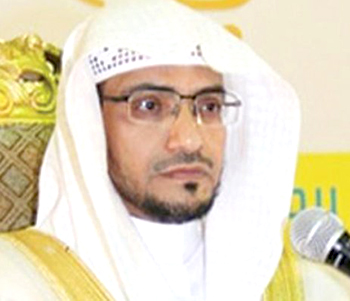
Music not haram, singing is: Quba Mosque imam

May 29, 2016

Jeddah, May 29: The imam and preacher of the Quba Mosque in Madinah has said that music is not haram or forbidden.

Sheikh Saleh Al-Maghamsi clarified that he was referring to music, not singing, which he said is haram.

saleh“The nation is in bad need of novelty and modernization, and I strongly believe in this, whether people accept my views or not,” he said during a talk show on MBC channel hosted by Yasser Amr and reported by local media.

Al-Maghamsi addressed a number of issues, including music, during the show. “I am not obliged to respond to any criticism on this issue. As for music, three Muslim scholars have said different things, although most of them agreed it is singing, not music, that is mentioned in the Holy Qur’an. Music is not talk, it is instruments, which is not specifically mentioned in the Holy Qur’an.”

He said that singing nowadays mostly involve men and women together, and this is forbidden. “I was asked about music in mobile phones and the main issue here is criminalizing people and making the issue of music as if it is our main or primary cause.”

On the issue of building mosques, Al-Maghamsi said: “There are other areas also that we need to focus on. Mosques are everywhere, thanks to Allah the Almighty ... every rich man builds a villa and a mosque in front of it.”

He added: “Building a mosque is good and recommended but building health facilities to treat poor patients and places for the displaced and other welfare services for the community are also important.”

Comments

bilal
 - 
Sunday, 29 May 2016

5000 ruling on music singing and dancing
since the period of sahaba [ r a a ] only 0.01% had this opinion

bilal
 - 
Sunday, 29 May 2016

There are more than 5000 ruling on music singing and dancing from the period of sahaba [ r a a]
where one can find such ruling .01 % only

ASI
 - 
Sunday, 29 May 2016

lol..... These wahabys adjust their religion according to their will....Shame on you mister wahaby....

Arif
 - 
Sunday, 29 May 2016

I give benefit of doubt to him. I assume that when he meant music, it is traditional daff, sound of water, birds and not the modern music instruments like harmonium, guitar etc. And when he said singing is haram, I assume that he is referring to modern singing involving words/verses that are vulgar. May Allah (swt) help us to be steadfast in the deen of Allah(swt).

Indian,
 - 
Sunday, 29 May 2016

This is his personnel opinion!
He will answer in the day of judgement!!
He is opening \DOOR TO SHAITAN\"
Islam is based on Qur'an and Sunnah!!!"

Add new comment

  • Coastaldigest.com reserves the right to delete or block any comments.
  • Coastaldigset.com is not responsible for its readers’ comments.
  • Comments that are abusive, incendiary or irrelevant are strictly prohibited.
  • Please use a genuine email ID and provide your name to avoid reject.
News Network
July 13,2020

Dubai, July 13: An explosion caused by a gas leak damaged a restaurant, and nearby shops at a residential building in Dubai on Monday morning. 

According to Brigadier Abdul Haleem Al Hashemi, Deputy Director of Al Qusais Police Station, the incident took place at 4am when the restaurant was closed.

No injuries were reported, but two nearby shops, a pharmacy, a salon and three cars were severely damaged.

"Dubai Police patrols were immediately dispatched to the scene and worked with Dubai Civil Defense to evacuate residents of the two-storey building as a precautionary measure," Brig Al Hashimi explained.

Preliminary investigations showed that the blast was caused by a gas leak, the officer said. The Crime Scene Department of the General Department of Forensics and Criminology in Dubai is studying the evidence collected from the site and will be preparing the final report on the accident.

Brig Al Hashimi urged restaurant owners to ensure that all safety and security systems at their outlets are in good condition. Regular maintenance checks should also be conducted on all pipes and gas regulators, especially during the summer season.

Comments

Add new comment

  • Coastaldigest.com reserves the right to delete or block any comments.
  • Coastaldigset.com is not responsible for its readers’ comments.
  • Comments that are abusive, incendiary or irrelevant are strictly prohibited.
  • Please use a genuine email ID and provide your name to avoid reject.
News Network
June 23,2020

Riyadh, Jun 23: Authorities in Saudi Arabia have decided to allow a limited number of citizens and residents who are already in the Kingdom to do this year’s Haj.

In a statement on Monday, the Ministry of Haj and Umrah said that in light of the continuation of the coronavirus pandemic and the risks of infections spreading in crowded spaces and large gatherings, it has been decided that Haj for this year (1441 H/ 2020 AD) will be held whereby a very limited number of pilgrims from various nationalities who already reside in Saudi Arabia, would be able to perform it.

“The decision was taken to ensure Haj is performed in a safe manner from a public health perspective while observing all preventative measures and the necessary social distancing protocols to protect human beings from the risks associated with this pandemic and in accordance with the teachings of Islam in preserving the lives of human beings, the statement added.

“The government of the Custodian of the Two Holy Mosques is honored to serve millions of Haj and Umrah pilgrims annually and it confirms that this decision stems from the top priority it accords maintaining the safety of pilgrims on its land until they depart to their home countries.”

“We ask Allah the Almighty to protect all countries from this pandemic and keep all humans protected and safe, the statement said.

Saudi Arabia’s top priority is to always enable Muslim pilgrims to perform Haj and Umrah rites safely and securely and the Kingdom has been keen since the beginning of the pandemic to take all necessary precautionary measures to protect pilgrims, including by suspending the entry of Umrah pilgrims while ensuring the safety of the pilgrims already present at the holy sites, the statement further added.

Commenting on the Haj decision, the Saudi Human Rights Commission said that Saudi Arabia believes in the universal right to health. Limiting Haj not only protects the Kingdom but also many pilgrims and the communities they call home around the world.

Comments

Add new comment

  • Coastaldigest.com reserves the right to delete or block any comments.
  • Coastaldigset.com is not responsible for its readers’ comments.
  • Comments that are abusive, incendiary or irrelevant are strictly prohibited.
  • Please use a genuine email ID and provide your name to avoid reject.
News Network
May 11,2020

May 11: Saudi Arabia will triple its value-added tax rate and suspend a cost of living allowance for state workers, it said on Monday, seeking to shield finances hit by low oil prices and a slump in demand for its lifeline export worsened by the new coronavirus.

Historic oil output cuts agreed by Riyadh and other major producers have given only limited support to prices after they sank on oversupply caused by a war for petroleum market share between the kingdom and its fellow oil titan Russia.

Saudi Arabia, the world's largest oil exporter, is also being hit hard by measures to fight the new coronavirus, which are likely to curb the pace and scale of economic reforms launched by Crown Prince Mohammed bin Salman.

"The cost of living allowance will be suspended as of June 1, and the value added tax will be increased to 15% from 5% as of July 1," Finance Minister Mohammed al-Jadaan said in a statement reported by the state news agency. "These measures are painful but necessary to maintain financial and economic stability over the medium to long term...and to overcome the unprecedented coronavirus crisis with the least damage possible."

The austerity measures come after the kingdom posted a $9 billion budget deficit in the first quarter.

The minister said non-oil revenues were affected by the suspension and decline in economic activity, while spending had risen due to unplanned strains on the healthcare sector and the initiatives taken to support the economy.

"All these challenges have cut state revenues, pressured public finances to a level that is hard to deal with going forward without affecting the overall economy in the medium to long term, which requires more spending cuts and measures to support non-oil revenues stability," he added.

The government has cancelled and put on hold some operating and capital expenditures for some government agencies, and cut allocations for some reform initiatives and projects worth a total 100 billion riyals ($26.6 billion), the statement said.

Central bank foreign reserves fell in March at their fastest rate in at least 20 years and to their lowest since 2011, while oil revenues in the first three months of the year fell 24% from a year earlier to $34 billion, pulling total revenues down 22%.

"The reforms are positive from a fiscal side as greater adjustment is essential. However, the tripling of VAT is unlikely to help that much in 2020 revenue wise with the expected fall in consumption," said Monica Malik, chief economist at Abu Dhabi Commercial Bank.

She said she kept unchanged her deficit forecast of 16.3% of GDP for this year, which already factors in a greater than previously announced spending cut.

About 1.5 million Saudis are employed in the government sector, according to official figures released in December.

In 2018, Saudi Arabia's King Salman ordered a monthly payment of 1,000 riyals ($267) to every state employee to compensate them for the rising living costs after the government hiked domestic gas prices and introduced value-added tax.

DIFFICULT TIMES

A committee has been formed to study all financial benefits paid to public sector employees and contractors, and will submit recommendations within 30 days, the statement said.

In late 2015, when oil prices fell from record highs, the kingdom slashed lavish bonuses, overtime payments and other benefits once considered routine perks in the public sector.

In a country without elections and with political legitimacy resting partly on distribution of oil revenue, the ability of citizens to adapt to such reforms is crucial for stability.

"Tripling the VAT will test the limits of the balance between revenues and consumption as the economy dives into a deep recession. The move will impact consumption and could also lower the expected revenues," said John Sfakianakis, a Gulf expert at the University of Cambridge.

"These are pro-austerity and pro-revenue moves rather than pro-growth ones," he said.

Hasnain Malik, head of equity strategy at Tellimer, said the VAT rise could bring about $24-$26.5 billion in additional non-oil fiscal revenue. The rise would hit consumer spending further but was a needed step towards fiscal sustainability, he said.


Comments

Add new comment

  • Coastaldigest.com reserves the right to delete or block any comments.
  • Coastaldigset.com is not responsible for its readers’ comments.
  • Comments that are abusive, incendiary or irrelevant are strictly prohibited.
  • Please use a genuine email ID and provide your name to avoid reject.