


Muslim ban proposal temporary, just a suggestion: Trump

May 12, 2016

Washington, May 12: Donald Trump, who courted global controversy with remarks on "temporarily" banning Muslims from entering the US, today appeared to be slightly softening his hardline stance saying the proposal was "just a suggestion" until the issue is worked out.
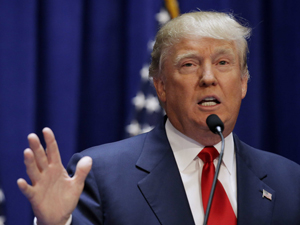
donald-trump"We have a serious problem, it's a temporary ban, it hasn't been called for yet, nobody's done it, this is just a suggestion until we find out what's going on," Republican presumptive presidential nominee Trump told Fox Radio.

"We have radical Islamic terrorism all over the world, you can go to Paris, you can go to San Bernardino, all over the world, if they want to deny it, they can deny it, I don't choose to deny it," he said responding to a question on newly- elected London Mayor Sadiq Khan.

Trump said he would grant exemption to the Pakistani- origin mayor to come to the US under his presidency though he was critical of Khan.

"Well I assume he denies there is Islamic terrorism. There is Islamic radical terrorism all over the world right now. It's a disaster what's going on. I assume he is denying that. I assume he is like our President that's denying its taking place," the real estate tycoon said to a question on an interview by Khan to CNN.

"My message to Donald Trump and his team is that your views of Islam are ignorant. It is possible to be a Muslim and live in the West. It is possible to be a Muslim and love America," Khan had told CNN.

In December, Trump had called for "a total and complete shutdown of Muslims entering the United States until our country's representatives can figure out what is going on," which had triggered global outrage.

Trump refrained from giving any hint on who his vice presidential nominee would be.
He said he would reveal the name at the Cleveland convention. But he praised two Senators Bob Corker and Jeff Sessions.

"Well Corker is a great guy. I want to keep it as a total surprise. I want to surprise even you. You have such access to me and everything I do, every once in a while I like to surprise even you. But I can tell you, Sessions and Corker are fantastic people, they love the country, they love their party and they love the country," he said.

While Sessions is helping him on immigration policies, Corker is Chairman of the Senate Foreign Relations Committee on foreign policy. It is Corker who has put a hold on the use of US taxpayers' money for sale of eight F-16s to Pakistan.

Comments

K.C.Mohammed Ali
 - 
Thursday, 12 May 2016

Mr. Trump

Terrorism motivated by America and Israel . All world knows who is the biggest terrorist in the world.....................

PK
 - 
Thursday, 12 May 2016

Bewakuf TRUMP said above \you have islamic terrorist all over the PLACE \"...

It is people like YOU Trump, who accept whatever said in the MEDIA and ONLY FOOLS like YOU are fooled by the MEDIA to think innocent as terrorist, WHEN in REALITY ... in US alone out of 1000 terrorist act only 20 are islamic and that too ... NOT PROVED - its just PRIME SUSPECT ...
LIsten CAREFULLY when you listen to the Controlled NEWS CHANNEL ... They fool YOU and fooled many like U ... Also notice PRIME SUSPECT and not TERRORIST."

Indian
 - 
Thursday, 12 May 2016

Let him try his trump card somewhere else.. Quack quack!!!

Add new comment

  • Coastaldigest.com reserves the right to delete or block any comments.
  • Coastaldigset.com is not responsible for its readers’ comments.
  • Comments that are abusive, incendiary or irrelevant are strictly prohibited.
  • Please use a genuine email ID and provide your name to avoid reject.
News Network
March 28,2020

Bengaluru, Mar 28: Sun Tsu, in 'The Art of War' speaks of a skilful general who can subdue his enemy without any fighting. This constitutes the ultimate triumph which is referred to as stratagem. Today, we would need one such when we are faced with the '21-day corona challenge' for India.
Nearly four weeks back, Dr Jyothsna Rao, Dr Gururaj Rao and I sat across the OPD in the afternoon at HCG Bengaluru discussing our ongoing cancer immunology research. While on this topic, we drifted into the discussion on the coronavirus. During this engaging discussion, we wondered the similarity of the enigma between the virus and cancer. I paused to ask Dr Jyothsna and Dr Guru - how we wish we could do something against this virus.
Dr Jyothsna is a PhD from NCBS and had worked under Dr Ralph Steinman, physician and researcher from Rockefeller University, who won the Nobel Prize for his discovery of the dendritic cell and its role in adaptive immunity in 2011. Dr Gururaj is a molecular and cell biologist who did his PhD at the Chapel Hill, University of North Carolina and is the Director of iCrest.
Jyothsna while hearing our perplexing conversation on the covid intervened, "Yes, surely. I think we should take a break from cancer and focus on the innate and adaptive immunity role in COVID-19."
Thus began this sincere attempt to relook the human immune system from the eyes of the COVID-19.
We have 10 types of immune cells at the least which are widely dispersed in millions across the body. When our body is invaded by a foreign organism (bacteria, fungi or virus), these cells work with each other to destroy the invader.
Now, the question is - how do the immune cells talk to each other? They use small-molecule substances called cytokines (cyto means cells; kine means movement). There are many cytokines that are involved in work on the immune system. The most relevant for viruses are interferons.
Interferons (IFN) as the name reflects have an ability to interfere with the viral activity and stop their multiplication. These specialised signal proteins are released by our cells in response to a viral attack to forewarn other cells. They help build the antiviral proteins within the cells to kill the virus as it tries to invade the new cells.
Historically, interferons are a group of cytokines known to be potent antiviral agents against viruses and a hallmark cytokine induced by the host upon viral infections. Interferons possess unique immunoregulatory activities and are signature cytokines released by (TH1) T immune cells, which are crucial in viral infections.
As the outbreak of COVID-19 grapples us, an urgent need for finding strategies to combat the virus is growing. Coronaviruses (CoVs) are a group of RNA viruses. In patients infected with coronavirus, it was indicated that the activation of the IFN does not occur until 48 hours post-infection. Thus the delayed IFN-related antiviral response by the healthy cells leads to coronavirus evade the immune response.
Numerous studies have presented the success in defeating CoVs by the direct administration of IFNs. In a combination as a concoction, it was shown to synergistically inhibit the virus replication in vitro.
Moreover, it is understood that the earlier induction of IFNs in children although they have a less developed immune system could be the reason behind the children being least affected.
The key to success in reducing the disease fatality might be the stimulation of the immune responses to trigger IFN production at the very early stages of the disease, which might be done through the administration of IFN. Despite the evidence for the efficacy of IFNs in treating CoV-induced infections, the proper dosing and ideal timing for such interventions needs to be verified in clinical trials.
For the later stages of the diseases in advance stages where patients are on ventilator and have developed respiratory distress, we propose to utilise the mesenchymal cells derived from donor bone marrow that have been known to treat acute respiratory syndrome. Mesenchymal cells are known to possess anti-inflammatory activity and thus used often in autoimmune diseases.
With this scientific background, we have activated T cells from healthy donors, in a cGMP facility at iCrest - HCG hospital with an enriched cocktail of cytokines rich in Interferons. Injections of this cocktail we believe will result in a surge of cytokines in the body of the infected person and will boost his ability to fight the virus in the early phases. We are in the initial phases of this study and hope to be ready in the coming weeks with meaningful data on its potential utility.
Currently, it awaits government approvals (Union and state) and we have applied to central drugs authority for their initial evaluation and further directions.
As my Guru often expounded the philosophy of 'Seva' - the goal of education is knowledge, the end goal of knowledge is service. In this attempt to serve our fellow humans at this brink of unprecedented crisis, medical fraternity stands with you and promises to do our best for your safety.
We assure to exhaust every bit of our spirit in this fight against coronavirus. We have lost the sight of shores and travelled thus far, but that is the mandatory first step to cross the ocean. Are we going to succeed in this battle, is something only time will answer. 

Comments

Add new comment

  • Coastaldigest.com reserves the right to delete or block any comments.
  • Coastaldigset.com is not responsible for its readers’ comments.
  • Comments that are abusive, incendiary or irrelevant are strictly prohibited.
  • Please use a genuine email ID and provide your name to avoid reject.
News Network
April 24,2020

Riyadh, Apr 24: As many as eleven Indian nationals have died due to COVID-19 in Saudi Arabia.

"As per information available with the Embassy as of April 22, eleven Indian nationals (four in Madinah, three in Makkah, two in Jeddah, one in Riyadh and one in Dammam) have passed away due to COVID-19 in Saudi Arabia," the Embassy of India in Saudi Arabia said in a press release on Wednesday.

It urged the Indian community to remain calm and avoid spreading of rumours amid the COVID-19 crisis.

"The Embassy also reiterates the need for the community to remain calm and avoid spreading of rumours that may create panic. It is important that social media is not used to disseminate false messages and spread hatred along communal lines that can vitiate the atmosphere," the Embassy said.

"As stated by Prime Minister Narendra Modi, COVID-19 does not see race, religion, colour, caste, creed, language or borders before striking, and our response and conduct should attach primacy to unity and brotherhood," it said.

Moreover, several measures on the supply of food, medicines and other emergency assistance to Indians in need are being implemented across the Kingdom.

Earlier, Indian Ambassador to Saudi Arabia, Ausaf Sayeed on April 22 had interacted with Indian community volunteers from the smaller towns all across the Kingdom to discuss the impact of the COVID-19 situation, and evaluate the implementation of various measures to ensure the welfare of Indian nationals.

Comments

Add new comment

  • Coastaldigest.com reserves the right to delete or block any comments.
  • Coastaldigset.com is not responsible for its readers’ comments.
  • Comments that are abusive, incendiary or irrelevant are strictly prohibited.
  • Please use a genuine email ID and provide your name to avoid reject.
News Network
July 7,2020

Bengaluru, Jul 7: There seems no impact of Covid-19 on kharif crop sowing in Karnataka with the current year actually being ahead of previous years, according to an official here on Monday.

"In agriculture, as far as sowing is concerned, there is no impact of COVID-19," Agriculture Commissioner Brijesh Kumar Dikshit told IANS. One of the reasons, according to Dikshit, is that people in rural areas are aware, but not scared of the pandemic.

"In rural India, coronavirus is there. People are aware, not scared. They are taking precautions, but don't have any phobia," he said.

Another reason was that by June the number of infections in Karnataka was not as high as other states, when a lot of sowing was done, he said.

By the end of June, Karnataka saw 15,242 Covid-19 cases. Of that, 7,074 were active.

The sowing is ahead of previous year as it's mostly dependent on weather. "It's ahead of previous years. Agriculture is directed by weather and rains had been slightly earlier this year," he said.

According to Karnataka State Natural Disaster Monitoring Centre, at 185 mm the state received 14 mm less rain in June against the normal 199 mm. "It's like a normal year, or slightly a good year," he said.

Some crops will be sown in the last fortnight of July and few more will extend up to August 15. "The last two weeks will be critical and on July 31 we should be able to tell whether we are short or ahead," he said.

According to preliminary indications, the Commissioner said the area under agriculture is increasing this year, which could also be because that labourers might have come back.

Comments

Add new comment

  • Coastaldigest.com reserves the right to delete or block any comments.
  • Coastaldigset.com is not responsible for its readers’ comments.
  • Comments that are abusive, incendiary or irrelevant are strictly prohibited.
  • Please use a genuine email ID and provide your name to avoid reject.