Muslim literary awards conferred; Teesta slams saffron forces

[email protected] (CD Network)
January 30, 2016

Mangaluru, Jan 30: Renowned human rights activist Teesta Setalvad lamented that those who do not believe in constitutional values, liberty and democracy are currently ruling India.

townhall 12

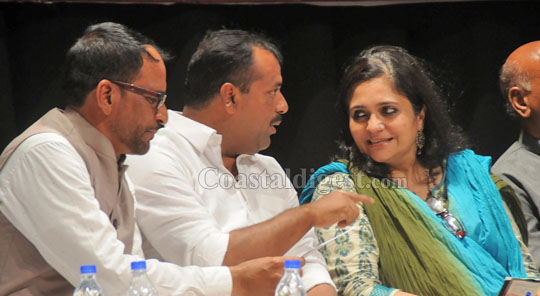
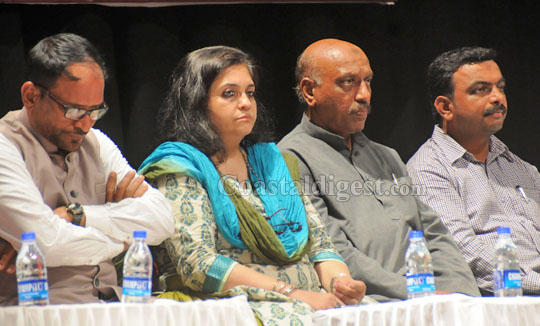
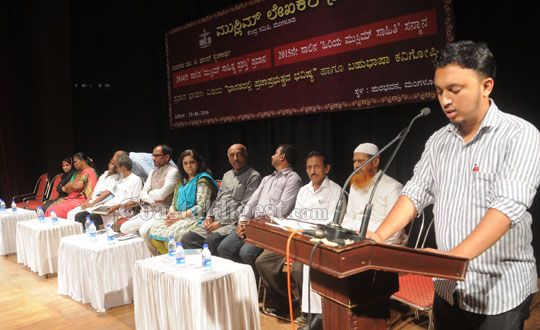
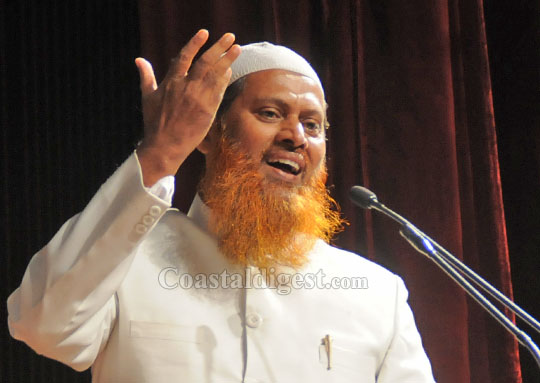
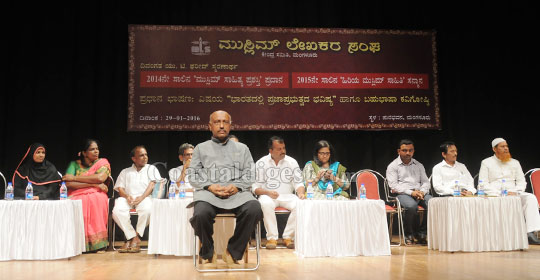
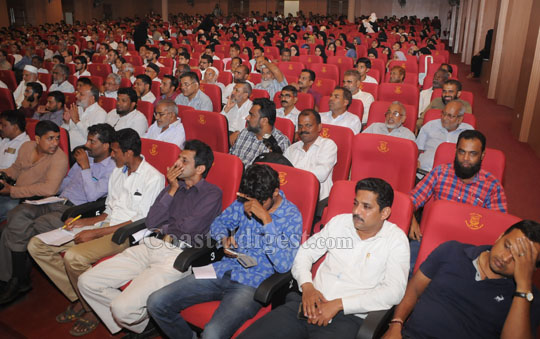
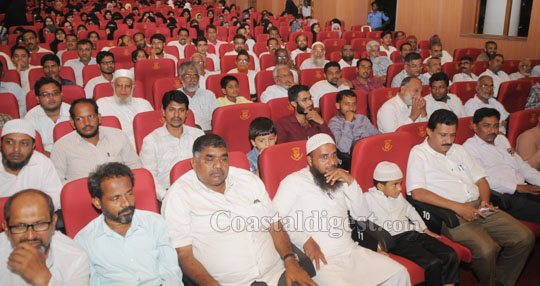
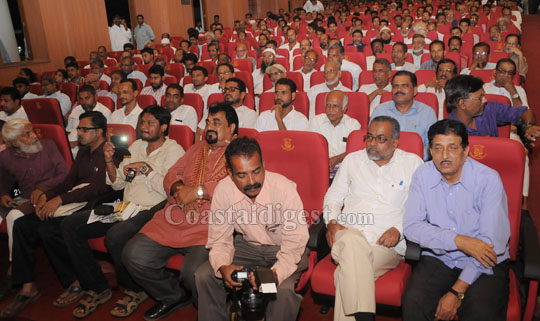
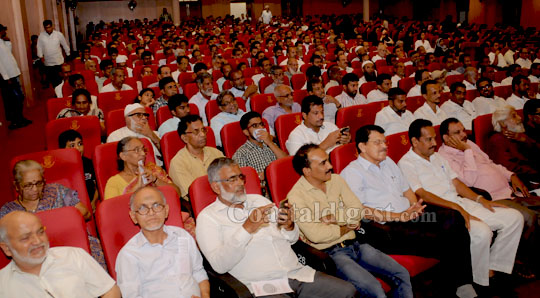
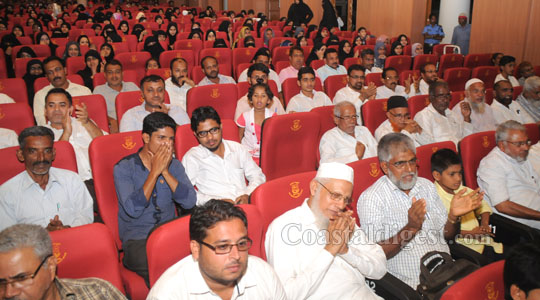
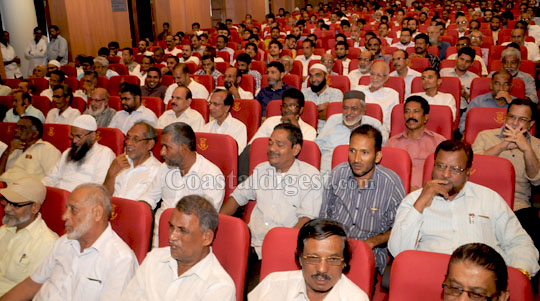
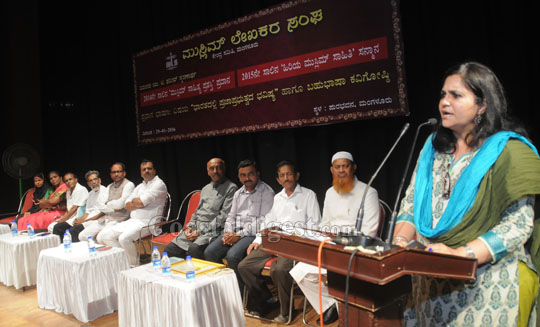
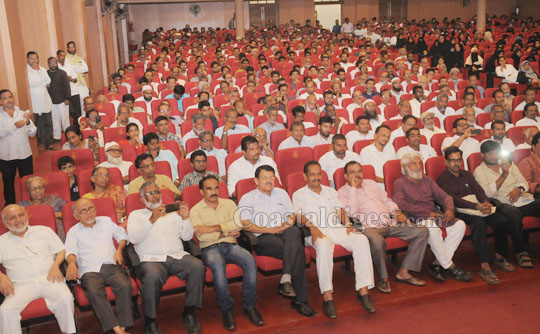
Delivering a talk on ‘Future of Democracy in India’ at a programme organized by the Muslim Lekhakara Sangha (MLS), a Kannada literary association for Muslims, to honour its annual literary award winners at Town Hall in the city on Friday evening, Ms Setalvad called upon the people for a collective fight against fascist and communal forces.

She asserted that the ones who are ruling India and dreaming of a Hindu nation were not part of India’s freedom movement against the British colonialists.

Expressing frustration over saffronization of education, she said that in states like Gujarat and Haryana primary school students are being taught that modern science and practice of plastic surgery was prevalent among ancient Hindus.

Reiterating that fascists in India have been misusing religion to spread violence, she said consolidation of political power and implementation of the agenda of ‘divide and rule’ are among the multiple motives behind the eruption of communal violence in the country. Through this, religion is being misused by political powers and the masses are being mislead, she claimed.

“We should not be a religion-based nation. Everybody has an equal share of citizenship. But, there are forces which do not believe in the Constitution,” she lamented.

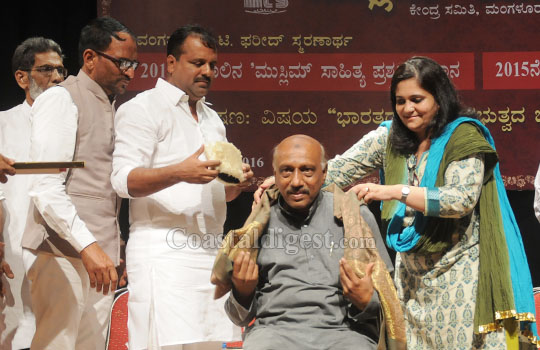
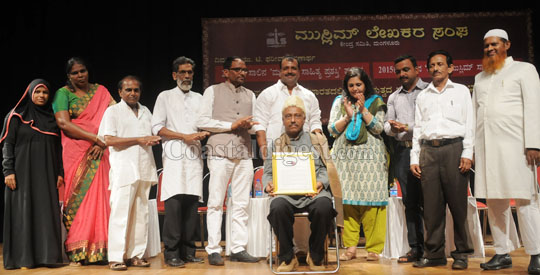
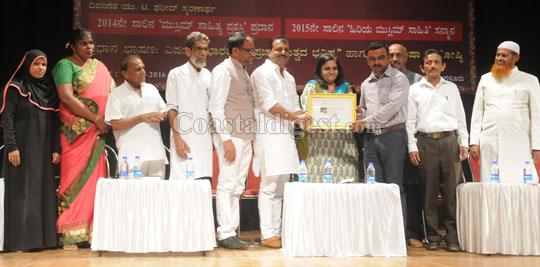
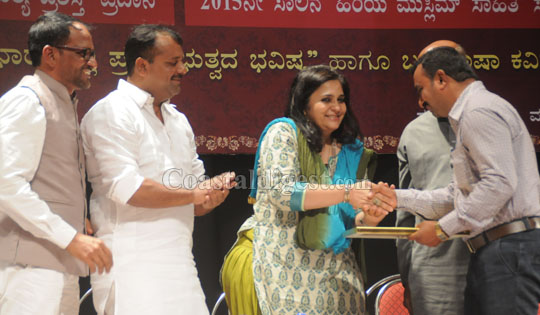
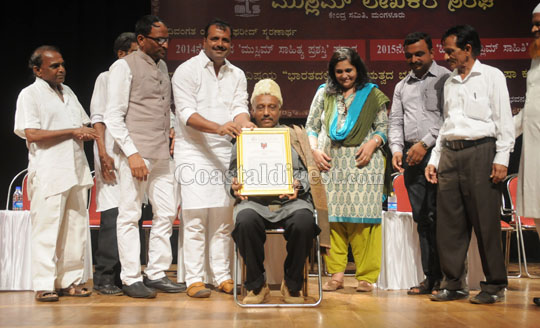
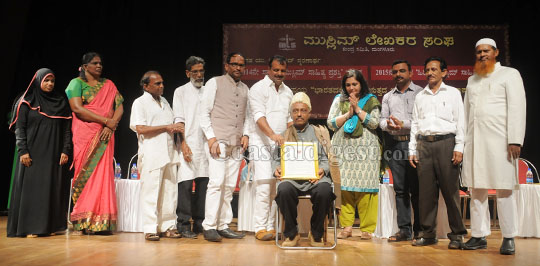
On the occasion, Muslim Sahitya Prashasti-2014 instituted by MLS in memory of Late UT Fareed was conferred on Sanavullah Navilehal, Davanagere for his work ‘Onti Marada Kelage’ Kannada writer Fakeer Mohammed Katpady was honoured as ‘senior Muslim litterateur-2015’. Health and Family Welfare Minister UT Khader conferred the awards.

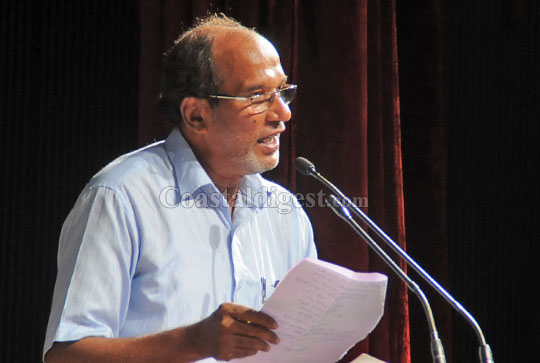
A multi-lingual poet’s meet was also held on the occasion. Mohammed Baddur, Peruru Jaru, Jyoti Chelyaru, Abdussalam Madani, Abdurrahman Kuthethur, Ayisha UK, Shamshad Mukri presented their poems.

Umar UH, president of MLS, presided over the programme. Shaukath Ali, general secretary, welcomed. Sadeed recited Quranic verses in the beginning. BA Mohammed Ali compered the programme.

townhall 5


townhall 15

townhall 1

townhall 2

townhall 3

townhall 6

townhall 8

townhall 10

townhall 11

townhall 13

townhall 14

townhall 17

townhall 18

townhall 19

townhall 20

townhall 21

townhall 22

townhall 24

townhall 25

Comments

Zahoor Ahmed
 - 
Saturday, 30 Jan 2016

Thanks to MLS for organizing such kind of event and inviting Well known Human rights activist to your event.

Add new comment

  • Coastaldigest.com reserves the right to delete or block any comments.
  • Coastaldigset.com is not responsible for its readers’ comments.
  • Comments that are abusive, incendiary or irrelevant are strictly prohibited.
  • Please use a genuine email ID and provide your name to avoid reject.
Agencies
February 13,2020

Dubai, Feb 13: An Indian expatriate found to be infected with coronavirus in the UAE on February 10 is in a stable condition, the Indian Embassy told Gulf News.

“The Indian is a 36-year-old male,” an embassy official said, adding “he a resident of the UAE”.

However, the official did not say if the man had any travel history to China and also refused to divulge which state he hailed from.

On February 10, the Ministry of Health said the Indian national was found infected with coronavirus in the latest such case in the UAE. “The Indian national had interacted with a recently diagnosed person,” the ministry had said in a statement.

"All reported cases are in stable condition, except for one case, who is being put under close observation by a team of senior consultants at the Intensive Care Unit," added the statement.

The man is among the eight cases of coronavirus detected in the UAE so far. Others include six Chinese nationals and one from Philippines.

Earlier this week, the UAE announced that one of the infected patients, a 73-year-old Chinese national, Liu Yujia, had recovered.

Comments

Add new comment

  • Coastaldigest.com reserves the right to delete or block any comments.
  • Coastaldigset.com is not responsible for its readers’ comments.
  • Comments that are abusive, incendiary or irrelevant are strictly prohibited.
  • Please use a genuine email ID and provide your name to avoid reject.
Ram Puniyani
February 10,2020

Noam Chomsky is one of the leading peace workers in the world. In the wake of America’s attack on Vietnam, he brought out his classic formulation, ‘manufacturing consent’. The phrase explains the state manipulating public opinion to have the public approve of it policies—in this case, the attack of the American state on Vietnam, which was then struggling to free itself from French colonial rule.

In India, we are witness to manufactured hate against religious minorities. This hatred serves to enhance polarisation in society, which undermines India’s democracy and Constitution and promotes support for a Hindu nation. Hate is being manufactured through multiple mechanisms. For example, it manifests in violence against religious minorities. Some recent ghastly expressions of this manufactured hate was the massive communal violence witnessed in Mumbai (1992-93), Gujarat (2002), Kandhamal (2008) and Muzaffarnagar (2013). Its other manifestation was in the form of lynching of those accused of having killed a cow or consumed beef. A parallel phenomenon is the brutal flogging, often to death, of Dalits who deal with animal carcasses or leather.

Yet another form of this was seen when Shambhulal Regar, indoctrinated by the propaganda of Hindu nationalists, burned alive Afrazul Khan and shot the video of the heinous act. For his brutality, he was praised by many. Regar was incited into the act by the propaganda around love jihad. Lately, we have the same phenomenon of manufactured hate taking on even more dastardly proportions as youth related to Hindu nationalist organisations have been caught using pistols, while police authorities look on.

Anurag Thakur, a BJP minster in the central government recently incited a crowd in Delhi to complete his chant of what should happen to ‘traitors of the country...” with a “they should be shot”. Just two days later, a youth brought a pistol to the site of a protest at Jamia Millia Islamia university and shouted “take Azaadi!” and fired it. One bullet hit a student of Jamia. This happened on 30 January, the day Nathuram Godse had shot Mahatma Gandhi in 1948. A few days later, another youth fired near the site of protests against the CAA and NRC at Shaheen Bagh. Soon after, he said that in India, “only Hindus will rule”.

What is very obvious is that the shootings by those associated with Hindu nationalist organisations are the culmination of a long campaign of spreading hate against religious minorities in India in general and against Muslims in particular. The present phase is the outcome of a long and sustained hate campaign, the beginning of which lies in nationalism in the name of religion; Muslim nationalism and Hindu nationalism. This sectarian nationalism picked up the communal view of history and the communal historiography which the British introduced in order to pursue their ‘divide and rule’ policy.

In India what became part of “social common sense” was that Muslim kings had destroyed Hindu temples, that Islam was spread by force, and that it is a foreign religion, and so on. Campaigns, such as the one for a temple dedicated to the Hindu god Rama to be built at the site where the Babri masjid once stood, further deepened the idea of a Muslim as a “temple-destroyer”. Aurangzeb, Tipu Sultan and other Muslim kings were tarnished as the ones who spread Islam by force in the subcontinent. The tragic Partition, which was primarily due to British policies, and was well-supported by communal streams also, was entirely attributed to Muslims. The Kashmir conflict, which is the outcome of regional, ethnic and other historical issues, coupled with the American policy of supporting Pakistan’s ambitions of regional hegemony, (which also fostered the birth of Al-Qaeda), was also attributed to the Muslims.

With recurring incidents of communal violence, these falsehoods went on going deeper into the social thinking. Violence itself led to ghettoisation of Muslims and further broke inter-community social bonds. On the one hand, a ghettoised community is cut off from others and on the other hand the victims come to be presented as culprits. The percolation of this hate through word-of-mouth propaganda, media and re-writing of school curricula, had a strong impact on social attitudes towards the minorities.

In the last couple of decades, the process of manufacturing hate has been intensified by the social media platforms which are being cleverly used by the communal forces. Swati Chaturvedi’s book, I Am a Troll: Inside the Secret World of the BJP’s Digital Army, tells us how the BJP used social media to spread hate. Whatapp University became the source of understanding for large sections of society and hate for the ‘Other’, went up by leaps and bounds. To add on to this process, the phenomenon of fake news was shrewdly deployed to intensify divisiveness.

Currently, the Shaheen Bagh movement is a big uniting force for the country; but it is being demonised as a gathering of ‘anti-nationals’. Another BJP leader has said that these protesters will indulge in crimes like rape. This has intensified the prevalent hate.

While there is a general dominance of hate, the likes of Shambhulal Regar and the Jamia shooter do get taken in by the incitement and act out the violence that is constantly hinted at. The deeper issue involved is the prevalence of hate, misconceptions and biases, which have become the part of social thinking.

These misconceptions are undoing the amity between different religious communities which was built during the freedom movement. They are undoing the fraternity which emerged with the process of India as a nation in the making. The processes which brought these communities together broadly drew from Gandhi, Bhagat Singh and Ambedkar. It is these values which need to be rooted again in the society. The communal forces have resorted to false propaganda against the minorities, and that needs to be undone with sincerity.

Combating those foundational misconceptions which create hatred is a massive task which needs to be taken up by the social organisations and political parties which have faith in the Indian Constitution and values of freedom movement. It needs to be done right away as a priority issue in with a focus on cultivating Indian fraternity yet again.


Comments

Add new comment

  • Coastaldigest.com reserves the right to delete or block any comments.
  • Coastaldigset.com is not responsible for its readers’ comments.
  • Comments that are abusive, incendiary or irrelevant are strictly prohibited.
  • Please use a genuine email ID and provide your name to avoid reject.
News Network
January 25,2020

Mangaluru, Jan 25: Orange vendor Harekala Hajabba, popularly known as 'Akshara Santha' (the saint of alphabets), who went on to build a school at Newpadpu village on the city’s outskirts in 1999 is among this year’s Padma Shri awardees.

When Hajabba received the call on being nominated for the award, he was standing in a queue to buy rations.

As he is not fluent in Hindi, Hajabba handed over the phone to an auto driver, who conveyed the news that the Padma Shri award will be conferred on him.

The unlettered achiever set up a primary school from his meagre savings of Rs 150 per day,  selling oranges in Mangaluru. 

“The first time I felt bad for being an illiterate was when a foreigner enquired about the price of oranges in English. I did not know what he meant. So, I decided to start a school in my village,” Hajabba had said during a felicitation programme.

When Hajabba decided to start a school, he did not get any support. He started the school with 28 children.

The school today has been upgraded to a composite high school and is catering to the educational needs of hundreds of children in and around Newpadpu.

He ran from pillar to post in the Zilla Panchayat to make his dream come true. All cash awards he had received went into building the school. The United Christians Association, moved by the sight of his dilapidated house, built a 760-square-foot house costing Rs 15 lakh for him. 

Hajabba’s life was prescribed for the syllabus of three universities - Davangere, Kuvempu and Mangalore. His success story is also included in a Tulu textbook.

He won the Karnataka Rajyotsava award in 2013, Real Heroes award from TV channel CNN-IBN.

Hajabba, when contacted, said he could not believe his ears when told about the award.

New dreams

The frail vendor, in his 60s, humbly declared that he could achieve all this because of the support of all. Hajabba now dreams of upgrading the school into a full-fledged PU college.

Comments

Meethal Kasaragod
 - 
Sunday, 26 Jan 2020

A big Salute to him!

Great effort,

fairman
 - 
Sunday, 26 Jan 2020

Where there is will, there is way

May God help him.

Add new comment

  • Coastaldigest.com reserves the right to delete or block any comments.
  • Coastaldigset.com is not responsible for its readers’ comments.
  • Comments that are abusive, incendiary or irrelevant are strictly prohibited.
  • Please use a genuine email ID and provide your name to avoid reject.