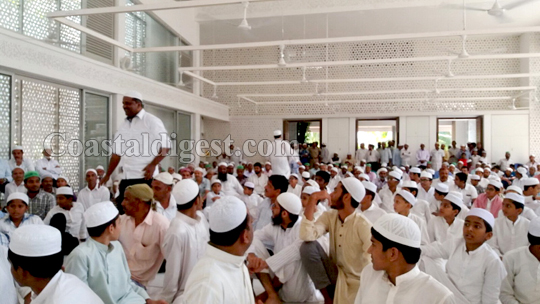
Muslim Personal Law Board chief inaugurates green mosque in Kodi

[email protected] (CD Network)
January 16, 2016

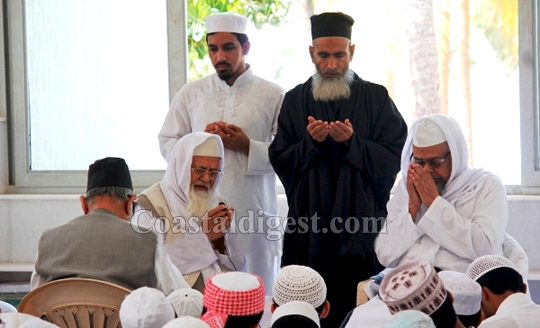
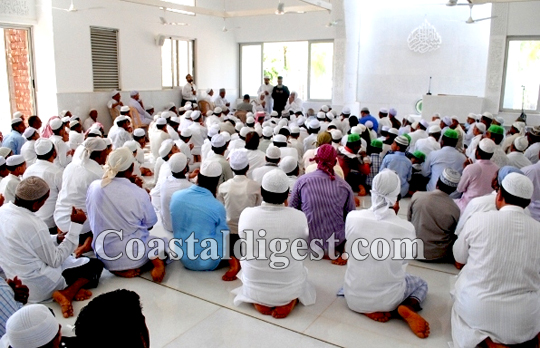
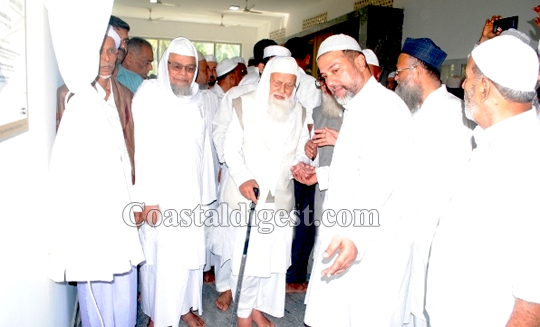
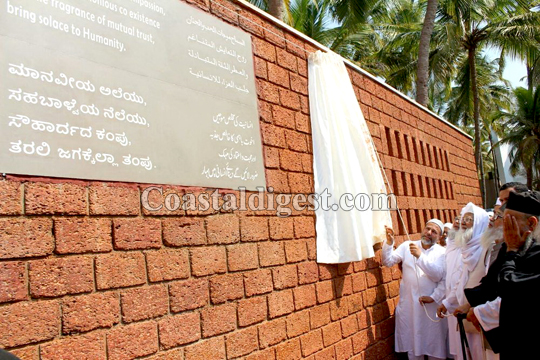
Udupi, Jan 16: Renovated with sustainable eco-friendly features by the Bearys Group, the Badriya Jum’a Masjid of Kodi in Kundapur taluk was formally inaugurated by Moulana Sayyed Mohammed Rabey Hasani Nadvi, president, All India Muslim Personal Law Board, in the presence of a galaxy of religious scholars.
kodimosque5

Speaking on the occasion he said that a mosque is centre of love, peace and humanity and it spreads the message of peace and brotherhood. He also called upon the Muslims to be harbingers of global peace by following the teachings of Quran and Sunnah.

Applauding Bearys Group for converting Badriya Jum’a Masjid into world’s first ‘zero energy’ eco-friendly green mosque, Maulana Mufti Mohammed Ashraf Ali Baqavi, principal of Darul Uloom Sabeelur Rashad, said that people of Kodi now bear the responsibility to spread peace and brotherhood through this facility.

Ibrahim Musliyar Bekal, Khazi of Udupi district, CMD, Bearys Group, UT Khader, Minister for Health and Family Welfare were present among others.

The mosque design has integrated Islamic architecture and sustainable technologies. The important feature of this green building is that its entire energy requirement is met through hybrid renewable energy, both wind and solar.

80 year old mosque

Mr Beary said that the mosque was built by his grandfather 80 years ago. It was renovated 40 years ago and now it was renovated again with eco-friendly measures. “It is our little contribution in India’s march towards sustainable development,” he said and hoped that the mosque will become a holistic place of worship where people from all over the world can come, pray and find true solace.

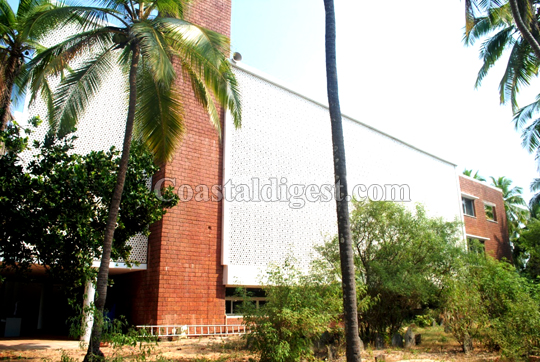
The mosque, built on 15,000 sqft area, at a cost of Rs 2 crore has come up in a palatial ground accommodating greenery in and around. The cooling of the building is achieved by using elements of nature. The building orientation minimizes solar heat gain.

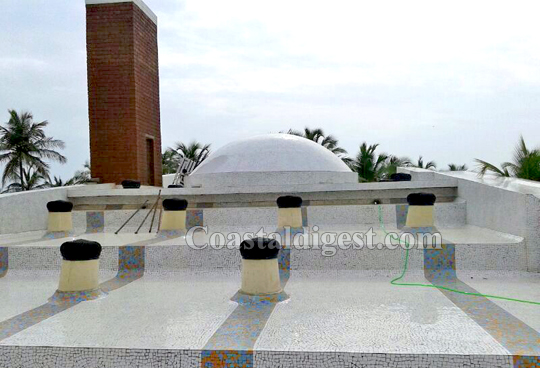
The ‘L’ shaped building plan and elevated nature of the prayer hall, green vegetation and water tanks around it offer a naturally cooled environment. The solar heat reflecting terrace floor, laid with white China mosaics and fitted with turbo vents, not only keep the prayer space cool, but also reduces warming of local micro climate, he said.

The power consumed is six kilo watts as against the actual requirement of 40 to 50 kilo watts. Its open envelope with sun rays travelling and non-conducting Glass Reinforced Concrete (GRC) Jallis with over 50 per cent openings, increase natural ventilation.

The natural cooling of the building is accentuated by the wind scoop on 70 foot multifunctional Minaret (from where the Azan, the call for prayer is given) which forces down draft of cool breeze into the prayer hall and also supports the tower structure of wind turbine mounted atop it.

Use of hybrid renewable energy (Wind and solar energy) in the mosque will produce more energy than used by the mosque, thus feeding energy to state grid and accruing (CER) credits for next 25 years.

“Reduce-Reuse-Recycle-Regenerate” technology has been implemented here and it is equipped with “Pressmatic” (Taps with technology that allows only a fixed quantity of water to flow with every press of its knob) water fixtures to conserve precious water, he claimed.

The calligraphy in Arabic, Chinese and Japanese languages on the walls of the mosque is done by Mukhthar Ahmed, the head of Institute of Indo-Islamic Art and culture, Bengaluru. The mosque also accommodates a library.

Also Read: World’s first ‘zero energy’ green mosque all set for inauguration in Udupi’s Kodi
kodimosque8

kodimosque3

kodimosque9

kodimosque10

kodimosque4

kodimosque6

kodimosque7

kodimosque11

Comments

Laurinda
 - 
Sunday, 31 Jan 2016

Dell has also made other strides toward becoming a greener technology company.
However, the industry believes that, at present,
China's household electrical appliance recycling enterprises
are facing difficulties. According to him, the practice of scrap metal recycling in Los Angeles will not only help us keep the environment clean but also make some
additional money.

Also visit my blog :: electronics recycling los angeles: http://Electronicrecycling-La.com/

Zahoor Ahmed
 - 
Saturday, 16 Jan 2016

May Allah accept all good deeds of Br. Syed Beary and his family and reward them the best in here and hereafter. Ameen

Salman
 - 
Saturday, 16 Jan 2016

Masha Allah. May allah accept the good deed of Syed Mohammed Beary, his grand father and all their family memebrs.

Add new comment

  • Coastaldigest.com reserves the right to delete or block any comments.
  • Coastaldigset.com is not responsible for its readers’ comments.
  • Comments that are abusive, incendiary or irrelevant are strictly prohibited.
  • Please use a genuine email ID and provide your name to avoid reject.
News Network
February 11,2020

Bengaluru, Feb 11: Onion price dropped to Rs 25-30 per kg on Monday, down from the dizzying Rs 200/kg in December and January. The price had spiked because of excess rain, which ruined the crop in several parts of the country.

With supply stabilising, especially from Maharashtra and northern Karnataka, and exports banned, the rate is now easing, officials said.

Consumers may be smiling but farmers are worried as they are not able to make more than Rs 17/kg as against the expected Rs 40.

"We get onions from Nasik and Sholapur in Maharashtra. Nasik onions used to be exported but since that is currently banned, they are landing in Bengaluru, leaving the market here with a surplus," said K Lokesh, president, Karnataka State Onion Merchants Association.

A farmer from Sholapur wh o was part of a onion growers' delegation which met traders in Bengaluru, said, "The cost of everything has gone up. Labour charges and fuel prices are draining us. How can we survive? How can I pay for my children's education?"

Another Sholapur farmer rued: "My daughter's wedding is in March. How am I going to meet all the expenses? I have to pay for labour, transportation, gunny bags and when everything adds up, I don't get to save more than Rs 30,000 in a month."

Comments

Add new comment

  • Coastaldigest.com reserves the right to delete or block any comments.
  • Coastaldigset.com is not responsible for its readers’ comments.
  • Comments that are abusive, incendiary or irrelevant are strictly prohibited.
  • Please use a genuine email ID and provide your name to avoid reject.
News Network
March 27,2020

Bengaluru, Mar 27: A 65-year-old coronavirus patient who died in Karnataka this morning after apparently contracting the infection on a train ride has raised concern about community transmission of the highly contagious disease.
The man, the 60th coronavirus patient in Karnataka, died in Tumakuru. It is not known for certain how he caught the virus. The Karnataka Health Department has posted a notice on Twitter asking whoever travelled with him on train to come forward.

He had no history of recent foreign travel but had apparently traveled to Delhi on March 5 by Sampark Kranti Express and returned on March 11.

On March 7, he arrived at Delhi's Nizamuddin station and participated in an event at Jamia Masjid.

The man took a train back on March 11 and arrived at Yeshwantpur in Bengaluru. From there, he took a bus on March 14 to his hometown Sira.

He first showed symptoms of COVID-19 on March 18 and was taken to a private hospital. He was sent home with medicines but his condition worsened.

On March 23, he was admitted to a district hospital, but checked himself out against all advice and went to a private hospital. When his health showed signs of deterioration, he was again sent to the district hospital, where he tested positive for coronavirus yesterday. He died around 10.30 am today.

The health department has since traced 24 people who came in direct contact with him and are so, in the high-risk category. Thirteen are in hospital and eight have tested negative.

"All passengers who had travelled with him on the train are being traced," K Rakesh Kumar, Deputy Commissioner, Tumakuru, was quoted as telling news agency ANI.

A 70-year old woman and a 76-year old man had died of coronavirus or COVID-19 earlier in Karnataka.

India has over 700 coronavirus cases, including 17 deaths.

Comments

Add new comment

  • Coastaldigest.com reserves the right to delete or block any comments.
  • Coastaldigset.com is not responsible for its readers’ comments.
  • Comments that are abusive, incendiary or irrelevant are strictly prohibited.
  • Please use a genuine email ID and provide your name to avoid reject.
coastaldigest.com news network
May 6,2020

Mangaluru, May 6: Amidst preparation for the paid evacuation of Indians stuck in Gulf countries amidst coronavirus lockdown, the central government has announced that it would only do a medical screening of the passengers before the flight and only asymptomatic persons would be allowed to travel.

Each passenger will have to fill a self-reporting form to be presented at the health and immigration counter at their destination.

The passengers are required to state whether they are suffering from fever, cough, diabetes or any respiratory disease. This form is similar to the one filled by passengers landing in India during the early days of the COVID-19 outbreak.

As per the announcement by the government, returnees would undergo COVID-19 once they complete 14-day quarantine in a hospital or government –arranged institution on a payment basis.

However, the form asks the applicants to keep themselves isolated at home for 28 days unless they develop any symptoms such as fever and cough.

During the journey, they will have to follow the protocols such as those issued by the Health Ministry and the Civil Aviation Ministry. Applicants from the UAE are yet to receive instructions on these.

On reaching the destination, passengers will have to register on the Arogya Setu app, India’s mobile application for COVID-19 surveillance.

No physical distancing!

Air India Express (AIE) which is set to operate the first two flights to Kerala on Thursday will operate its Boeing 737-800 flights, with a seating capacity of 186 economy class seats.

With nine seats reserved for isolation, only 177 passengers would be flown, sources said.

While most of the UAE flights in the first week will be operated by the AIE, Air India will operate two of its Dreamliner aircraft with a seating capacity of 256 seats. These flights would also reserve some seats for isolation.

However, the plan has made it clear that the Indian government will not be following the rules of physical distancing to prevent the spread of coronavirus in the repatriation flights.

Several people, including the Chief Minister of Kerala Pinarayi Vijayan, expressed concern over flying passengers, who will not be tested for COVID-19, without observing physical distancing.

Comments

Add new comment

  • Coastaldigest.com reserves the right to delete or block any comments.
  • Coastaldigset.com is not responsible for its readers’ comments.
  • Comments that are abusive, incendiary or irrelevant are strictly prohibited.
  • Please use a genuine email ID and provide your name to avoid reject.