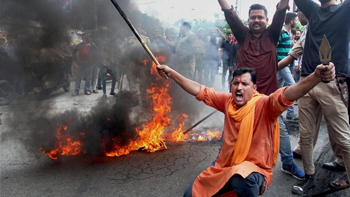
Muslim youth slapped during protest against Amarnath terror attack

Agencies
July 12, 2017

Hisar, Jul 12: A Muslim trader from UP was allegedly slapped by an unidentified person when he refused to raise 'Bharat Mata ki Jai' slogan during a protest by Bajrang Dal activists here against the attack on Amarnath pilgrims, police said today.bajrangdal

The activists of the Dal took out a march near a mosque here yesterday to protest the attack on pilgrims in Kashmir Valley.The Muslim trader hailing from Saharanpur in Uttar Pradesh had come to the mosque to offer prayers yesterday when the Dal activists were taking out a march.

As the Bajrang Dal activists were raising 'Bharat Mata Ki Jai' slogans, someone in the crowd asked the trader who was at the gate of the mosque, to raise the slogan.

When he refused, he was allegedly slapped by someone in the crowd, police said today, adding a complaint was filed by the trader against around 100 unidentified people who were part of the crowd.

A Bajrang Dal leader here said no one from the Dal had slapped the trader.

After the incident, the people in the mosque closed the main door of the religious place and informed the police.

The activists of Bajrang Dal, in the meanwhile, also dispersed after burning effigies and raising slogans against Pakistan.

A case of rioting, promoting enmity between classes, maliciously insulting religious beliefs of any class, causing disturbance to an assembly engaged in religious worship, voluntarily causing hurt and criminal intimidation has been registered against 100-125 unknown persons, police said.

Lalit Kumar, SHO, City Police Station said no arrest has been made so far.

Comments

Holy cow
 - 
Saturday, 15 Jul 2017

What about the agenda of creating hindu rashtra?

Cow and the politics
 - 
Saturday, 15 Jul 2017

Now the gandu dogs will bark that its Islamic conspiracy

Suraksha
 - 
Saturday, 15 Jul 2017

she was always greedy in making money her previous one more case was thr she was roaming with married man.

Add new comment

  • Coastaldigest.com reserves the right to delete or block any comments.
  • Coastaldigset.com is not responsible for its readers’ comments.
  • Comments that are abusive, incendiary or irrelevant are strictly prohibited.
  • Please use a genuine email ID and provide your name to avoid reject.
News Network
February 5,2020

Bengaluru, Feb 5: Despite installing a BJP government in Karnataka through disguised operation Kamala, the Prime Minister Narendra Modi-led union government has continued its step motherly attitude towards this south Indian state.

Under the new formula adopted to share central taxes among states Karnataka will be the worst-affected. Though the 15th Finance Commission has recommended a special grant of Rs 5,495 crore for the state for 2020-21, the Centre appears reluctant to pay up and instead has asked for the proposal to be reviewed.

During the Union budget, the report of the 14th Finance Commission headed by NK Singh for 2020-21 was tabled in Lok Sabha. It shows besides Karnataka, Telangana, Mizoram and Kerala saw their central tax share decrease, while Uttar Pradesh, Bihar and Maharashtra were top gainers.

Karnataka's share has decreased from 4.7% provided by the previous finance commission, to 3.6%. Acknowledging there is a steep decline in Karnataka's share from 2019-20, the finance commission has recommended a special grant of Rs 5,495 crore for the state.

Its share in 2019-20 was Rs 36,675 crore, but under the new formula, Karnataka will get only Rs 31,180 crore in 2020-21 from the divisible pool of Rs 8.5 lakh crore - a decline of 22.5%.

Also, the decrease for Karnataka comes on the back of a shortfall in 2019-20. While the state was entitled to Rs 39,806 crore from the divisible pool, it got only Rs 36,675 crore as the Centre suffered a tax revenue shortfall of Rs 1.5 lakh crore.

What is more disheartening though is the Centre's refusal to pay the special grant. Instead, the Union finance ministry has asked the finance commission to reconsider the recommendation. This has prompted the state to take up the issue with the Centre.

"The decline in central taxes devolution comes at a time when the state is going through a tough financial situation. Steps are being taken to ensure Karnataka gets justice," said chief secretary TM Vijay Bhaskar.

Officials said besides corrective measures for 2020-21, the focus will be on ensuring a fair share in subsequent years. However, Karnataka has little chance of getting its dues as the Centre is known to be prudent when distributing tax proceeds among states.

"The Centre has certain views on devolution. We have done our duty by submitting the interim report. It's up to the states to convince the Centre," said Ravi Kota, joint secretary of 15th Finance Commission.

Under the new formula, the commission changed the weightage for some of the six criteria it considers - population, area, forest cover, income distance, demographic performance and tax effort.

Comments

Add new comment

  • Coastaldigest.com reserves the right to delete or block any comments.
  • Coastaldigset.com is not responsible for its readers’ comments.
  • Comments that are abusive, incendiary or irrelevant are strictly prohibited.
  • Please use a genuine email ID and provide your name to avoid reject.
Agencies
February 20,2020

India ranked 77th on a sustainability index that takes into account per capita carbon emissions and ability of children in a nation to live healthy lives and secures 131st spot on a flourishing ranking that measures the best chance at survival and well-being for children, according to a UN-backed report.

The report was released on Wednesday by a commission of over 40 child and adolescent health experts from around the world. It was commissioned by the World Health Organization (WHO), UN Children's Fund (UNICEF) and The Lancet medical journal.

In the report assessing the capacity of 180 countries to ensure that their youngsters can survive and thrive, India ranks 77th on the Sustainability Index and 131 on the Flourishing Index, it said.

Flourishing is the geometric mean of Surviving and Thriving. For Surviving, the authors selected maternal survival, survival in children younger than 5 years old, suicide, access to maternal and child health services, basic hygiene and sanitation, and lack of extreme poverty.

For Thriving, the domains were educational achievement, growth and nutrition, reproductive freedom, and protection from violence.

Under the Sustainability Index, the authors noted that promoting today's national conditions for children to survive and thrive must not come at the cost of eroding future global conditions for children's ability to flourish.

The Sustainability Index ranks countries on excess carbon emissions compared with the 2030 target. This provides a convenient and available proxy for a country's contribution to sustainability in future.

The report noted that under realistic assumptions about possible trajectories towards sustainable greenhouse gas emissions, models predict that global carbon emissions need to be reduced from 39·7 giga­ tonnes to 22·8 gigatonnes per year by 2030 to maintain even a 66 per cent chance of keeping global warming below 1·5°C.

It said that the world's survival depended on children being able to flourish, but no country is doing enough to give them a sustainable future.

"No country in the world is currently providing the conditions we need to support every child to grow up and have a healthy future," said Anthony Costello, Professor of Global Health and Sustainability at University College London, one of the lead authors of the report.

"Especially, they're under immediate threat from climate change and from commercial marketing, which has grown hugely in the last decade," said Costello – former WHO Director of Mother, Child and Adolescent health.

Norway leads the table for survival, health, education and nutrition rates - followed by South Korea and the Netherlands. Central African Republic, Chad and Somalia come at the bottom.

However, when taking into account per capita CO2 emissions, these top countries trail behind, with Norway 156th, the Republic of Korea 166th and the Netherlands 160th.

Each of the three emits 210 per cent more CO2 per capita than their 2030 target, the data shows, while the US, Australia, and Saudi Arabia are among the 10 worst emitters. The lowest emitters are Burundi, Chad and Somalia.

According to the report, the only countries on track to beat CO2 emission per capita targets by 2030, while also performing fairly – within the top 70 – on child flourishing measures are: Albania, Armenia, Grenada, Jordan, Moldova, Sri Lanka, Tunisia, Uruguay and Vietnam.

"More than 2 billion people live in countries where development is hampered by humanitarian crises, conflicts, and natural disasters, problems increasingly linked with climate change," said Minister Awa Coll-Seck from Senegal, Co-Chair of the commission.

The report also highlights the distinct threat posed to children from harmful marketing.

Evidence suggests that children in some countries see as many as 30,000 advertisements on television alone in a single year, while youth exposure to vaping (e-cigarettes) advertisements increased by more than 250 per cent in the US over two years, reaching more than 24 million young people.

Studies in Australia, Canada, Mexico, New Zealand and the US – among many others – have shown that self-regulation has not hampered commercial ability to advertise to children.

Children's exposure to commercial marketing of junk food and sugary beverages is associated with purchase of unhealthy foods and overweight and obesity, linking predatory marketing to the alarming rise in childhood obesity, it said.

The number of obese children and adolescents increased from 11 million in 1975 to 124 million in 2016 – an 11-fold increase, with dire individual and societal costs, the report said.

To protect children, the authors call for a new global movement driven by and for children.

Specific recommendations include stopping CO2 emissions with the utmost urgency, to ensure children have a future on this planet; placing children and adolescents at the centre of global efforts to achieve sustainable development, the report said.

New policies and investment in all sectors to work towards child health and rights; incorporating children's voices into policy decisions and tightening national regulation of harmful commercial marketing, supported by a new Optional Protocol to the UN Convention on the Rights of the Child, it said.


Comments

Add new comment

  • Coastaldigest.com reserves the right to delete or block any comments.
  • Coastaldigset.com is not responsible for its readers’ comments.
  • Comments that are abusive, incendiary or irrelevant are strictly prohibited.
  • Please use a genuine email ID and provide your name to avoid reject.
News Network
May 15,2020

Bengaluru, May 15: With lockdown-3 coming to an end in a couple of days, Karnataka Chief Minister B S Yediyurappa on Friday expressed confidence about the Centre announcing relaxation to "many things" after May 17.

"After May 17, the government of India is going to relax so many things, let us wait for it," he said in response to a question from reporters here. "According to me they (centre) will relax everything.... maybe for things like five-star hotels and others they may not give permission for the time being, but for other things they are going to give permission. Let's wait and see."

The nationwide lockdown was initially imposed from March 25 to April 14, then extended to May 3 and again to May 17 to prevent the spread of the novel coronavirus. Karnataka Tourism Minister C T Ravi on Wednesday had hinted at the state government permitting the opening of gyms, fitness centres and golf courses, also certain hotels for local tourism purpose after May 17, when the third phase of the COVID-19 induced lockdown comes to an end.

The Muzrai department (in charge of the administration of temples) was also planning to have a Standard Operating Procedure (SOP) in place, that needs to be followed at temples once they are opened for the public, officials have said. They said the opening of temples for the public is however subject to the MHA (Ministry of Home Affairs) guidelines.

During the recent video conferencing Prime Minister Narendra Modi had with Chief Ministers of various states, Yediyurappa had proposed doing away with district wise colour-coding and instead advocated strict cordoning of containment zones to control the spread of the pandemic.

He had pitched for resuming all economic activities in stand-alone establishments while continuing the restrictions on malls, cinema halls, dining facilities and establishments with centrally controlled air-conditioning. The CM had suggested that 50 to 100 meters around known clusters be declared as containment zones and commercial activities, including public transport, to be allowed in non- containment zones.

Comments

MR
 - 
Sunday, 17 May 2020

Please don't go out until May 31st.

Remember the Politicians and their famiies will stay inside  until May 31'st to protect their families.

If you go out and fall sick your whole family will suffer. So be smart and stay home.

Add new comment

  • Coastaldigest.com reserves the right to delete or block any comments.
  • Coastaldigset.com is not responsible for its readers’ comments.
  • Comments that are abusive, incendiary or irrelevant are strictly prohibited.
  • Please use a genuine email ID and provide your name to avoid reject.