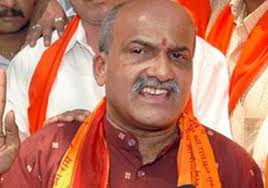
Muthalik, others booked for staging protest at Bababudan Dargah

[email protected] (News Network)
November 22, 2016

Chikkamgaluru, Nov 22: The district administration has filed a case against Sri Ram Sene founder Pramod Muthalik and others for staging a protest inside the Guru Dattatreya Bababudan Swamy Dargah atop Bababudangiri Hills during the valedictory function of Dattamala Abhiyana on Sunday.

1muthalikA case has been registered by the Chikkamagaluru Rural police on charges of assaulting a public servant (Section 353 of the IPC), obstructing a public servant from discharging duties (Section 186), and disobedience of order passed by a public servant (Section 188).

It was registered based on a complaint filed by S.G. Nagesh, Deputy Director of Public Instruction, who was deputed as a special officer to the shrine. The other accused are Mahesh Kumar Kattinamane, Sharadamma and Mohan Kumar.

Superintendent of Police K. Annamalai said the accused had allegedly staged a dharna in the shrine seeking an opportunity to offer prayers to Datta Paduka, despite being aware of the court's order on this issue. They attempted to disturb peace and also obstructed other devotees from havingPaduka Darshana'.

Comments

ali
 - 
Wednesday, 23 Nov 2016

Encounter is the only solution to finish such criminals like

MOhammed athif
 - 
Tuesday, 22 Nov 2016

no one is there to raise voice against this trouble maker in all over karnataka... y dont punish this guy..? he shld be bhind the bar... until his last breath shld not come out frm there
where are his followers gone

Althaf
 - 
Tuesday, 22 Nov 2016

Government of India must Ban this type of anti national elements and should put them behind bars without granting any bail. He should be put behind bars atleast for 10 to 15 years.

Add new comment

  • Coastaldigest.com reserves the right to delete or block any comments.
  • Coastaldigset.com is not responsible for its readers’ comments.
  • Comments that are abusive, incendiary or irrelevant are strictly prohibited.
  • Please use a genuine email ID and provide your name to avoid reject.
Ram Puniyani
January 9,2020

‘Go to Pakistan’ has probably been most often used phrase used against Muslims in India. Recently in yet another such incident the SP of Meerut, UP has been in the news and a video is circulating where he, Akhilesh Narayan Singh, is allegedly using the jibe ‘Go to Pakistan’. In the video he is seen shouting at protestors at Lisari Gate area in Meerut, “The ones (protestors) wearing those black or yellow armbands, tell them to go to Pakistan”. His seniors stood by him calling it ‘natural reaction to shouting of pro Pakistan slogans. Many BJP leaders like Uma Bhararti also defended the officer. Breaking ranks with fellow politicians, Mukhtar Abbas Naqvi of BJP, criticised the said officer and asked for suitable action against him. Interestingly this is same Naqvi, who earlier when the beef related arguments were going on; had stated that those who want to eat beef can go to Pakistan.

Interestingly this is probably the first time that any BJP leader has opposed the use of this jibe against the Indian Muslims. True to the dominance of trolls who support divisive politics, Naqvi has been trolled on the issue. As such vibe ‘Go to Pakistan’ has been a strong tool in the hands of aggressive elements to demonise Muslims in general and to humiliate those with Muslim names. One recalls that when due to the rising intolerance in the society many eminent writers, film makers were returning their awards, Aamir Khan said that his wife Kiran Rao is worried about their son. Immediately BJP worthies like Giriraj Singh pounced on him that he can go to Pakistan.

The strategy of BJP combine has been on one hand to use this ‘go to Pakistan’ to humiliate Muslims on the other from last few years another Pakistan dimension has been added. Those who are critical of the policies of BJP-RSS have on one hand been called as anti National and on the other it is being said that ‘they are speaking the language of Pakistan’.

Use of Pakistan to label the Muslims and dissidents here in India has been a very shrewd tool in the hands of communal forces. One remembers that the ‘cricket nationalism’ was also the one to use it. In case of India-Pakistan cricket match, the national hysteria, which it created, was also aiming at Indian Muslims. What was propagated was that Indian Muslims cheer for Pakistan victory and they root for Pakistan. There was an unfortunate grain of truth in this as a section of disgruntled, alienated Muslim did that. That was not the total picture, as most Indian Muslims were cheering for Indian victory. Many a Muslim cricketers contributed massively to Indian cricket victories. The cricket legends like Nawab Mansoor Ali Khan Pataudi, Irfan Pathan, and Mohammad Azaruddin are just the few among the long list of those who brought glories for India in the field of cricket.

Even in matters of defence there are legions of Muslims who contributed to Indian efforts in the war against Pakistan all through. Abdul Hamid’s role in 1965 India Pak war and the role of Muslim soldiers in Kargil war will be part of Indian military history. There have been generals in army who contributed in many ways for the role which military has been playing in service of the nation. General Zamiruddin Shah, when asked to handle Gujarat carnage, does recount how despite the lack of support from local administration for some time, eventually the military was able to quell the violence in some ways.

During freedom movement Muslims were as much part of the struggle against British rule as any other community. While the perception has been created that Muslims were demanding Pakistan, the truth is somewhere else. It was only the elite section of Muslims who supported the politics of Muslim League and later the same Muslim League could mobilize some other section and unleash the violence like ‘Direct Action’ in Kolkata, which in a way precipitated the actual process of partition, which was the goal of British and aim of Muslim League apart from this being the outcome of ‘Two Nation theory’.

Not much is popularized about the role of great number of Muslims who were part of National movement, who steadfastly opposed the idea and politics which led to the sad partition of the subcontinent. Few excellent accounts of the role of Muslims in freedom movement like Syed Nasir Ahmad, Ubaidur Rahman, Satish Ganjoo and Shamsul Islam are few of these not too well know books which give the outline of the great Muslim freedom fighters like Khan Abdul Gaffar Khan, Maulana Abul Kalam Azad, Ansari Brothers, Ashfaqulla Khan.

Immediately after partition tragedy the communal propaganda did the overdrive to blame the whole partition process on Muslim separatism, this totally undermined the fact that how poor Muslims had taken out massive marches to oppose the Lahore Resolution of separate Pakistan moved by Mohammad Ali Jinnah. The whole Muslim community started being seen as the homogenous, ‘The other’ and other misconceptions started against the community, the one’s relating them to atrocities of Muslim kings started being made as the part of popular folklore, leading the Hate against them. This Hate in turn laid the foundation of violence and eventual ghettoisation of this community.

The interactive-syncretism prevalent in India well presented by Gandhi-Nehru was pushed to the margins as those believing in pluralism did not actively engage with the issue. The economic marginalization of this community, coupled with the increasing insecurity in turn led to some of them to identify with Pakistan, and this small section was again presented as the representative of the whole Muslim community.

Today the battle of perception is heavily tilted against the Muslim community. It is a bit of a surprise as Naqvi is differing from his other fellow colleagues to say that the action should be taken against the erring police officer. The hope is that all round efforts are stepped up to combat the perception constructed against this religious minority in India. 

Comments

Prakash SS
 - 
Thursday, 9 Jan 2020

it is very much understandable if Pakistan is bad country our PM Namo would never visited without any invitation, that time Pakistan was good he prised their Mutton biriyani and Karak chai in pakistan. we feel something is wrong with our PM and his chelas. 

Add new comment

  • Coastaldigest.com reserves the right to delete or block any comments.
  • Coastaldigset.com is not responsible for its readers’ comments.
  • Comments that are abusive, incendiary or irrelevant are strictly prohibited.
  • Please use a genuine email ID and provide your name to avoid reject.
Ram Puniyani
February 22,2020

This January 2020, it is thirty years since the Kashmiri Pundits’ exodus from the Kashmir valley took place. They had suffered grave injustices, violence and humiliation prior to the migration away from the place of their social and cultural roots in Kashmir Valley. The phenomenon of this exodus had been due to the communalization of militancy in Kashmir in the decade of 1980s. While no ruling Government has applied itself enough to ‘solve’ this uprooting of pundits from their roots, there are communal elements who have been aggressively using ‘what about Kashmiri Pundits?’, every time liberal, human rights defenders talk about the plight of Muslim minority in India. This minority is now facing an overall erosion of their citizenship rights.

Time and over again in the aftermath of communal violence in particular, the human rights groups have been trying to put forward the demands for justice and rehabilitation of the victim minority. Instead of being listened to those particularly from Hindu nationalist combine, as a matter of routine shout back, where were you when Kashmiri Pundits were driven away from the Valley? In a way the tragedy being heaped on one minority is being justified in the name of suffering of Pundits and in the process violence is being normalized. This sounds as if two wrongs make a right, as if the suffering Muslim minority or those who are trying to talk in defense of minority rights have been responsible for the pain of Kashmiri Pundits.

During these three, many political formations have come to power, including BJP, Congress, third front and what have you. To begin with when the exodus took place Kashmir was under President’s rule and V. P. Singh Government was in power at the center. This Government had the external support of BJP at that time. Later BJP led NDA came to power for close to six years from 1998, under the leadership of Atal Bihari Vajpayee. Then from 2014 it is BJP, with Narerda Modi as PM, with BJP brute majority is in power. Other components of NDA are there to enjoy some spoils of power without any say in the policies being pursued by the Government. Modi is having absolute power with Amit Shah occasionally presenting Modi’s viewpoints.

Those blurting, ‘what about Kashmiri Pundits?’ are using it as a mere rhetoric to hide their communal color. The matters of Kashmir are very disturbing and cannot be attributed to be the making of Indian Muslims as it is being projected in an overt and subtle manner. Today, of course the steps taken by the Modi Government, that of abrogation of Article 370, abolition of clause 35 A, downgrading the status of Kashmir from a state to union territory have created a situation where the return of Kashmiri Pundits may have become more difficult, as the local atmosphere is more stifling and the leaders with democratic potential have been slapped with Public Safety Act, where they can be interned for long time without any answerability to the Courts. The internet had been suspended, communication being stifled in an atmosphere where democratic freedoms are curtailed which makes solution of any problem more difficult.

Kashmir has been a vexed issue where the suppression of the clause of autonomy, leading to alienation led to rise of militancy. This was duly supported by Pakistan. The entry of Al Qaeda elements, who having played their role against Russian army in 1980s entered into Kashmir and communalized the situation in Kashmir. The initial Kashmir militancy was on the grounds of Kashmiriyat. Kashmiriyat is not Islam, it is synthesis of teachings of Buddha, values of Vedant and preaching’s of Sufi Islam. The tormenting of Kashmiri Pundits begins with these elements entering Kashmir.

Also the pundits, who have been the integral part of Kashmir Valley, were urged upon by Goodwill mission to stay on, with local Muslims promising to counter the anti Pundit atmosphere. Jagmohan, the Governor, who later became a minister in NDA Government, instead of providing security to the Pundits thought, is fit to provide facilities for their mass migration. He could have intensified counter militancy and protected the vulnerable Pundit community. Why this was not done?

Today, ‘What about Kashmiri Pundits?’ needs to be given a serious thought away from the blame game or using it as a hammer to beat the ‘Muslims of India’ or human rights defenders? The previous NDA regime (2014) had thought of setting up enclosures of Pundits in the Valley. Is that a solution? Solution lies in giving justice to them. There is a need for judicial commission to identify the culprits and legal measures to reassure the Pundit community. Will they like to return if the high handed stifling atmosphere, with large number of military being present in the area? The cultural and religious spaces of Pundits need to be revived and Kashmiryat has to be made the base of any reconciliation process.

Surely, the Al Qaeda type elements do not represent the alienation of local Kashmiris, who need to be drawn into the process of dialogue for a peaceful Kashmir, which is the best guarantee for progress in this ex-state, now a Union territory. Communal amity, the hallmark of Kashmir cannot be brought in by changing the demographic composition by settling outsiders in the Valley. A true introspection is needed for this troubled area. Democracy is the only path for solving the emigration of Pundits and also of large numbers of Muslims, who also had to leave the valley due to the intimidating militancy and presence of armed forces in large numbers. One recalls Times of India report of 5th February 1992 which states that militants killed 1585 people from January 1990 to October 1992 out of which 982 were Muslims and 218 Hindus.

We have been taking a path where democratic norms are being stifled, and the promises of autonomy which were part of treaty of accession being ignored. Can it solve the problem of Pundits?

Comments

Add new comment

  • Coastaldigest.com reserves the right to delete or block any comments.
  • Coastaldigset.com is not responsible for its readers’ comments.
  • Comments that are abusive, incendiary or irrelevant are strictly prohibited.
  • Please use a genuine email ID and provide your name to avoid reject.
News Network
August 4,2020

Bengaluru, Aug 4: Police barricades, yellow banners, walls with a fresh coat of paint and the sounds of bhajan mark parts of Ayodhya as the city awaits its big day Wednesday, when the first brick will be laid for the Ram temple.

Ayodhya is decked up for the bhoomi pujan that will be attended at the Ram Janmabhoomi by 175 people, who figure in a select guest list of seers and politicians topped by Prime Minister Narendra Modi.

Concerned over the spread of coronavirus, the authorities are encouraging others not to come to the temple town, asking them to mark the occasion by celebrating at their homes. The groundbreaking ceremony will be telecast live.

Roads leading to Ayodhya display hoardings with the picture of the proposed Ram temple and of Ram Lalla, the infant Ram, the deity now housed in a makeshift temple.

Around the town’s Hanumangarhi area – named after a well-known temple which Modi will visit on Wednesday – both police sirens and ‘bhajans’ in praise of Ram are heard.

Most of the shops in the locality wear a new look, with their fronts painted in bright yellow. A large number of policemen were deployed there on Tuesday. Some sat in the sweet shops, waiting for their next instructions.

Roads leading into the area are barricaded. Yards of yellow cloth and marigold garlands were being hung on poles.

Even on the day before the event, security checks on vehicles heading to Ayodhya begin from adjoining Barabanki district itself on the Lucknow-Ayodhya road. Policemen take down details, including mobile numbers of the travellers.

Senior Superintendent of Police Deepak Kumar said the focus of the force is on maintaining the Covid-19 protocol.

“So we are not going to allow any outsider to enter Ayodhya city,” he said. Prohibitory orders are also in force and not more than four people will be allowed to gather.

“The markets and shops will remain open but with strict adherence to the Covid protocol,” he said. Outsiders will be stopped from entering the city, but Ayodhya residents will be allowed in if they produce any identification document.

“We are also carrying out random checks on people living in Ayodhya to ensure that no outsiders are staying here,” he said.

The city’s temples and mosques will remain open, but no other religious event – except for the bhoomi pujan – will take place on Wednesday.

Pickets have been set up at sensitive points in the city.

Sub-inspector Ram Chandra Yadav and constables Avnish Kumar and Ankit Chaudhary man the Terhi Bazar Chauraha picket near the Ram Janmabhoomi site.

"We are here for the past some days, and were on duty on the Rakshabandhan day. Duty comes first and only after that come other things in life, like festivals," Yadav said.

Mayank Gupta, who runs a restaurant, was handing out food packets to policemen, his customers.

"For the last two months, I have been providing tiffin to them twice a day. There are around 100 policemen to whom I supply tiffin," Gupta said.


Comments

Add new comment

  • Coastaldigest.com reserves the right to delete or block any comments.
  • Coastaldigset.com is not responsible for its readers’ comments.
  • Comments that are abusive, incendiary or irrelevant are strictly prohibited.
  • Please use a genuine email ID and provide your name to avoid reject.