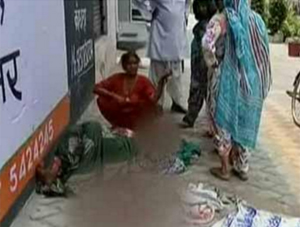
Muzaffarnagar riot victim gives birth on road after hospital denies entry

June 22, 2016

Muzaffarnagar, Jun 22: A 35-year-old woman who was displaced from her native village during the 2013 Muzaffarnagar riots, gave birth on a road after she was allegedly denied admission by a government hospital here, prompting a probe by the Chief Medical Officer (CMO).

Untitled-1The incident occurred yesterday when the pregnant woman was denied entry at the government primary health centre in Kandhla town, her husband said.

She was asked by the doctors to return as her delivery date was scheduled three days later, he alleged.

He said that his wife gave birth on the road while they were returning to their house.

The woman was later shifted to a hospital in Shamli district on the directive of CMO V Agnihotri.

Meanwhile, the CMO has ordered a probe into the incident.

The woman claimed that she was displaced from her native Phugana village during the riots and was later rehabilitated at Kandhla town.

Comments

TURE WORD
 - 
Thursday, 23 Jun 2016

Mr.Bala,
How if she is your MOTHER,SISTER OR DAUGHTER will you still calculate, Country, State, Village, Panchayat Bla Bla.... be a human first, shame on people like you living in INDIA.
show your comments to your Mother & Sisters and come back with your replay.

Mohammed SS
 - 
Wednesday, 22 Jun 2016

this shows actual situation of India it says India is progressing we believe India is progressing only about intolerance ignorance cruelty and ill behavior other than nothing else.

Rajiv
 - 
Wednesday, 22 Jun 2016

RSS pepole they dont have mercy,what a crucial doctor? cheeeeeeeee. goverment should take proper investigation and kill the culprits.

Add new comment

  • Coastaldigest.com reserves the right to delete or block any comments.
  • Coastaldigset.com is not responsible for its readers’ comments.
  • Comments that are abusive, incendiary or irrelevant are strictly prohibited.
  • Please use a genuine email ID and provide your name to avoid reject.
Agencies
January 16,2020

Bengaluru, Jan 16: Amping up the online payment experience for consumers, Razorpay, the leading full-stack financial services company, today launched a new product, Instant Refunds for businesses.

This new feature activates refunds and credits the customer's source account across payment methods such as credit card, net banking, and UPI within a minute of initiation.

India is one of the fastest-growing online retail markets today. About 71 per cent of internet users in the country purchase products online. Today, the refund process has two major pain points for both the end customer and the business.

First, a delay of five-seven business days for the customer in receiving the money because of multiple intermediaries like the acquiring bank, issuing bank and the networks (VISA/MasterCard/Rupay).

Second, the lack of transparency during the entire refund process for both the customer and the business. This long cycle of processing refunds is a significant problem with every popular payment method in the industry.

By issuing refunds instantly, Razorpay will help businesses retain their customers, build trust through an improved hassle-free payment experience and provide complete transparency on refunds to both the business and the end-user.

This new feature will also reduce the dependence on manpower as every refund issue on an average leads to ten service emails or calls from customer support teams.

"Instant Refunds are the new normal and central to great customer experience. A lot of consumers fail to use online payment methods as they feel getting refunds through an online platform is a very time-consuming task; hence they prefer CoD as the best alternative. Given the technological advancements being made in the fin-tech ecosystem, its fair for customers to expect refunds as fast as possible. A solution like Instant Refunds will not only help build consumer confidence in digital payments but also reduce losses for e-commerce companies where CoD has become an expensive option with more than 50 per cent online transactions made through cash", said Shashank Kumar, CTO & Co-founder of Razorpay.

"Our Instant Refunds feature ensures that the refund is processed at a 3600x faster pace than the normal expected time of five-seven business days. The team is focused on creating new technologies designed to make the entire payment lifecycle hassle-free. We believe this new feature will make customers experience a notch higher, help brands create a competitive advantage, and even make them more profitable", he added.

Razorpay's growth has been uphill, particularly in the last two years. With a 500 per cent growth in 2019, the company has been witnessing a healthy growth rate of 35 per cent month-on-month.

The company also recently launched its corporate credit cards for its partner businesses, RazorpayX current accounts, support for freelancers and homepreneurs, and acquired Opfin, a payroll and HR management software company.

Currently powering payments for over 800,000 businesses including the likes of Indigo, BSE, Thomas Cook, Reliance, SpiceJet, Aditya Birla, Sony, and Oyo, the team plans to increase this count to 1,400,000 by this year. The full-stack financial solutions company expects a 4x growth in its revenue by the end of the next fiscal year.

This story is provided by NewsVoir. ANI will not be responsible in any way for the content of this article.

Comments

Add new comment

  • Coastaldigest.com reserves the right to delete or block any comments.
  • Coastaldigset.com is not responsible for its readers’ comments.
  • Comments that are abusive, incendiary or irrelevant are strictly prohibited.
  • Please use a genuine email ID and provide your name to avoid reject.
Agencies
February 6,2020

Even more than three years after demonetisation and all-out efforts to make most transactions through electronic, cash is still king, as it thrives in a digital India, said fintech start-up Paytm founder Vijay Sekhar Sharma.

"While cashless economy is not possible in India, less cash economy will be in the future. Less cash is the only solution, not the elimination of cash," Sharma told IANS in an interview after unveiling an all-in-one payment gateway on Tuesday.

Asserting that it would take 5-10 years for India to make the transition to digital payments from the traditional mode of cash, Sharma, 41, said the e-payment industry benefitted more from the November 8, 2016 note ban and withdrawal of old Rs 1,000 and Rs 500 denominations.

"I think it (demonetisation) helped the industry despite lack of specific help. But the world has changed since then. It is about the scale of distribution of merchants that is what is propelling digital payments," said Sharma.

Most of the cash not only came back into circulation, but also remains as the mode of payment for the majority due to its convenience for the people used to such transactions.

Expounding Paytm's zero service charge, Sharma said the strategy is sustainable as it leads to acquiring more customers and merchants, enabling newer business opportunities.

Paytm also does not levy a service charge to small merchants for its payments services, unlike organised players like Uber.

"Though there is a monetisation model, the merchants who are small shopkeepers, become our financial services customers as they open a bank account, which is profitable."

Paytm secured a Payments Bank license from the Reserve Bank of India to offer a savings bank account, Rupay debit card and money transfer services.

"We are banking on payment services acquiring customers and merchants who avail banking, lending, insurance, wealth and software services like billing software and business ledger software services eventually," Sharma noted.

The mobile first bank services include zero balance and zero digital transaction charge accounts.

"Basically, payments, cloud, commerce and financial services are a cohort we follow. So, payments is our customer as well as merchant acquisition. If it breaks even, we are happy because other line items make more money, he affirmed.

Noting that in a market like India, one cannot price services at a premium unlike in a developed country like the US, the billionaire businessman said a consumer in a developing country would not be able to afford such a hefty charge.

Forbes ranked Sharma as India's youngest billionaire in 2017, with a net worth of $2.1 billion.

While several countries operate on the model of higher service charges, Sharma said newer business models have to be discovered in India, as customer lifecycle value is accounted for more stages than in other nations.

Asked about an upscale retailer like Zara not giving a wallet payment option during its recent end of season sale in Bengaluru, Sharma said Paytm was addressing such hiccups with its all-in-one payment solutions.

"It's an opportunity, because if the retailer has our all-in-one point of sale machine, where in they enter the amount, it shows both the Quick Response code (QR) and card payment options," he observed.

Sharma compared older swiping payment machine to feature phones and modern ones to feature-rich smartphones.

"If you notice, they look like feature phones and the modern day card machine is more a smartphone like. You can add the smatphone components, which can add the features," reiterated Sharma.

Though Paytm's all-in-one QR point of sale machine integrates the billing system, its chief executive said it was not ideal to have an independent QR feature.

Paytm has 16 million strong merchant user base, which Sharma aims to raise to 26 million base in the next one year.

Sharma has launched in this tech city an all-in-one payment gateway and Paytm Business Payments solution, which enable digital payments through multiple methods for small and medium enterprises (SMEs) and an Android point of sale machine.

With the new gateway solution, collecting digital payments through multiple methods can be achieved seamlessly while Paytm Business Payments solution enables automated vendor payments, including employee salaries and customer refunds among others.

The One97 Communications-owned Paytm aims to help SMEs streamline and digitise their business activities using its new solutions, which enhance the overall efficiency of both accepting and making payments.

Paytm has a data bank of over 200 million saved cards and bank accounts, a feature which enables partner apps to shorten transaction times and propel faster conversions while using the all-in-one payment gateway.

Complementing the two solutions, Sharma also launched an all-in-one Android point of sale machine, which can accept payments through all forms such as cards, wallets, UPI apps and even cash.

The device has a QR code that supports all contact and contactless payments, coming with integrated billing software customized solutions for different sectors such as catering, ticketing, parking and others.

The handheld Android device is equipped with an in-built printer, scanner and can also generate bills.

Valued at $16 billion, Paytm is not alone in the fiercely competitive Indian fintech space where a dozen players like PhonePe, MobiKwik, Kotak 811 and deep pocketed international giants Google Pay and Amazon Pay are in the fray.


Comments

Add new comment

  • Coastaldigest.com reserves the right to delete or block any comments.
  • Coastaldigset.com is not responsible for its readers’ comments.
  • Comments that are abusive, incendiary or irrelevant are strictly prohibited.
  • Please use a genuine email ID and provide your name to avoid reject.
News Network
July 25,2020

Bengaluru, Jul 25: The Karnataka government on Saturday announced a waiver of crematorium fees for those who succumb to the COVID-19 infection in Bengaluru and said the city civic body would bear the cost.

It said that from now on, families of the COVID deceased need not pay any fees fixed by the city civic body- Bruhat Bengaluru Mahanagara Palike (BBMP)- across 12 electric crematoriums in the city.

"There were reports in the media about difficulties faced in performing the last rites of those who died due to COVID-19 infections. Aimed at resolving those difficulties, certain decisions have been taken," Revenue Minister R Ashoka said.

He told reporters here that BBMP had fixed Rs 250 as the cremation fee, Rs 100 for the ash collection pot and Rs 900 for the bier (bamboo stretcher on which the body is carried), all of which have been waived for COVID deaths.

"So it will be a waiver of Rs 1,250 per cremation. The BBMP will bear this cost," he added.

Ashoka also announced Rs 500 per body incentive for the personnel who conduct the last rites of COVID victims.

"This is in recognition of their services at a time when family members of the deceased are not ready to touch the body and not ready to take the body in some cases," he said.

Noting that the government has identified 23 acres of land at five places around Bengaluru for burial or cremation of COVID victims, Ashoka locals in all these areas are protesting against it.

Appealing to the people for cooperation during these difficult times, he said the government's intention was to ensure respectful burial or cremation for the deceased.

"Obstructing it is not right, it is not Indian tradition," he said.

Pointing out that it takes almost a day's time for a COVID victim's body to be handed over for burial or cremation, he said "scientifically, according to experts and doctors, the virus will not remain alive for more than three hours.

...Also, bodies are either burnt or buried eight feet below. So there will not be any problem for those living in nearby areas and it will not spread infection. Cooperate with humanity," he said.

"These lands identified are for all religions and communities and once the pandemic subsides, can be used for other deaths as well," he said.

Comments

Add new comment

  • Coastaldigest.com reserves the right to delete or block any comments.
  • Coastaldigset.com is not responsible for its readers’ comments.
  • Comments that are abusive, incendiary or irrelevant are strictly prohibited.
  • Please use a genuine email ID and provide your name to avoid reject.