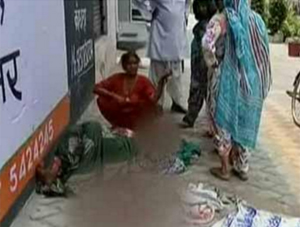
Muzaffarnagar riot victim gives birth on road after hospital denies entry

June 22, 2016

Muzaffarnagar, Jun 22: A 35-year-old woman who was displaced from her native village during the 2013 Muzaffarnagar riots, gave birth on a road after she was allegedly denied admission by a government hospital here, prompting a probe by the Chief Medical Officer (CMO).

Untitled-1The incident occurred yesterday when the pregnant woman was denied entry at the government primary health centre in Kandhla town, her husband said.

She was asked by the doctors to return as her delivery date was scheduled three days later, he alleged.

He said that his wife gave birth on the road while they were returning to their house.

The woman was later shifted to a hospital in Shamli district on the directive of CMO V Agnihotri.

Meanwhile, the CMO has ordered a probe into the incident.

The woman claimed that she was displaced from her native Phugana village during the riots and was later rehabilitated at Kandhla town.

Comments

TURE WORD
 - 
Thursday, 23 Jun 2016

Mr.Bala,
How if she is your MOTHER,SISTER OR DAUGHTER will you still calculate, Country, State, Village, Panchayat Bla Bla.... be a human first, shame on people like you living in INDIA.
show your comments to your Mother & Sisters and come back with your replay.

Mohammed SS
 - 
Wednesday, 22 Jun 2016

this shows actual situation of India it says India is progressing we believe India is progressing only about intolerance ignorance cruelty and ill behavior other than nothing else.

Rajiv
 - 
Wednesday, 22 Jun 2016

RSS pepole they dont have mercy,what a crucial doctor? cheeeeeeeee. goverment should take proper investigation and kill the culprits.

Add new comment

  • Coastaldigest.com reserves the right to delete or block any comments.
  • Coastaldigset.com is not responsible for its readers’ comments.
  • Comments that are abusive, incendiary or irrelevant are strictly prohibited.
  • Please use a genuine email ID and provide your name to avoid reject.
News Network
March 5,2020

Bengaluru, Mar 5: The Karnataka government has advised city-based companies to allow their employees to work from home if they have flu-like symptoms.

"Those employees having flu like symptoms may be allowed to work from home with advice of standard hand hygiene and cough etiquette," the Health Department said in its advisory.

The advisory asked people to avoid non-essential travel to COVID-19 affected countries and refrain from travel to China, Iran, Republic of Korea, Italy and Japan.

"Employees other than those restricted countries arriving directly or indirectly from China, South Korea, Japan, Iran, Italy, Hong Kong, Maccau, Veitnam, Malaysia, Indonesia, Nepal, Thailand, Singapore, Taiwan, the UAE and Qatar must undergo medical screening at airport entry," the advisory read.

The government advisory also mandated employees arriving through all international flights entering lndia from any port to furnish duly filled self-declaration form, including personal particulars - phone numbers and address in India, and travel history to health officials and immigration officials.

It also appealed to promote regular and thorough hand washing at work places and keeping sanitising hand rub dispensers (alcohol-based) in prominent places and provide access to places where staff can wash their hands with soap and water.

Companies have been asked to promote good respiratory hygiene and ensure the availability of surgical masks and paper tissues at workplaces only for those who develop a running nose or cough at work along with closed bins for their hygienic disposal.

Meanwhile, the Bruhat Bengaluru Mahanagara Palike Commissioner B H Anil Kumar chaired a meeting on Wednesday regarding the preparedness to deal with coronavirus.

Comments

Add new comment

  • Coastaldigest.com reserves the right to delete or block any comments.
  • Coastaldigset.com is not responsible for its readers’ comments.
  • Comments that are abusive, incendiary or irrelevant are strictly prohibited.
  • Please use a genuine email ID and provide your name to avoid reject.
News Network
August 7,2020

Bengaluru, Aug 7: Action will be taken against private hospitals that were violating government norms and charging exorbitant fees charges for the treatment of Covid-19 patients and suspects, said Water Resources Minister Ramesh Jarkiholi.

The government has taken action against private hospitals in Bengaluru and the same parameters would be adopted other cities, he said speaking to media persons in Belagavi on Friday.

Jarkiholi said that the government had noticed that patients were levied exorbitant charges for Covid-19 treatment. People too have complaints regarding the huge bills by these private hospitals and have demanded action.

“We are not under the obligation of any private hospital and stringent action will be taken against all erring and violating government tariffs. They will have to treat patients and follow the tariffs fixed,” he stated.

Belagavi Institute of Medical Sciences District Hospital had been directed to install CCTV cameras in Covid-19 wards and install monitors at reception to facilitate monitoring of treatment and condition of the wards. BIMS management was taken to task for not following the directive and have been given a deadline to install CCTV cameras, Jarkiholi informed.

Comments

Add new comment

  • Coastaldigest.com reserves the right to delete or block any comments.
  • Coastaldigset.com is not responsible for its readers’ comments.
  • Comments that are abusive, incendiary or irrelevant are strictly prohibited.
  • Please use a genuine email ID and provide your name to avoid reject.
News Network
June 26,2020

Bengaluru, Jun 26: The National Restaurant Association of India (NRAI) on Thursday came up with a Standard Operating Procedure (SOP) for restaurants whereby among other physical distancing norms, it has suggested a 2-metre gap between tables.

Formulated in partnership with Releski, a Bengaluru based skill-tech company, the SoP suggests that in case of back-to-back seating, people sitting with their backs towards each other will have their seats divided by 'Plexiglass' divider raised up to 2 meters from the ground.

"In a typical restaurant, the improvised seating plan should have a minimum distance of 2 metres between tables. The distance of 2 metres (6 feet) between tables should measure from one edge of the table to the other table's edge," it said.

In case of loose or free seating such as in banquet style or food court style seating, a minimum 2 meters of distance should be maintained between tables.

The guidelines noted that, to encourage physical distancing, restaurants have to sacrifice their seating capacity, to promote health and safety, and also to gain trust from their patrons.

"In order to perform this, divide your restaurants under different sectors. Pull out your restaurant's floor plan and colour code different sections red and yellow. Red sections are potential areas where maximum footfall or traffic is observed. Yellow sections are areas where the footfalls are average," it said.

All the red sections are encircled or bordered by placing barricades or Q manager and will open at specific points to access the yellow section and all the opening points will have hand sanitisers and sprays, and every guest who walks from red zones to yellow zones will sanitise himself/herself to reduce the chances of contamination.

For air conditioning, the guidelines of CPWD shall be followed which inter alia emphasises that the temperature setting of all air conditioning devices should be in the range of 24-30 degree Celsius, relative humidity should be in the range of 40- 65 per cent, intake of fresh air should be as much as possible and cross ventilation should be adequate, the guidelines suggested.

The industry body has also suggested appointment of a COVID-free Ambassador who would operate as the Chief Health Officer within the restaurant team, preferably from the management team in each shift.

The ambassador's would put the new daily work routines into practice, to monitor compliance with good practice and to lead the preventative measures, adapt to health & safety recommendations and requirements of the restaurant and oversee the implementation of the norms.

Anurag Katriar, President of NRAI and CEO & Executive Director of deGustibus Hospitality, said: "Every restaurant cutting across formats is facing the harsh reality of subdued to shut business volumes in the present and the uncertainty of business environment in the future. One thing is certain that hygiene and safety will be a key differentiator in the post-pandemic restaurant operations."


Comments

Add new comment

  • Coastaldigest.com reserves the right to delete or block any comments.
  • Coastaldigset.com is not responsible for its readers’ comments.
  • Comments that are abusive, incendiary or irrelevant are strictly prohibited.
  • Please use a genuine email ID and provide your name to avoid reject.