



Myanmar's Military Finds Plane Wreckage, Bodies

June 8, 2017

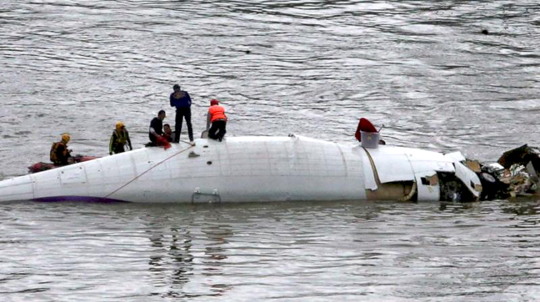
Yangon, Jun 8: Myanmar's military said Thursday it has found the wreckage of a plane in the Andaman Sea that went missing with around 120 people on board, along with several bodies.
Myanmar

A navy search ship scouring the waves found the bodies of a man, woman and child, as well as pieces of luggage, safety jackets and a tyre presumed to be from the aircraft's wheel.

"We have found the plane and some dead bodies this morning about 8.25 am (0155 GMT)," a spokesman from the military's information team told AFP.

The commander in chief's office confirmed wreckage had been found off the coast of Launglon, in southern Myanmar, on Thursday morning.

Nine navy ships and three air force planes had been dispatched in a desperate search for the aircraft, which disappeared on Wednesday afternoon as it flew from the southern city of Myeik to Yangon, Myanmar's commercial heart.

There was conflicting information on the number of people on board, but in the latest update the military said the plane was carrying a total of 122 people.

More than half of the passengers were from military families, including 15 children, along with 35 soldiers and 14 crew members, the army chief's office said in a statement.

Some were travelling for medical check-ups or to attend school in Yangon.

Search and rescue efforts continued Thursday morning as relatives of the passengers braced for the worst.

Wai Lin Aung said his mother had been on the plane after visiting his sister, who is married to a soldier based in Myeik.

"The whole family is very sad and we are waiting for news," he told AFP.

It is monsoon season in Myanmar but there were no reports of stormy weather in the area at the time.

The commander-in-chief's office said the plane lost contact with air traffic control at 1:35 pm (07:05 GMT) on Wednesday, about half an hour after takeoff.

The Myanmar military named the captain of the Shaanxi Y8 four-engine turboprop as Lieutenant Colonel Nyein Chan, who it said had more than 3,000 hours of flying experience.

The plane was bought in March 2016 and had a total of 809 flying hours.

The debris was found in the Andaman Sea, north of the last known location of Malaysia Airlines flight 370.

The plane went missing in March 2014 en route from Kuala Lumpur to Beijing with 239 people on board, but no wreckage has ever been found.

Myanmar's military fleet has a chequered recent history of plane crashes.

A five-strong crew died when an air force plane burst into flames soon after taking off from the capital Naypyidaw in February last year.

Three army officers were also killed in June when their Mi-2 helicopter crashed into a hillside and burst into flames in south-central Bago.

Comments

Add new comment

  • Coastaldigest.com reserves the right to delete or block any comments.
  • Coastaldigset.com is not responsible for its readers’ comments.
  • Comments that are abusive, incendiary or irrelevant are strictly prohibited.
  • Please use a genuine email ID and provide your name to avoid reject.
Agencies
January 20,2020

For the first time in the 15 years of the Global Risks Report, the climate change and environment risk has occupied all the top five slots.

According to the 15th edition of the World Economic Forum's (WEF) Global Risks Report, the top five risks in terms of likelihood are extreme weather, climate action failure, natural disasters, biodiversity loss and human-made environmental disasters. They all fall in the one category of climate change and related environmental disasters.

WEF President Borge Brende said the world was feeling long-mounting and interconnected risks.

The report also points to how citizens are protesting across the world as discontent rises with failed systems that are creating inequality. The citizens' discontent had hardened with systems that had failed to promote advancement, it said.

"Disapproval of how governments are addressing profound economic and social issues has sparked protests throughout the world, potentially weakening the ability of governments to take decisive action should a downturn occur. Without economic and social stability, countries could lack the financial resources, fiscal margin, political capital or social support needed to confront key global risks," it said.

Listing the grim scenario, Borge said the global economy was faced with "synchronised slowdown", the past five years had been the warmest on record and cyber attacks were expected to increase this year.

The report warns that while the myriad risks were rising, time was running out on how to prevent them.

Borge said the growing palpability of shared economic, environmental and societal risks indicated that the horizon had shortened for preventing "or even mitigating" some of the direst consequences of global risks.

"It's sobering that in the face of this development, when the challenges before us demand immediate collective action, fractures within the global community appear to only be widening," he said.

The report points to grave concern about the consequences of continued environmental degradation, including the record pace of species decline.

Pointing to an unsettled geopolitical environment, the report said today's risk landscape was one in which new centres of power and influence were forming and old alliance structures and global institutions were being tested.

"While these changes can create openings for new partnership structures in the immediate term, they are putting stress on systems of coordination and challenging norms around shared responsibility. Unless stakeholders adapt multilateral mechanisms for this turbulent period, the risks that were once on the horizon will continue to arrive," it said.

Calling it a "an unsettled world", the WEF report notes that powerful economic, demographic and technological forces were shaping a new balance of power. "The result is an unsettled geopolitical landscape in which states are increasingly viewing opportunities and challenges through unilateral lenses," it said.

"What were once givens regarding alliance structures and multilateral systems no longer hold as states question the value of long-standing frameworks, adopt more nationalist postures in pursuit of individual agendas and weigh the potential geopolitical consequences of economic decoupling. Beyond the risk of conflict, if stakeholders concentrate on immediate geo-strategic advantage and fail to re-imagine or adapt mechanisms for coordination during this unsettled period, opportunities for action on key priorities may slip away," the WEF said.

In a chapter on risks to economic stability and social cohesion, it said a challenging economic climate might persist this year and members of the multi-stakeholder community saw "economic confrontations" and "domestic political polarisation" as the top risks in 2020.

The report also warned of downward pressure on the global economy from macroeconomic fragilities and financial inequality. These pressures continued to intensify in 2019, increasing the risk of economic stagnation.

Low trade barriers, fiscal prudence and strong global investment, once seen as fundamentals for economic growth, are fraying as leaders advance nationalist policies. The margins for monetary and fiscal stimuli are also narrower than before the 2008-2009 financial crisis, creating uncertainty about how well countercyclical policies will work.

The strategic partners for the WEF report included Marsh & McLennan and Zurich Insurance Group. The academic advisers were National University of Singapore, Oxford Martin School, University of Oxford and Wharton Risk Management and Decision Processes Center, University of Pennsylvania.

Comments

Add new comment

  • Coastaldigest.com reserves the right to delete or block any comments.
  • Coastaldigset.com is not responsible for its readers’ comments.
  • Comments that are abusive, incendiary or irrelevant are strictly prohibited.
  • Please use a genuine email ID and provide your name to avoid reject.
Agencies
June 24,2020

Washington, Jun 24: Twitter has once again flagged a tweet from US President Donald Trump which promoted violence by saying if protesters tried to set up an "autonomous zone" in Washington, DC they would be met with "serious force".

This is the fourth time Twitter has red flagged Trump's tweet for glorifying violence or violating its policies.

Trump has been critical of the "autonomous zone" in Seattle, an area occupied by protestors for much of this month.

"We've placed a public interest notice on this Tweet for violating our policy against abusive behaviour, specifically, the presence of a threat of harm against an identifiable group," Twitter's safety team tweeted late Tuesday.

Trump had tweeted: "There will never be an ‘Autonomous Zone' in Washington, D.C., as long as I'm your President. If they try they will be met with serious force!"

Twitter earlier labeled a video tweeted by him which mocked CNN as manipulated media.

According to Twitter, "this Tweet has been labeled per our synthetic and manipulated media policy to give people more context".

In May, Twitter labeled two Trump tweets that made false claims about mail-in ballots in California.

Twitter later labeled another Trump tweet glorifying violence in which he said, "when the looting starts, the shooting starts."

Facebook also removed a Trump campaign ad featuring a symbol used by Nazis for political dissenters, saying the ad violated its policies.

Comments

Add new comment

  • Coastaldigest.com reserves the right to delete or block any comments.
  • Coastaldigset.com is not responsible for its readers’ comments.
  • Comments that are abusive, incendiary or irrelevant are strictly prohibited.
  • Please use a genuine email ID and provide your name to avoid reject.
News Network
May 2,2020

Balochistan, May 1: Sajid Hussain, Editor-in-Chief of Balochistan Times, has been found dead in a Swedish town, the police have confirmed.

The Swedish police informed his family on Thursday night that they discovered his body from a river in Uppsala, The Times reported.
The Baloch journalist had been missing from the Swedish city since March 2 this year.

Sajid, 39, left Pakistan in 2012 and had been living as a refugee in Sweden since 2017. He wrote extensively on the suffering of the Balochis at the hands of the Pakistani military establishment.

His work often got him into trouble as the authorities did not like his reporting of Balochistan's forbidden stories, the reason he had to leave and live in exile.

The Baloch journalist was found dead two months after he went missing in Sweden.
Sajid left Pakistan because of security threats from Pakistan Army and its intelligence service ISI.

The spokesperson of the Baloch National Movement, Hammal Haider told news agency: "We are deeply saddened by the demise of prominent Baloch intellectual and writer Sajid Hussain."
"His death is indeed a loss of a great mind for the people of Balochistan. Due to his straightforwardness, he was loved among all journalistic, literary and political circles," added Haider.

"After this incident, we have serious concerns about our members and other Baloch refugees living in the West," he said.

Comments

Add new comment

  • Coastaldigest.com reserves the right to delete or block any comments.
  • Coastaldigset.com is not responsible for its readers’ comments.
  • Comments that are abusive, incendiary or irrelevant are strictly prohibited.
  • Please use a genuine email ID and provide your name to avoid reject.