Nabeel Musthafa creates history in VTU, gets first rank with 12 gold medals

[email protected] (CD Network)
April 24, 2014
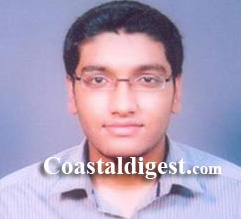
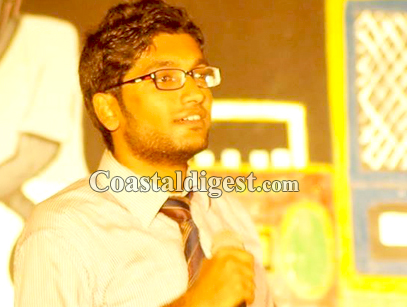
Bhatkal, Apr 24: Nabeel Musthafa of Anjuman Engineering College, Bhatkal, has secured 12 gold medals. He is the first rank holder in B.E. (Civil Engineering) and has also got the highest aggregate marks in all eight semester examinations conducted by Visvesvaraya Technological University (VTU). With this he created a new record by bagging maximum number of gold medals in the history of VTU.

nabeelAnnouncing this at a press meet in Bangalore, VTU Vice-Chancellor H Maheshappa said Mr Musthafa has scored 91.98 percent, securing the first place, among a total of 12,000 students who had appeared in the civil engineering examinations at the University, which is considered the top most university of Karnataka and under which a total 190 colleges are running.

Anjuman Hami-e-Muslimeen (AHM) General Secretary Abdur Raheem Jukaku said in a press release, this was the third time a student of AITM had secured a university rank.

“Our students have secured ranks in the years 2000 and 2007 previously. It is a matter of great pride for our institution,” he said.

“In 2007, one of students in the civil engineering department, Prasanna Kumar had secured the first rank and he was awarded with four gold medals,' said AITM vice principal professor Mushtaque Ahmed Bhavikatte.

AHM president S M Syed Khalil ur Rahman, Additional Secretary Siddique Ismail, college secretary S M Syed Saleem, Javid Hussain Armar and management members have congratulated Mustafa Nabeel for his achievement.

Other rank holders

Anushree R. of B.N.M. Institute of Technology, Bangalore, has got eight gold medals. She has got first rank in B.E. (Electrical & Electronics Engineering). Waseem Ahmad Ahanger of Vidyavardhaka College of Engineering, Mysore, secured six gold medals. He has got first rank in B.E. (Electronics & Communication Engineering).

Dayanand Sagar College of Engineering, Bangalore, has got 51 ranks, PG Studies at VTU campus 28 and M.V.J College of Engineering got 21 ranks.

Sam Pitroda to address VTU convocation on May 3

The Vice Chancellor also said that Sam Pitroda, advisor to Prime Minister, Public Information Infrastructure and Innovations, would deliver the convocation address. He will also receive honorary degree of D.Sc. Minister for Higher Education and VTU Pro-Chancellor R.V. Deshpande would be present.

Ved Prakash, chairman, University Grants Commission; H.K. Mittal, adviser and member secretary, National Science & Technology Entrepreneurship Development Board; and Secretary, Technology Development; and Vikram Kirloskar, industrialist, have been selected for the honorary degree of Doctor of Science (D.Sc.) of Visvesvaraya Technological University (VTU).

Governor H.R. Bhardwaj will confer the honour upon them at the annual convocation of VTU on its Jnana Sangama campus here on May 3.

Nabeel_mustafa

Comments

sabrina cheng
 - 
Friday, 15 Jul 2016

Timely piece - I appreciate the facts . Does someone know where my company might obtain a fillable a form example to work with ?

Add new comment

  • Coastaldigest.com reserves the right to delete or block any comments.
  • Coastaldigset.com is not responsible for its readers’ comments.
  • Comments that are abusive, incendiary or irrelevant are strictly prohibited.
  • Please use a genuine email ID and provide your name to avoid reject.
News Network
July 28,2020

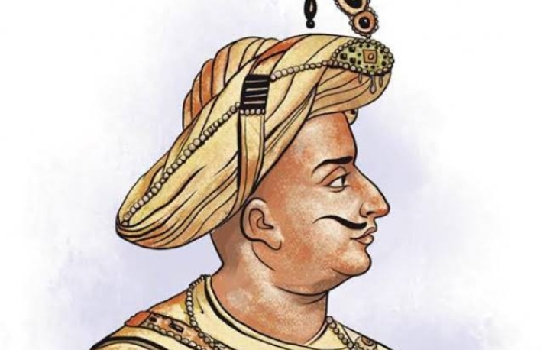
Bengaluru, Jul 28: After the Central Board of Secondary Education (CBSE) reduced the syllabi for Classes 9 to 12 due to COVID-19 pandemic, the Karnataka government has followed the suit. The Department of Public Instruction has omitted the chapters on legendary south Indian rulers Hyder Ali and Tipu Sultan from the textbooks of Class 7 in their attempt to reduce syllabus for state board schools by 30 per cent. 

The department, however, has decided to retain similar chapters on Tipu Sultan in 6th and 10th Classes, though the syllabus in text books for all classes from 1 to 10th has been trimmed. 

The trimmed textbooks uploaded on the website of the Department of State Education Research and Training (DSERT) by Karnataka state Textbook Society revealed removal of chapters on Tipu Sultan for the seventh grade.

Justifying the decision, officials said, "students study similar chapters in Class 6 and more in the 10th grade." Yet another senior official from the Text Book Society said, "Trimming does not mean we have removed half of the syllabus from textbooks. It is only keeping in mind the repetition we have condensed the chapters. In case students study about a particular dynasty in higher grades, then the same had been removed from lower grades."

A few months ago, there was an uproar over dropping of content on Tipu Sultan and MLAs from the ruling BJP also demanded the same and petitioned to the Chief Minister. Even an expert committee led by Prof Baraguru Ramachandrappa suggested to not drop any content on the historic figure. However, the department still decided to drop lessons from one of the classes while keeping the syllabus short for the next 120 active academic days.

Earlier this month, a controversy had erupted over the CBSE's decision to omit topics like federalism, secularism, citizenship, etc while reducing the syllabus for Classes 9 to 12. The education board had issued a detailed clarification later, stating that topics claimed to be dropped "are either being covered by the rationalised syllabus or in the Alternative Academic Calendar of NCERT".

"The rationalisation of syllabus up to 30 per cent has been undertaken by the Board for nearly 190 subjects of class 9 to 12 for the academic session 2020-21 as a one-time measure only. The objective is to reduce the exam stress of students due to the prevailing health emergency situation and prevent learning gaps," it said.

Last week, the Congress in Uttar Pradesh expressed its concern over 'deliberate and systematic' deletions of chapters related to the freedom struggle and the party's role in it from the Class 10-12 syllabi of the Secondary Education Board.

Comments

Add new comment

  • Coastaldigest.com reserves the right to delete or block any comments.
  • Coastaldigset.com is not responsible for its readers’ comments.
  • Comments that are abusive, incendiary or irrelevant are strictly prohibited.
  • Please use a genuine email ID and provide your name to avoid reject.
News Network
June 8,2020

Bengaluru, Jun 8: Normal life is slowly returning to normal across Karnataka with the state government further easing the restrictions by throwing open places of worship, hotels, malls for the public.

Despite these places being opened after a gap of more than two months, the places wore a deserted look as the people are and cautious and not ready to take of risk of venturing out amid the ongoing Corona threat.

"Business is not as heavy as expected though it was allowed after a gap of almost three months. You can see for yourself the crowd, it is not what it should have been in a commercial area like this prior to the imposition of lockdown. However, hope it will improve", a Cloth merchant B Ramesh told UNI when asked for his reaction.

Comments

Add new comment

  • Coastaldigest.com reserves the right to delete or block any comments.
  • Coastaldigset.com is not responsible for its readers’ comments.
  • Comments that are abusive, incendiary or irrelevant are strictly prohibited.
  • Please use a genuine email ID and provide your name to avoid reject.
News Network
February 6,2020

Kalaburagi, Feb 6: The State government will take steps to ensure that Kannada as a language is taught in all private schools, Chief Minister B.S. Yediyurappa announced today at the 85th Akhila Bharata Kannada Sahitya Sammelana in Kalaburagi.

This comes in the wake of the demand by some Kannada activists for making Kannada medium compulsory in all schools in the State. Sammelana president H.S. Venkatesh Murthy, who spoke after the Chief Minister, also made this demand.

The Chief Minister said “We are committed to putting in place a series of steps to see that Kannada is taught in all schools, aided and private, as a language. Kannada should be taught as the first or second language. We will also take steps to strengthen government schools. However, the government alone cannot do much. The community and parents should offer support to make sure that government schools provide quality education to all.”

To inculcate the spirit of scientific inquiry, the State government is setting up mobile planetariums. This will increase the interest of children in space technology and India’s efforts in space exploration.

The government is committed to protecting the interests of the State in Mahadayi and other river water disputes. It will take the border row issue, based on the Mahajan Commission report pending in the Supreme Court, to its logical end.

The government will also address backwardness and related issues. It will make sure that adequate funds are allocated to the development of Kalyana Karnataka. Among other things, it will establish a hostel for students from Kalaburagi region in Bengaluru. Land has been allotted in Nagarabavi for the hostel that can accommodate around 200 students. The government has decided to celebrate Kalyana Karnataka Utsav once every two years. This will showcase the culture of the region.

“We are working towards forging sentimental and emotional unity of the State other than unity based on language or administration. Our dream is to see that Karnataka remains a homogeneous unit with equality and equal opportunity for all,’’ the Chief Minister added.

Kambar bats for technology

Chandrashekar Kambar, Sahitya Akademi president and former president of the Akhila Bharata Kannada Sahitya Sammelana, favoured effective implementation of technology in administration and for universal use of Kannada in computing and e-governance.

Speaking at the Sammelana inauguration, he said “Several years ago, at the insistence of writer Poornachandra Tejaswi, I appealed to the State government to give a push to Kannada computing. We were convinced that no language can survive without the use of modern technology and use of the language in computers. The Department of Kannada and Culture, headed by then director Manu Baligar, released ₹2 crore for the project. The work began in earnest and teams of technologists came up with software and fonts. Some departments started using Kannada software. But this work has stopped or slowed down at some level. I appeal to Chief Minister B.S. Yediyurappa to continue the work and ensure that computerised Kannada is used at all levels of government and in e-governance.’’

Supports dubbing

Mr. Kambar batted for content dubbing of informative TV channels in Kannada. Channels such as Discovery and History produce good quality content that can be educative and informative. They are very useful for children. These channels are now available in Tamil, Telugu and Hindi and some other Indian languages. But they are not available in Kannada. That is because some people in the film industry are opposing dubbing. Such opposition is not good. Informative channels are our window to the world and allowing dubbing will enhance our knowledge base. There is no merit in not allowing dubbing. I appeal to C.T. Ravi, Minister for Kannada and Culture, to allow dubbing in Kannada, he said.

Mr. Kambar favoured primary education in the mother tongue of the child and urged the State government to introduce universal and compulsory education in Kannada medium in all schools. “This will help preserve our culture. Nothing else can,’’ he said.

He blamed the East India Company administration for inculcating a craze for English education among the people. “The introduction of English education by the British was strongly welcomed by the masses in India as they had been denied the opportunity for education for millenia. The deprived classes and Dalits who had not been exposed to education till then, were excited about the opportunity. However, along with English education, the British were successful in introducing inferiority in our minds. We are yet to escape from this inferiority complex.”

Quoting from Greek mythology, Mr. Kambar said that Hercules had killed his children and relatives in a fit of alcohol-induced rage. “We should not behave like that. We may be very strong, but we should not kill our mother tongue, in our power-induced rage,’’ he said.


Comments

Add new comment

  • Coastaldigest.com reserves the right to delete or block any comments.
  • Coastaldigset.com is not responsible for its readers’ comments.
  • Comments that are abusive, incendiary or irrelevant are strictly prohibited.
  • Please use a genuine email ID and provide your name to avoid reject.