Name Valencia – Jeppu Road after Konkan Kogul Wilfy Rebimbus: KWAA

[email protected] (CD Network)
January 14, 2017

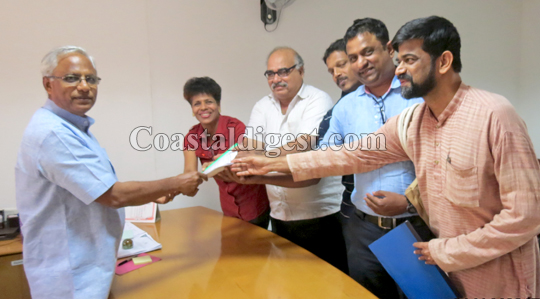
Mangaluru, Jan 14: Konkani Writers and Artistes Association has requested the government to name the Valencia Circle to Koti Chennaya Circle Road after late singer Wilfy Rebimbus in recognition of his invaluable service to the cause of Konkani music, language, literature, plays, Konkani films and Konkani journalism.

KWAA 1

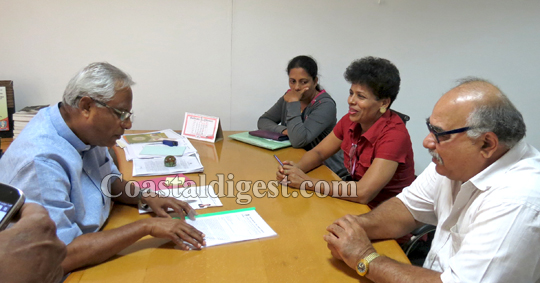
President of KWAA Ronald Sequeira, Secretary Florine Roche and members Roshan Madtha, Wilson Kateel and Henry Mendonca submitted a memorandum to Mangalore south MLA J R Lobo in this regard.

The members said that 2017 marks the 75th birth anniversary of this Konkani legend who strived relentlessly to give recognition to Konkani music, language and literature at global level. Wilfly Rebimbus was born in Valencia and spent his lifetime working for Konkani in Valencia and therefore naming the road from Valencia circle to Koti Chennayya Circle after him would be a befitting tribute and honour to this living legend.

The members stated that Late Wifly who is rightly honoured with the title “Konkan Kogul” lives in the hearts of Konkani people through his songs and he should be honoured befitting his contribution for promoting Konkani.

In a press release the association pointed out that copy of the memorandum was also submitted to Chief Whip of Karnataka Legislative Council Mr. Ivan D Souza with a request to take up the matter with Urban Development Ministry and other concerned departments as the resolution to the effect was already passed in the council meeting of Mangalore City Corporation.

About KWAA

Konkani Writers and artists Association is registered body working for the general and social cause of promoting, fostering, protecting and propagating Konkani Language , Konkani Literature , Konkani Art and Culture , general welfare of writers and artists in konkani language, literature, art and culture , creating awareness amongst the public as to the wealth and depth of literature, art and culture and also fighting against the illegal, injustice, misuse of public money and property , malpractices or unlawful actions by any organization, Institution, association or any group of people, directly or indirectly, in the field of language, literature , art and culture.

KWAA 2

Comments

abdullah
 - 
Saturday, 14 Jan 2017

What he done for the Society?
HE EARNED MONEY FOR HIMSELF.

Add new comment

  • Coastaldigest.com reserves the right to delete or block any comments.
  • Coastaldigset.com is not responsible for its readers’ comments.
  • Comments that are abusive, incendiary or irrelevant are strictly prohibited.
  • Please use a genuine email ID and provide your name to avoid reject.
Ram Puniyani
February 10,2020

Noam Chomsky is one of the leading peace workers in the world. In the wake of America’s attack on Vietnam, he brought out his classic formulation, ‘manufacturing consent’. The phrase explains the state manipulating public opinion to have the public approve of it policies—in this case, the attack of the American state on Vietnam, which was then struggling to free itself from French colonial rule.

In India, we are witness to manufactured hate against religious minorities. This hatred serves to enhance polarisation in society, which undermines India’s democracy and Constitution and promotes support for a Hindu nation. Hate is being manufactured through multiple mechanisms. For example, it manifests in violence against religious minorities. Some recent ghastly expressions of this manufactured hate was the massive communal violence witnessed in Mumbai (1992-93), Gujarat (2002), Kandhamal (2008) and Muzaffarnagar (2013). Its other manifestation was in the form of lynching of those accused of having killed a cow or consumed beef. A parallel phenomenon is the brutal flogging, often to death, of Dalits who deal with animal carcasses or leather.

Yet another form of this was seen when Shambhulal Regar, indoctrinated by the propaganda of Hindu nationalists, burned alive Afrazul Khan and shot the video of the heinous act. For his brutality, he was praised by many. Regar was incited into the act by the propaganda around love jihad. Lately, we have the same phenomenon of manufactured hate taking on even more dastardly proportions as youth related to Hindu nationalist organisations have been caught using pistols, while police authorities look on.

Anurag Thakur, a BJP minster in the central government recently incited a crowd in Delhi to complete his chant of what should happen to ‘traitors of the country...” with a “they should be shot”. Just two days later, a youth brought a pistol to the site of a protest at Jamia Millia Islamia university and shouted “take Azaadi!” and fired it. One bullet hit a student of Jamia. This happened on 30 January, the day Nathuram Godse had shot Mahatma Gandhi in 1948. A few days later, another youth fired near the site of protests against the CAA and NRC at Shaheen Bagh. Soon after, he said that in India, “only Hindus will rule”.

What is very obvious is that the shootings by those associated with Hindu nationalist organisations are the culmination of a long campaign of spreading hate against religious minorities in India in general and against Muslims in particular. The present phase is the outcome of a long and sustained hate campaign, the beginning of which lies in nationalism in the name of religion; Muslim nationalism and Hindu nationalism. This sectarian nationalism picked up the communal view of history and the communal historiography which the British introduced in order to pursue their ‘divide and rule’ policy.

In India what became part of “social common sense” was that Muslim kings had destroyed Hindu temples, that Islam was spread by force, and that it is a foreign religion, and so on. Campaigns, such as the one for a temple dedicated to the Hindu god Rama to be built at the site where the Babri masjid once stood, further deepened the idea of a Muslim as a “temple-destroyer”. Aurangzeb, Tipu Sultan and other Muslim kings were tarnished as the ones who spread Islam by force in the subcontinent. The tragic Partition, which was primarily due to British policies, and was well-supported by communal streams also, was entirely attributed to Muslims. The Kashmir conflict, which is the outcome of regional, ethnic and other historical issues, coupled with the American policy of supporting Pakistan’s ambitions of regional hegemony, (which also fostered the birth of Al-Qaeda), was also attributed to the Muslims.

With recurring incidents of communal violence, these falsehoods went on going deeper into the social thinking. Violence itself led to ghettoisation of Muslims and further broke inter-community social bonds. On the one hand, a ghettoised community is cut off from others and on the other hand the victims come to be presented as culprits. The percolation of this hate through word-of-mouth propaganda, media and re-writing of school curricula, had a strong impact on social attitudes towards the minorities.

In the last couple of decades, the process of manufacturing hate has been intensified by the social media platforms which are being cleverly used by the communal forces. Swati Chaturvedi’s book, I Am a Troll: Inside the Secret World of the BJP’s Digital Army, tells us how the BJP used social media to spread hate. Whatapp University became the source of understanding for large sections of society and hate for the ‘Other’, went up by leaps and bounds. To add on to this process, the phenomenon of fake news was shrewdly deployed to intensify divisiveness.

Currently, the Shaheen Bagh movement is a big uniting force for the country; but it is being demonised as a gathering of ‘anti-nationals’. Another BJP leader has said that these protesters will indulge in crimes like rape. This has intensified the prevalent hate.

While there is a general dominance of hate, the likes of Shambhulal Regar and the Jamia shooter do get taken in by the incitement and act out the violence that is constantly hinted at. The deeper issue involved is the prevalence of hate, misconceptions and biases, which have become the part of social thinking.

These misconceptions are undoing the amity between different religious communities which was built during the freedom movement. They are undoing the fraternity which emerged with the process of India as a nation in the making. The processes which brought these communities together broadly drew from Gandhi, Bhagat Singh and Ambedkar. It is these values which need to be rooted again in the society. The communal forces have resorted to false propaganda against the minorities, and that needs to be undone with sincerity.

Combating those foundational misconceptions which create hatred is a massive task which needs to be taken up by the social organisations and political parties which have faith in the Indian Constitution and values of freedom movement. It needs to be done right away as a priority issue in with a focus on cultivating Indian fraternity yet again.


Comments

Add new comment

  • Coastaldigest.com reserves the right to delete or block any comments.
  • Coastaldigset.com is not responsible for its readers’ comments.
  • Comments that are abusive, incendiary or irrelevant are strictly prohibited.
  • Please use a genuine email ID and provide your name to avoid reject.
News Network
January 10,2020

Mangaluru, Jan 10: A gang of smugglers, who were planning to illegally export 4,000 kg of red sandalwood worth Rs 2 crore through New Mangalore Port, were nabbed in a joint operation by the anti-rowdy squad of Mangaluru North sub-division and sleuths of Panambur police station.

The arrested have been identified as Tabrez (36), Lohith (35), Rakesh Shetty (44), Hussain kunhimonu (45) and Farooq (45).

Commissioner of Police Dr P S Harsha said that red sandalwood worth Rs 2 crore were seized from the accused.

The other seized properties from the arrested include a Maruti Brezza, Renault Pulse, Tata Ace, two plywood boxes and seven mobile phones valued Rs 19 lakh.

Based on a tip off, the police raided a godown on the road leading to Jokatte from Baikamlady Industrial Area and seized 4,000 kg of red sanders worth  Rs 2 crore.

A case has been registered under Sections 50, 62, 80, 104 of Karnataka Forest Act and 144, 165 of Karnataka Forest Rules at the Panambur police station.

Comments

Add new comment

  • Coastaldigest.com reserves the right to delete or block any comments.
  • Coastaldigset.com is not responsible for its readers’ comments.
  • Comments that are abusive, incendiary or irrelevant are strictly prohibited.
  • Please use a genuine email ID and provide your name to avoid reject.
News Network
May 24,2020

Bengaluru, May 24:The first 'Sunday curfew' imposed by the Karnataka government to try and contain the spread of COVID-19 got underway in the state today, with people by and large adhering to norms, roads wearing a deserted look and almost no vehicular traffic, barring essential services.

With barricades being up across most roads in the state, people ventured out only to purchase groceries, vegetabes and medicines.

Instances of violation of Sunday curfew lockdown norms were reported in COVID-19 hotspots of Shivajinagar and Rayapura in Bengaluru and Nelamangala and Devanahalli.

Temples, malls, bars, eateries and small food joints remained shut throughout state.

In most parts of the state buses, autorickshaws and cabs did not ply.

In Bengaluru, the ever bustling Majestic area, which houses the central city bus stand, inter-city bus stand, Metro Railway Station and the City Railway Station, did not see any activity as buses did not ply and all shops were shut, police said.

Reports from Mysuru, Tumakuru, Kolar, Mangaluru, Udupi and other towns across the state said there were no lockdown violations.

Amid the rigid curfew marriages were conducted in a simple manner in various parts of the state like Gollarahatti and Yashwanthapura in Bengaluru and also in Davangere.

Families of the brides and grooms invited only a few people for the event, adhered to social distancing norms and wore masks.

In Gollarahatti, the event organisers cleaned the road, after which the invitees, who were hardly 25 to 30 in number, sat down to have a feast.

The Karnataka government had eased restrictions during Lockdown 4 for start of economic activities like city buses, inter-district bus service, intrastate train services, opening of shops and markets.

However, the government had made it clear that there will be 'Janata Curfew' every Sunday during which only essential services would be permitted.

Comments

Add new comment

  • Coastaldigest.com reserves the right to delete or block any comments.
  • Coastaldigset.com is not responsible for its readers’ comments.
  • Comments that are abusive, incendiary or irrelevant are strictly prohibited.
  • Please use a genuine email ID and provide your name to avoid reject.