


Never talked about charging migrant labourers; 85% fare borne by railways, 15% by state govts: Centre

Agencies
May 4, 2020

New Delhi, May 4: The government has not talked about charging anything from migrant labourers as 85 per cent of the transportation cost is borne by the railways and 15 per cent by state governments, the Centre said on Monday amid a row over the national transporter allegedly charging the workers for ferrying them home during the COVID-19-induced lockdown.

The government also said the process of transporting the stranded migrant labourers was being coordinated by states “except for one or two states”.

Asked if the migrant labourers were being charged for being ferried home, Joint Secretary at the Health Ministry Lav Agarwal said that as far as migrant labourers are concerned, the guidelines have clearly stated that under the infectious disease management one should stay where he or she is.

“Based on the request given from states for particular cases, permission was given to run special trains. Be it government of India or the Railways, we have not talked about charging from workers. Eighty-five per cent of the transportation cost is borne by the Railways, while states have to bear 15 per cent of the cost,” he told reporters.

“Based on the request of the states the process that started, under which limited number of stranded migrant labourers have to be transported for a particular reason, is being coordinated by the state governments, except for one or two states,” Agarwal said.

At the daily briefing on the COVID-19 situation, Agarwal also said that in the last 24 hours, 1,074 COVID-19 patients have recovered, the highest number of recoveries in one day.

The recovery rate stands at 27.52 per cent with 11,706 COVID-19 patients cured till now, he said.

Agarwal said in the last 24 hours, 2,553 novel coronavirus cases were reported, taking the number of overall cases to 42,533. The total number of active cases stands at 29,453, he said.

The joint secretary also said that the COVID-19 curve is relatively flat as of now and it was not right to talk in terms of when the peak would come.

“If we collectively work then the peak might not ever come, while if we fail in any way we might experience a spike in cases,” he said.

Amitabh Kant, Chairman of the Empowered Group dealing with civil society, NGOs, industries and international partners, said in 112 aspirational districts, “we worked with the collectors and in these 112 districts only 610 cases have been reported which is two per cent of the national level infection”.

In these 112 districts, 22 per cent of India's population resides, he said.

In a few districts like Baramulla, Nuh Rachi, Kupwara and Jaisalmer more than 30 cases have been reported, while in the rest of the places very few cases are there, Kant said.

Comments

alert
 - 
Tuesday, 5 May 2020

why is no one talking about privatized railways? why Adani is not offering free travel to laborers?

Add new comment

  • Coastaldigest.com reserves the right to delete or block any comments.
  • Coastaldigset.com is not responsible for its readers’ comments.
  • Comments that are abusive, incendiary or irrelevant are strictly prohibited.
  • Please use a genuine email ID and provide your name to avoid reject.
coastaldigest.com web desk
August 1,2020

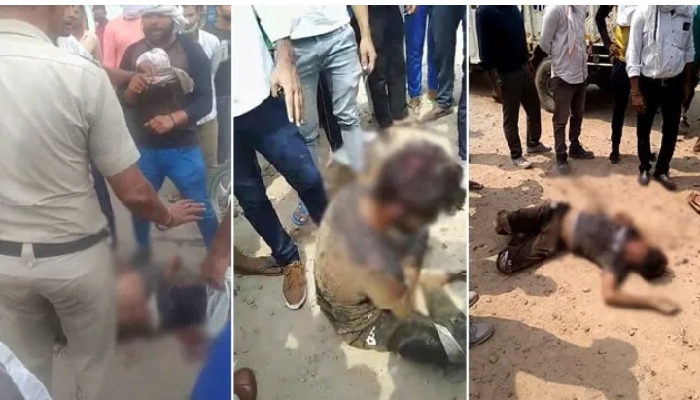
New Delhi, July 1: In a terrific incident with chilling echoes of the 2015 Dadri mob lynching, a Muslim man, who was carrying meat, was savagely attacked by a mob belonging to a saffron outfit in the presence of in BJP ruled Haryana on the eve of Eid al-Adha. 

The incident occurred at around 9 a.m. on Friday, July 31 at Badshahpur village in Haryana’s Gurgaon, when Lukman was transporting meat in a pic-kup truck. 

The attack was captured on mobile phones by onlookers and the video clips of the incident are now spreading on social media. 

A group of saffronite cow vigilantes chased the truck for about 8 km managed waylay it. Lukman, who was driving the truck was pulled out and brutally assaulted on the suspicion that he was transporting cow meat.

Just like Dadri, the police were faster at sending the meat to a lab for testing than catching any one of the suspects. One of the assailants - Pradeep Yadav- has been arrested. 

After being beating to an inch of his life, Lukman was bundled into the pick-up truck and taken back to Gurgaon's Badshahpur village where the goons started thrashing him again.

This is when the police stepped in and stopped them - only to find the assailants fearless enough to even take on them.

Lukman was taken to a hospital and the police filed a case against "unidentified individuals" even though the video of the incident recorded by witnesses shows the faces of the assailants.

The owner of the vehicles said that the meat was buffalo and he has been in the business for 50 years.

The police have so far refused to give a statement on record on the incident and explain their inaction as seen on video.

Comments

Add new comment

  • Coastaldigest.com reserves the right to delete or block any comments.
  • Coastaldigset.com is not responsible for its readers’ comments.
  • Comments that are abusive, incendiary or irrelevant are strictly prohibited.
  • Please use a genuine email ID and provide your name to avoid reject.
Agencies
July 20,2020

Mumbai, Jul 20: The Bombay High Court on Monday asked the NIA and the Maharashtra government to inform it about the health condition of poet Varavara Rao, an accused in the Elgar Parishad-Maoists links case, and if his family could be allowed to see him "from a reasonable distance".

The directions came after Rao's lawyer told the court that the activist was "almost on his deathbed".

Rao, 81, is currently admitted in the Nanavati Hospital here. He tested positive for coronavirus earlier this month and is also suffering from several other ailments.

A division bench of Justices S S Shinde and S P Tavade asked the National Investigation Agency (NIA) and the state to inform the court about Rao's health condition and clarify by July 22 whether his family members could be permitted to see him.

Rao's lawyer Sudeep Pasbola told the court that the activist was "almost on his deathbed" and that if he were to die, it should be in the presence of his family.

"His condition is very serious. He hit his head against the hospital bed while he was at the J J hospital and sustained severe injuries. Besides COVID-19, he suffers from several ailments, he is hallucinating and is delirious," Pasbola said.

"His days are numbered and if he is to die, at least let him die in the presence of his family members," the lawyer said while seeking that Rao be granted bail. Pasbola said Rao was in no condition to cause any prejudice to the probe in the case and even the NIA could not dispute this fact.

The bench, however, asked if Rao was in such a critical condition, wouldn't it be counterproductive to move him out of the hospital, and take him to any other place? "Also, if he has COVID-19, then how can he meet his family?" the court asked.

To this, Pasbola said if permitted, Rao's family could take precautions, and see him from a distance. The state's counsel, Deepak Thakare, told the high court that it could arrange for video-conferencing facilities for Rao's family.

Additional Solicitor General Anil Singh, who appeared for the NIA, said as far as he knew, "COVID-19 patients could not be permitted to meet anyone". He also said Rao had been admitted to "one of the best multi-speciality hospitals in the city," and that he was being taken care of in accordance with guidelines of the Indian Council of Medical Research (ICMR).

"We are providing the best treatment to him, all his medical needs are being attended to and we are following ICMR guidelines in treating him for COVID-19," Singh said. The court, while seeking details from the NIA and the state, said, "Can his family members see him from a reasonable distance in the hospital?"

Rao earlier filed two pleas in HC through his lawyer. One was to direct the state to produce all his medical reports from the state-run J J Hospital, where he was admitted in May but discharged hurriedly on June 2 and sent back to Taloja jail in neighbouring Navi Mumbai.

The other plea sought bail on health grounds.

The same bench also heard a petition filed by Rao's co-accused in the case, activists Vernon Gonsalves and Anand Teltumbde, seeking that they be tested for COVID-19 as they had been in close contact with Rao in the jail.

The court directed the prison authorities and the NIA to respond to the plea by July 23. "The prayer in the petition is limited. You (authorities) carry out the test for COVID-19 and see. If they are negative then good," the court said.

It noted that they (Gonsalves and Teltumbde) are lodged in the Taloja jail where there have been cases of inmates testing positive for coronavirus. Besides, the hearing on the plea of activist Sudha Bharadwaj, also an accused in the case, seeking bail on health grounds was adjourned after the court found the Byculla women prison superintendent's report on her health to be "illegible".

Her plea will also be heard on July 23.

Bharadwaj has been in jail since September 2018. She applied for bail on health grounds after an inmate at the Byculla prison tested positive for coronavirus last month.

Rao and nine other activists were arrested in the Elgar Parishad-Maoist links case, which was initially probed by the Pune Police and later transferred to the NIA.

Comments

Add new comment

  • Coastaldigest.com reserves the right to delete or block any comments.
  • Coastaldigset.com is not responsible for its readers’ comments.
  • Comments that are abusive, incendiary or irrelevant are strictly prohibited.
  • Please use a genuine email ID and provide your name to avoid reject.
Agencies
June 29,2020

New Delhi, Jun 29: The Supreme Court on Monday asked the Central government to find out the facts related to blacklisting and canceling of visas of foreign nationals who attended the congregation of Tablighi Jamaat in Nizamuddin area here.

A three-judge bench headed by Justice AM Khanwilkar and also comprising Justices Dinesh Maheshwari and Sanjiv Khanna asked the Centre to find out the facts related to the matter and fixed it for further hearing on July 2.

The apex court asked Solicitor General Tushar Mehta "if visas of these foreigners are canceled, then why are they still in India?"

"You (Centre) can deport them. If visas are not canceled, then, it is a different situation," the court said. The top court was hearing a number of petitions challenging blacklisting and cancellation of visas filed by few foreigners.

Mehta sought more time to file a reply on the matter, after which the court posted the matter for further hearing on July 2.

The petitions, filed by the foreign nationals from 35 countries, have sought directions to the Ministry of Home Affairs (MHA) to remove their names from the blacklist, reinstate their visas and facilitate their return to their respective countries.

The petitions sought to declare the decision of the MHA of blacklisting the foreign nationals who attended the Tablighi Jamaat congregation as "arbitrary".

"Unilateral blacklisting of 960 foreigners by the Home Ministry vide press release dated April 2, 2020, and the subsequent blacklisting of around 2500 foreigners as reported on June 4, 2020, is in violation of Article 21. Therefore, it is void and unconstitutional as the petitioners have neither been provided any hearing nor notice or intimation in this regard," the plea said.

One of the petitioners named Fareedah Cheema, a Thai national in the seventh month of her pregnancy, said she was quarantined in March, like other foreign nationals but was released from quarantine only in late May and is still at a facility under restricted movements, without the avenue to go back to her home nation and experience the birth of her child with security and dignity, with her loved ones.

These foreign nationals presently in India were blacklisted for a period of 10 years from traveling to India for their alleged involvement in Tablighi Jamaat activities.

The Home Ministry had said that foreign Tablighi Jamaat members, who were staying in India in violation of visa rules during the nationwide lockdown implemented to combat the COVID-19 spread, have been blacklisted.
A large congregation organised by Tablighi Jamaat in the national capital in March had emerged as a major COVID-19 hotspot in the country.

The government had said the decision of banning the foreign Tablighi Jamaat members was taken after details of foreigners found illegally living in mosques and religious places emerged from various states across the country.

Comments

Add new comment

  • Coastaldigest.com reserves the right to delete or block any comments.
  • Coastaldigset.com is not responsible for its readers’ comments.
  • Comments that are abusive, incendiary or irrelevant are strictly prohibited.
  • Please use a genuine email ID and provide your name to avoid reject.