


Never talked about charging migrant labourers; 85% fare borne by railways, 15% by state govts: Centre

Agencies
May 4, 2020

New Delhi, May 4: The government has not talked about charging anything from migrant labourers as 85 per cent of the transportation cost is borne by the railways and 15 per cent by state governments, the Centre said on Monday amid a row over the national transporter allegedly charging the workers for ferrying them home during the COVID-19-induced lockdown.

The government also said the process of transporting the stranded migrant labourers was being coordinated by states “except for one or two states”.

Asked if the migrant labourers were being charged for being ferried home, Joint Secretary at the Health Ministry Lav Agarwal said that as far as migrant labourers are concerned, the guidelines have clearly stated that under the infectious disease management one should stay where he or she is.

“Based on the request given from states for particular cases, permission was given to run special trains. Be it government of India or the Railways, we have not talked about charging from workers. Eighty-five per cent of the transportation cost is borne by the Railways, while states have to bear 15 per cent of the cost,” he told reporters.

“Based on the request of the states the process that started, under which limited number of stranded migrant labourers have to be transported for a particular reason, is being coordinated by the state governments, except for one or two states,” Agarwal said.

At the daily briefing on the COVID-19 situation, Agarwal also said that in the last 24 hours, 1,074 COVID-19 patients have recovered, the highest number of recoveries in one day.

The recovery rate stands at 27.52 per cent with 11,706 COVID-19 patients cured till now, he said.

Agarwal said in the last 24 hours, 2,553 novel coronavirus cases were reported, taking the number of overall cases to 42,533. The total number of active cases stands at 29,453, he said.

The joint secretary also said that the COVID-19 curve is relatively flat as of now and it was not right to talk in terms of when the peak would come.

“If we collectively work then the peak might not ever come, while if we fail in any way we might experience a spike in cases,” he said.

Amitabh Kant, Chairman of the Empowered Group dealing with civil society, NGOs, industries and international partners, said in 112 aspirational districts, “we worked with the collectors and in these 112 districts only 610 cases have been reported which is two per cent of the national level infection”.

In these 112 districts, 22 per cent of India's population resides, he said.

In a few districts like Baramulla, Nuh Rachi, Kupwara and Jaisalmer more than 30 cases have been reported, while in the rest of the places very few cases are there, Kant said.

Comments

alert
 - 
Tuesday, 5 May 2020

why is no one talking about privatized railways? why Adani is not offering free travel to laborers?

Add new comment

  • Coastaldigest.com reserves the right to delete or block any comments.
  • Coastaldigset.com is not responsible for its readers’ comments.
  • Comments that are abusive, incendiary or irrelevant are strictly prohibited.
  • Please use a genuine email ID and provide your name to avoid reject.
coastaldigest.com web desk
August 1,2020

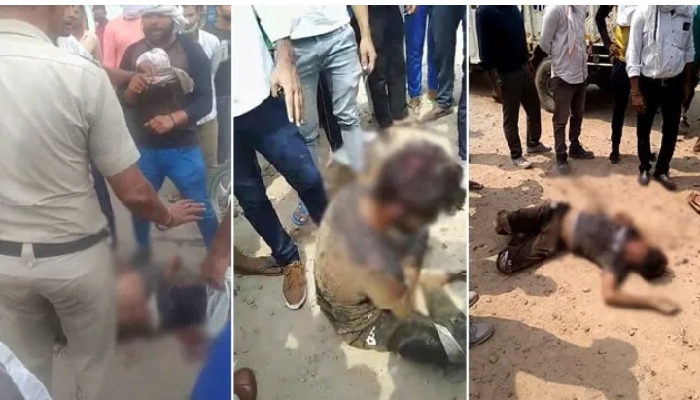
New Delhi, July 1: In a terrific incident with chilling echoes of the 2015 Dadri mob lynching, a Muslim man, who was carrying meat, was savagely attacked by a mob belonging to a saffron outfit in the presence of in BJP ruled Haryana on the eve of Eid al-Adha. 

The incident occurred at around 9 a.m. on Friday, July 31 at Badshahpur village in Haryana’s Gurgaon, when Lukman was transporting meat in a pic-kup truck. 

The attack was captured on mobile phones by onlookers and the video clips of the incident are now spreading on social media. 

A group of saffronite cow vigilantes chased the truck for about 8 km managed waylay it. Lukman, who was driving the truck was pulled out and brutally assaulted on the suspicion that he was transporting cow meat.

Just like Dadri, the police were faster at sending the meat to a lab for testing than catching any one of the suspects. One of the assailants - Pradeep Yadav- has been arrested. 

After being beating to an inch of his life, Lukman was bundled into the pick-up truck and taken back to Gurgaon's Badshahpur village where the goons started thrashing him again.

This is when the police stepped in and stopped them - only to find the assailants fearless enough to even take on them.

Lukman was taken to a hospital and the police filed a case against "unidentified individuals" even though the video of the incident recorded by witnesses shows the faces of the assailants.

The owner of the vehicles said that the meat was buffalo and he has been in the business for 50 years.

The police have so far refused to give a statement on record on the incident and explain their inaction as seen on video.

Comments

Add new comment

  • Coastaldigest.com reserves the right to delete or block any comments.
  • Coastaldigset.com is not responsible for its readers’ comments.
  • Comments that are abusive, incendiary or irrelevant are strictly prohibited.
  • Please use a genuine email ID and provide your name to avoid reject.
News Network
June 17,2020

New Delhi, 17: Tensions on the Indo-China border have spiked to the highest since 1962 after over 20 troops, including an Indian commanding officer, were killed in the face-off in Galwan valley that has seen a six-week long standoff underway with the Peoples Liberation Army.

The Army said that the soldiers – including the Commanding Officer of 16 Bihar regiment in charge of the area – died while a `de-escalation process’ was underway. Sources said that this death toll could rise up as some soldiers are currently not accounted for after PLA troops attacked with spiked sticks and stones in the Galwan valley.

Chinese side also has casualties but the number is still not known. The Indian death toll is perhaps the worst single day loss in decades and has come at a time when thousands of troops are forward deployed in Eastern Ladakh.

ET was the first to report on May 12 about a massive troop build up in the Galwan valley, which is an old flashpoint that had seen action in the 1962 war as well.

There have been reports of casualties on the Chinese side in the clash but numbers are currently not available. Worryingly, information from the ground suggests that several Indian soldiers, including four officers, are missing and could have been taken captive by a vastly larger Chinese force. Their status is still not known.

“During the de-escalation process underway in the Galwan Valley, a violent face-off took place yesterday night with casualties. The loss of lives on the Indian side includes an officer and two soldiers. Senior military officials of the two sides are currently meeting at the venue to defuse the situation,” an Indian Army statement reads.

The Ministry of External Affairs said that the clash occurred when the Chinese side violated the LAC. “On the late-evening and night of 15th June, 2020 a violent face-off happened as a result of an attempt by the Chinese side to unilaterally change the status quo there. Both sides suffered casualties that could have been avoided had the agreement at the higher level been scrupulously followed by the Chinese side,” a statement reads.

The loss of the Commanding Officer is especially devastating and he had been directly involved in de-escalation talks with the Chinese side, including one hours before the clash took place. Sources said that the talks on Monday morning had led to an agreement for Chinese forces to withdraw from Indian territory as part of the disengagement.

According to one version, the CO had gone to the standoff point with a party of 50 men to check if the Chinese had retreated as promised. As the Indian side proceeded to demolish and burn illegal Chinese structures on its side of the LAC, including an observation post constructed on the South bank of the river, a fresh stand off took place as a large force of Chinese troops returned back.

Sources said that a Chinese force in excess of 250 quickly assembled near Patrol Point 14 and were physically stopped by Indian soldiers from entering Indian territory. Soldiers from both sides did not use firearms but the Chinese soldiers carried spiked sticks to attack.

Given the terrain of the region, a part of the standoff and clash took place in the middle of the Galwan river that is currently flowing at full spate, leading to high casualties as injured soldiers got swept away. Indian soldiers have to cross the Galwan river at atleast five points to reach PP 14, which marks the LAC.

Chinese media reports on Tuesday quoted the spokesperson from its Western Theatre Command as laying claim over the Galwan valley region and blaming the Indian side for the clash. Reports quoted Col Zhang Shuili as saying that India has violated the consensus made during Army commander level talks.

As reported, Galwan river area has a painful history with China, with Peoples Liberation Army (PLA) soldiers surrounding a freshly set up Indian Army post in July 1962, in what would be one of the early triggers to the Sino-Indian war. At an Army post that was overrun at Galwan, 33 Indian soldiers were killed and several dozen taken captive in 1962.

In the past, the Doklam crisis in 2017 saw tensions building up along the Pangong Tso lake as well with soldiers engaging in a fight with sticks and stones. However, the Eastern Ladakh standoff is of a much more serious nature, with over 6000 Chinese troops lined up with tanks and artillery, faced off with a larger Indian forces. Troop build up has also been reported across the borders in Himachal Pradesh, Uttarakhand, Sikkim and Arunachal.

Comments

Add new comment

  • Coastaldigest.com reserves the right to delete or block any comments.
  • Coastaldigset.com is not responsible for its readers’ comments.
  • Comments that are abusive, incendiary or irrelevant are strictly prohibited.
  • Please use a genuine email ID and provide your name to avoid reject.
News Network
April 3,2020

Washington, Apr 3: The World Bank has approved USD 1 billion emergency funding for India to help it tackle the coronavirus pandemic, which has claimed 76 lives and infected 2,500 people in the country.

The World Bank's first set of aid projects, amounting to USD 1.9 billion, will assist 25 countries, and new operations are moving forward in over 40 nations using the fast-track process, the bank said on Thursday.

The largest chunk of the emergency financial assistance has gone to India USD 1 billion.

"In India, USD 1 billion emergency financing will support better screening, contact tracing, and laboratory diagnostics; procure personal protective equipment; and set up new isolation wards," the World Bank said after its Board of Executive Directors approved the first set of emergency support operations for developing countries around the world, using a dedicated, fast-track facility for COVID-19 response.

In South Asia, the World Bank also approved USD 200 million for Pakistan, USD 100 million for Afghanistan, USD 7.3 million for the Maldives and USD 128.6 million for Sri Lanka.

The World Bank said it was now working to grant up to USD 160 billion over the next 15 months to support measures to tackle the pandemic which will focus on the immediate health consequences and bolster economic recovery.

The broader economic program will aim to shorten the time to recovery, create conditions for growth, support small and medium enterprises, and help protect the poor and vulnerable.

"The World Bank Group is taking broad, fast action to reduce the spread of COVID-19 and we already have health response operations moving forward in over 65 countries," said World Bank Group President David Malpass.

"We are working to strengthen (the) developing nations' ability to respond to the COVID-19 pandemic and shorten the time to economic and social recovery," Malpass said.

According to the bank, USD 100 million will support Afghanistan to slow and limit the spread of COVID-19 through enhanced detection, surveillance, and laboratory systems, as well as strengthen essential health care delivery and intensive care.

In Pakistan, USD 200 million will support preparedness and emergency response in the health sector and include social protection and education measures, the bank said.

A total of 1,002,159 COVID-19 cases have been reported across more than 175 countries and territories with 51,485 deaths reported so far, according to Johns Hopkins University data.

Comments

Add new comment

  • Coastaldigest.com reserves the right to delete or block any comments.
  • Coastaldigset.com is not responsible for its readers’ comments.
  • Comments that are abusive, incendiary or irrelevant are strictly prohibited.
  • Please use a genuine email ID and provide your name to avoid reject.