



New virus attacks when you swipe your debit card

January 19, 2014

Virus_attacks_debit_cardNew Delhi, Jan 19: Cyber security sleuths have detected a "black" private information stealing virus in the Indian online banking transactions space and have alerted consumers who swipe debit or credit cards at shopping counters to make payments.

The "severely" spreading virus of the Trojan family has been detected conducting its clandestine operations at the Point of Sale (POS) counters placed at retail terminals after the RBI made it mandatory in December last year for debit cards holders to punch in their PIN every time they make a purchase.

The virus named "Dexter, black POS, memory dump and grabber" can acquire seven aliases when infecting a system and once it is successful in breaching the security protocols of a POS terminal, it steals confidential data like card holder's name, account number, expiration date, CVV code and other discretionary information which could lead to financially compromising and phishing attacks on the card at a later stage.

"It has been reported that malware campaigns targeting payment card processing, point-of-sale (POS), check out systems or equipment are on the rise.

"The common infection vectors for POS system malwares includes phishing emails or social engineering techniques to deliver the malware, use of default or weak credentials, unauthorised access, open wireless networks along with the methods of installing malware as a part of service," a latest advisory issued to the public by the Computer Emergency Response Team (CERT-India) said.

The CERT-In is the nodal department to protect Indian cyberspace and software base infrastructure against any destructive and hacking activities.

Comments

Add new comment

  • Coastaldigest.com reserves the right to delete or block any comments.
  • Coastaldigset.com is not responsible for its readers’ comments.
  • Comments that are abusive, incendiary or irrelevant are strictly prohibited.
  • Please use a genuine email ID and provide your name to avoid reject.
coastaldigest.com news network
August 7,2020

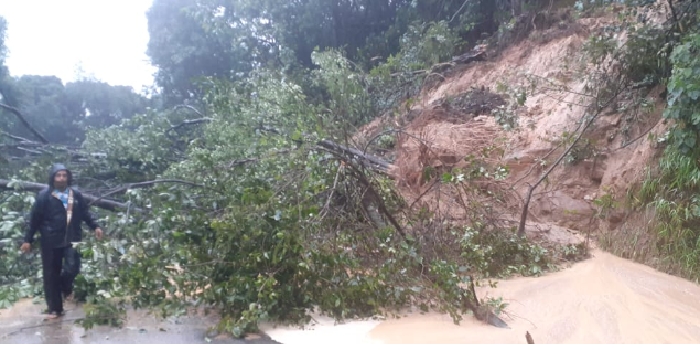
Mangaluru, Aug 7: Following the incessant rain for last few days and subsequent landslides reported at various places along Charmadi Ghat, the movement of vehicles been banned for two days. 

Charmadi Ghat road connects Dakshina Kannada and Chikkamagaluru districts on National Highway-73. The fresh landslides caused cracks on the road and uprooted many trees. 
Officials have closed Charmadi as well as Kottigehara check posts as a precautionary measure.

Belthangady tahsildar Mahesh J confirmed that multiple landslides have hit Charmadi Ghat road.

"The road has been closed for vehicular movement as the officials are at the spot to clear landslide debris. As a precautionary measure, vehicular movement has been banned as there are chances of further landslides," he said.

Hundreds of commuters who were stuck on various stretches of the ghat following a landslide between Maleyamaruta and Alekan falls in Chikkamagaluru district have been rescued.

Comments

Add new comment

  • Coastaldigest.com reserves the right to delete or block any comments.
  • Coastaldigset.com is not responsible for its readers’ comments.
  • Comments that are abusive, incendiary or irrelevant are strictly prohibited.
  • Please use a genuine email ID and provide your name to avoid reject.
DHNS
January 2,2020

Jan 2: A year after 12,000 acres of forests in Bandipur went up in smoke, the Karnataka Forest Department is gearing up for the summer even as the Forest Survey of India (FSI) has cautioned that 22.78 lakh acres (9,222 sq km) or about 20% of the green cover spread across three districts in the central part of the state is fire-prone.

The FSI studied forest fire incidents across the country between 2004-05 and 2017 before coming up with state-specific inputs.

According to the 13-year observation, Karnataka has 7,352 “fire points” or areas measuring 5 km X 5 km with frequent fire incidents.

Though the number is lower compared to states like Maharashtra, Madhya Pradesh and Odisha with over 20,000 points, the sheer spread of the fire-prone area itself is a challenge for the Karnataka Forest Department.

According to data, about three lakh acres (1,199.9 sq km) of forest area is very highly fire prone with 26 to 52 fire incidents in 13 years. This is followed by 7.6 lakh acres (3,067 sq km) of “highly fire prone” areas with an average of one to two incidents every year.

Almost all of the “red alert” areas are concentrated in Uttara Kannada, Chikkmagaluru, Shivamogga and Chamarajanagar districts. As temperature rises at the end of January, so does the risk of forest fires, requiring officials to be on vigil till the end of summer.

After an investigation into the Bandipur blaze revealed that faulty fire lines and poor supervision were the reason for the spread of the fire, the department has come up with a multi-pronged approach to prevent similar incidents this year.

“After the Bandipur incident, we have created a fire cell and a standard operating procedure (SOP) which everyone has to follow. Firstly, a fire management plan is prepared and approved by a competent authority.

The SOP has well defined firelines which have to be executed by December-end and burning must be completed by January 15,”  Principal Chief Conservator of Forests (Head of Forest Force) Punati Sridhar told DH.

He said that to ensure its strict implementation, GPS readings of firelines are to be submitted for random verification.

“All the required equipment from fire jackets to shoes, gloves, backpack sprayers and tractors mounted with 2,000-5,000 litre tanks with high pressure pumps will be deployed at vantage points,” he said.

In addition, the department’s fire cell works in collaboration with the Karnataka State Remote Sensing Applications Centre (KSRSAC) to give fire alerts within half and hour of an area catching fire and detected by satellites.

“Earlier, the gap used to be four hours by when the fire would have spread beyond control. Now, with reduced time gap, it would be easier to control fire early,” he added.

Comments

Add new comment

  • Coastaldigest.com reserves the right to delete or block any comments.
  • Coastaldigset.com is not responsible for its readers’ comments.
  • Comments that are abusive, incendiary or irrelevant are strictly prohibited.
  • Please use a genuine email ID and provide your name to avoid reject.
Ram Puniyani
January 22,2020

Shivaji is a great icon in Maharashtra. Different sections of society have given him very high status, though for diverse reasons. Folklores about him abound in the state. His statues, popular songs on him are very prevalent. These folk songs (Powadas) praise his multifarious actions. So it was no surprise that when Jayabhagwan Goyal, released his book, ‘Aaj ka Shivaji: Narendra Modi’, at religious-cultural meet organized by Delhi BJP, there was a strong resentment in Maharashtra. Various leaders from Maharashtra were furious. The Shiv Sena leader Sanjay Raut challenged the Shivaji’s descendent, Sambhaji Raje who is in BJP and is member of Rajya Sabha, to resign on the issue. Sambhaji Raje in turn stated that "We respect Narendra Modi, who was elected as the prime minister of the country for the second time. But neither (Narendra) Modi nor anybody else in the world can be compared with Chhatrapati Shivaji Maharaj,"

Not to be left behind Jitendra Awhad of NCP felt Modi-BJP are insulting the pride of Maharashtra. It is not the first time that controversy is erupting around the Maharashtra warrior of medieval period. Earlier we had seen Sambhaji Brigrade demanding the ban on James Laine book, Shivaji: ‘A Hindu King in an Islamic Kingdom’, for its objectionable content. Bhandarkar Institute in Pune, which had helped James Laine in his research, was also vandalized. At another level there was a talk that Babasaheb Purandare, a Brahmin, who has written some popular material on Shivaji will be made as the Chairman of the committee for statue of Shivaji. Maratha Mahasangh and Shiv Dharm officials objected to a Brahmin heading the committee for a statue for the Maratha warrior. The caste angel in Shivaji’s case is coming to the fore from quite some time.

While there is no dearth of controversies around Shivaji, it is also true that each political tendency has created Shivaji’s image from their political point of view. Who was the real Shivaji, is the question. One can see two clear streams of projection in this matter. On one hand there is an attempt to present Shivaji as the anti Muslim King, a king who was respecting Cows and Brahmins (Go Brahman pratipalak). This view was brought forward from the times of Lokmanya Tilak and picked up by Hindu nationalists, who have been looking for icons in history to suit their political agenda. Nathram Godse, while criticizing Gandhi says that Gandhi’s nationalism was dwarf in front of the one of Shivaji or Rana Pratap.

In tune with this the Hindu nationalists are promoting both these as icons of Hindu nationalism and giving anti-Muslim slant to the whole discourse. This discourse also hides in this the Brahmanical agenda of Hindu nationalism as Cows and Brahmins are presented as the central object of veneration by Shivaji. This image of Shivaji fits well into the current agenda of Hindu nationalists, being spearheaded by RSS Combine.

It is because of this that for seeking votes in Mumbai Narendra Modi on the eve of 2014 elections stated that Shivaji attacked Surat to plunder the treasury of Aurangzeb. This also presents Shivaji-Aurangzeb, Shivaji-Afzal Khan interactions as battle between Hindus and Muslims. The truth is that Surat was plundered for its wealth as it was a rich port city and Bal Samant’s book on the topic gives in depth description of the same. It is noteworthy that Shivaji began his real career of conquest in 1656 when he conquered Javli from the Maratha Chief Chandra Rao More. He took over the treasures of this kingdom. That it was not a Hindu Muslim battle becomes clear when we know that in confrontation with Aurangzeb it was Mirza Raja Jaisingh who was negotiating and engaging with Shivaji on behalf of Aurangzeb. And Shivaji had Muslim officers like Kazi Haider as confidential secretary and many Muslim Generals in his army.

Darya Sarang was chief of armor division, Daulat Khan was in-charge of his naval division; Ibrahim Khan was another general of significance in his army.  This mixed up administration just shows that the kings were not having Hindu or Muslim administration depending on their religion. In the confrontation between Shivaji and Afzal Khan, Rustam-e-Jaman was Shivaji’s side and Afzal Khan had Krisnaji Bhaskar Kulkarni on his side.

As far as Shivaji’s popularity is concerned it was due to his being a King with welfare of his subjects in his mind. He lightened the burden of taxation on the average peasants, and reduced the domination of landlords over the serfs. This picture of Shivaji is well documents in the booklets by Com. Govind Pansare (Who was Shivaji) and Jayant Gadkari (Shivaji: Ek Lok Kalyankari Raja- Shivaji: King doing People’s Welfare). He did not belong to the warrior caste so Brahmins had refused to coronate him, for which purpose Gaga Bhatt a Brahmin from Kashi was brought in with heavy fees. Teesta Setalvad’s hand book on History for teachers underlined this fact.

Today while BJP-Brahmanical forces want to present Shivaji as worshipper of Brahmins and cows, the non upper caste have seen through the game. As such it was Jotirao Phule who brought forward the caste angel of Shivaji as he wrote Powada (Poem) in his honor and today dalit Bahujan are not toeing Hindu Nationalist projection on the issue.

The likes of Jayabhagwan Goyal of BJP as such are trying to give two messages through such attempts. One hand they want to paint Shivaji in anti Muslim and Brahmanical color, they also want to give the subtle message of similarity of this presentation of Shivaji with what Modi is doing. Non BJP forces have seen this game and want to present the other picture of Shivaji, which was highlighted by the likes of Jotirao Phule and which today many of those standing for rights of dalit-Bahujan are trying to articulate. The criticism of the said, book, since withdrawn is on these twin aspects. One about the picture of Shivaji who was concerned about welfare of the farmers, and two his respect for people of all religions.

Comments

Add new comment

  • Coastaldigest.com reserves the right to delete or block any comments.
  • Coastaldigset.com is not responsible for its readers’ comments.
  • Comments that are abusive, incendiary or irrelevant are strictly prohibited.
  • Please use a genuine email ID and provide your name to avoid reject.