


Southern Railway changes timings of 12 trains

July 3, 2011

southern-railways

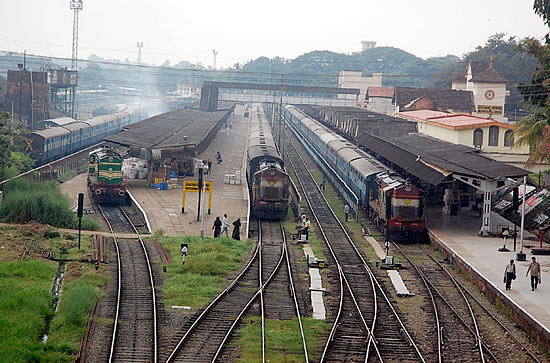
Mangalore, July 3: The Southern Railway has changed the departure timings of 12 trains, 11 leaving Mangalore Central Station and one passing through Mangalore Junction.

The departure timings of Thiruvanthapuram-Lokmanya Tilak Terminal (Mumbai, train no 16346) has been advanced by 50 minutes. It will leave Mangalore Junction at 11.30 pm instead of 12.20 am.

The release said the departure of Mangalore Central-Kabaka Puttur Passenger (train no 56647) had been advanced from 10.20 am to 10.15 am.

Though the non-monsoon departure time of Mangalore Central-Lokmanya Tilak Matsyagandha Express (train no. 12620) too had been advanced (to leave at 2.35 pm instead of 2.40 pm), the new departure time would come into effect only from November 1. With the monsoon timings for the Konkan railway route, the train would leave at 12.50 pm till October 1.

Chennai superfast (train no 12686) and Puducherry Express (train no 16044) would leave Mangalore at 4.10 pm instead of 4 pm. Mangalore Central-Jammu Tawi Navyug Express (train no 16687) will leave at 5.05 pm instead of 4.20 pm. Mangalore Central-Chennai Egmore Express (train no 16108) will leave at 6.50 pm instead of 6.40 pm and Mangalore Central-Chennai West Coast Express (train no 16628) will leave at 9.45 pm instead of 9.30 pm.

Maveli Express (train no 16603) will leave at 5.45 pm instead of 5.40 pm. Ernad Express (train no 16605) will leave at 7.20 am instead of 7.10 am, Malbar Express (train no 16630) will leave at 6.25 pm instead of 6.15 pm and Parasuram Express (train no 16649) will leave at 4.40 am instead of 4.15 am, the press release informed.

Daily train

Mumbai-Chatrapathi Shivaji terminus -Mangalore Junction Express train (12134) which was running three days in a week will be a daily train from Saturday.

The train number 12134 will leave Mangalore Junction at 2 pm. The train 12133 from Mumbai will reach Mangalore at 12.25 pm.

Though Yeshwanthpura-Mangalore Central Express (day train) will be extended to Karwar, the date has not yet been decided. The train will stop at Mangalore Junction, Udupi, Mookambika Road, Bhatkal and Kumta.

Mangalore Central-Palakkad Superfast train (Train number 22609/22610) will leave Mangalore at 1.40 pm. The train will leave from Palakkad at 7.25 am. However, the date of commencement of the train will be announced later.

Mangalore-Howrah superfast (22852/22851) will run once in a week. The train will leave Mangalore at 10.45 pm on every Saturday. The date of commencement of the train is yet to be announced.

The train will ply via Kasargod-Kannur-Vadagara-Calicut-Shornoor-Palakkad-Coimbatore-Erode-Salem-Kattadi-Chithur-Thirupathi-Renigunta-Vishakhapattanam-Srikakulam road-Brahmapura-Bhuvaneshwar-Katak-Balasore-Kharagapura and Santhragachi.

Comments

Sarath
 - 
Tuesday, 5 Jul 2016

My name is sarath.Am from ernakulam.i am telling about the train maveli express.i travel ernakulam to manglore 2times in a week.mostly i choose maveli express.Now the traveling condition in this train is changing day by day.Reservaton ticket availability of this train is very less and also passengers are increasing day by day.when the train enters in ernakulam station general coaches becomes full than the local passengers enters into reservations coaches.i am telling that please changes or covert the maveli express into maveli express superfast and also reduce the departure time from trivandrum.Now the train has 30 more stops .please reduce the stops into 15 or 20.This will helps the long trip passengers from trivandrum to manglore,trivandrum to ernakulam,kozhikode,ernakulam to manglore etc.There are many longtrip passenger choosing these train.The arrival time of this train is good but stations and traveling time is more.so change this train to superfast category.And also change malabar express into mail.so the local passengers from maveli express goes to malabar express.malabar express runs like an ordinary train.it has 40 more stops 10hours takes for running.reduce the time of malabar express.I am humbly requesting to indian railway for make this changes.i heard about the southern railway changing 16 train into superfast category on july onwards.please makes maveli express to superfast.i request you to make this changes as fast you can. THANKS

Add new comment

  • Coastaldigest.com reserves the right to delete or block any comments.
  • Coastaldigset.com is not responsible for its readers’ comments.
  • Comments that are abusive, incendiary or irrelevant are strictly prohibited.
  • Please use a genuine email ID and provide your name to avoid reject.
News Network
March 15,2020

Bengaluru, Mar 15: All 21 Madhya Pradesh MLAs from Jyotiraditya Scindia's camp, who were lodged here at Prestige Golfshire Club, have been shifted to Ramada hotel in Yelahanka ahead of Monday's floor test in the state assembly.

In view of their arrival, the concerned authorities have strengthened security outside the hotel.

Following the exit of Scindia from Congress, these MLAs claimed to have resigned from the state Legislative Assembly.

On March 11, Congress sent two of its leaders -- Sajjan Singh Verma and Govind Singh -- to Bengaluru in order to pacify some of these rebel MLAs.

Most of the rebel MLAs are perceived close to Scindia and were apparently unhappy at Scindia being "ignored" in the party.
Meanwhile, Madhya Pradesh Congress MLAs, who arrived in Bhopal from Jaipur today morning ahead of the floor test in the Assembly on Monday, have been shifted to Courtyard by Marriott Hotel.

These MLAs were accompanied by senior Congress leader Harish Rawat, who exuded confidence of Kamal-Nath led government winning floor test in the Assembly.

Both Congress and BJP have issued whips to all its MLAs for the legislative assembly session in Madhya Pradesh, which is scheduled to be held from March 16 to April 13.

On Saturday, Madhya Pradesh Governor Lalji Tandon had directed that a floor test will be held in the assembly on Monday.

Comments

Add new comment

  • Coastaldigest.com reserves the right to delete or block any comments.
  • Coastaldigset.com is not responsible for its readers’ comments.
  • Comments that are abusive, incendiary or irrelevant are strictly prohibited.
  • Please use a genuine email ID and provide your name to avoid reject.
News Network
May 3,2020

Bengaluru, May 3: Karnataka Chief Minister BS Yediyurappa requested his Maharashtra counterpart Uddhav Thackeray to release six TMC water from his state's reservoirs to rivers in Karnataka to meet acute drinking water shortage in North Karnataka.

Yediyurappa pointed out that the North Karnataka districts, namely Belagavi, Vijayapura, Bagalkot, Kalaburagi, Yadagiri and Raichur are facing acute shortage of drinking water due to onset of summer during early days of March this year.

"I request you to kindly direct the concerned authorities to release 3 TMC of water from Warna/Koyna reservoirs to Krishna river and 3 TMC of water from Ujjaini reservoir to Bhima river on humanitarian grounds for drinking purpose," Yediyurappa said in his letter.

He reminded Thackeray that even in the past the Maharashtra government had released water from its reservoirs to meet the drinking water needs of both human beings and livestock in drought-affected areas of Karnataka.

Comments

Add new comment

  • Coastaldigest.com reserves the right to delete or block any comments.
  • Coastaldigset.com is not responsible for its readers’ comments.
  • Comments that are abusive, incendiary or irrelevant are strictly prohibited.
  • Please use a genuine email ID and provide your name to avoid reject.
Agencies
May 8,2020

Washington D.C., May 8: The prime time for brain development in a child's life is the first year, where the infant spends most of the time asleep. It is the time when neural connections form and sensory memories are encoded.

However, when sleep is disrupted, as occurs more often among children with autism, brain development may be affected, too.

New research led by the University of Washington finds that sleep problems in a baby's first 12 months may not only precede an autism diagnosis but also may be associated with altered growth trajectory in a key part of the brain, the hippocampus.

The study, which was published in the American Journal of Psychiatry, researchers report that in a sample of more than 400 taken of 6- to 12-month-old infants, those who were later diagnosed with autism were more likely to have had difficulty falling asleep.

It also states that this sleep difficulty was associated with altered growth trajectories in the hippocampus.

"The hippocampus is critical for learning and memory, and changes in the size of the hippocampus have been associated with poor sleep in adults and older children.

As many as 80 per cent of the children with autism spectrum disorder have sleep problems," said Annette Estes, director of the UW Autism Center and senior author of the study.

"In our clinical experience, parents have a lot of concerns about their children's sleep, and in our work on early autism intervention, we observed that sleep problems were holding children and families back," added Estes, who is also a UW professor of speech and hearing sciences.

"It could be that altered sleep is part-and-parcel of autism for some children. One clue is that behavioural interventions to improve sleep don't work for all children with autism, even when their parents are doing everything just right. This suggests that there may be a biological component to sleep problems for some children with autism," said Estes.

To consider links among sleep, brain development, and autism, researchers at the IBIS Network looked at MRI scans of 432 infants, surveyed parents about sleep patterns, and measured cognitive functioning using a standardized assessment.

At the outset of the study, infants were classified according to their risk for developing autism: Those who were at higher risk of developing autism -- about two-thirds of the study sample -- had an older sibling who had already been diagnosed.

Infant siblings of children with autism have a 20 per cent chance of developing autism spectrum disorder -- a much higher risk than children in the general population.

In the current study, 127 of the 432 infants were identified as "low risk" at the time the MRI scans were taken because they had no family history of autism.

They later evaluated all the participants at 24 months of age to determine whether they had developed autism. Of the roughly 300 children originally considered "high familial risk," 71 were diagnosed with autism spectrum disorder at that age.

Problems with sleep were more common among the infants later diagnosed with an autism spectrum disorder, as were larger hippocampi. No other subcortical brain structures were affected, including the amygdala, which is responsible for certain emotions and aspects of memory, or the thalamus, a signal transmitter from the spinal cord to the cerebral cortex.

The authors note that while parents reported more sleep difficulties among infants who developed autism compared to those who did not, the differences were very subtle and only observed when looking at group averages across hundreds of infants.

Sleep patterns in the first years of life change rapidly as infants transition from sleeping around the clock to a more adult-like sleep/wake cycle. Until further research is completed, Estes said, it is not possible to interpret challenges with sleep as an early sign of increased risk for autism.

Comments

Add new comment

  • Coastaldigest.com reserves the right to delete or block any comments.
  • Coastaldigset.com is not responsible for its readers’ comments.
  • Comments that are abusive, incendiary or irrelevant are strictly prohibited.
  • Please use a genuine email ID and provide your name to avoid reject.