
Quadruplet babies born to Kasargod couple, one dies after month long battle

April 3, 2012

1A4C1

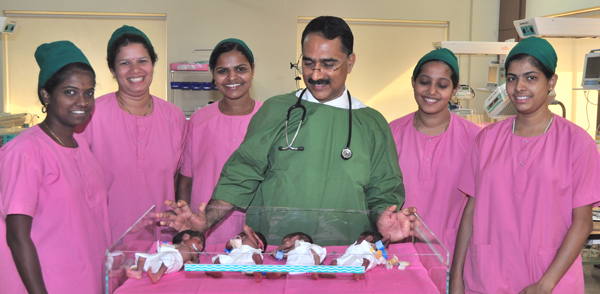
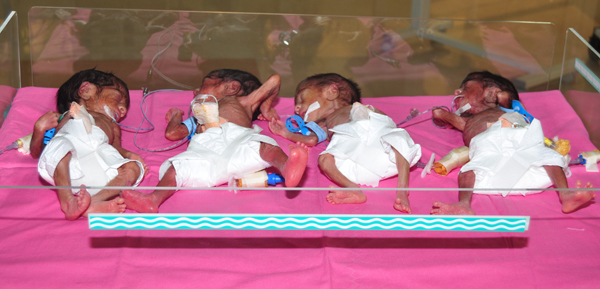
Mangalore, April 3: A very rare case of four babies of same sex in a single birth (quadruplets) succeeded nearly a month of life by the team effort of highly qualified doctors and medical personals led by Dr Ali kumble in tertiary centre, lndiana Hospital, Mangalore.

However, one among the four babies died on Monday, April 2.

Dr Yusuf kumble Managing Director of the Hospital told media persons that with this Indiana Hospital and Heart Institute's medical team achieved a new milestone in Indian pediatric healthcare.

Aysha Tahira and Latheef hailing from kasargod were not blessed with offspring's for many years. After a prolonged period of waiting they were quite happy to come to know that Aysha has conceived. But the happiness did not last for long time as she delivered prematurely four babies in a single birth. Gynecologist Dr Veena Manjunath was surprised to see new babies one after the other.

The parents were informed that the chance of survival of these babies were extremely rare. Quadruplet incidences occur once in 70 lakh births. These babies survival for more than one week is extremely rare especially if they are very premature. Also it is very expensive and life saving support is required in a high tech care center to make them survive.

Dr Yousuf Kumble said that the four babies got admitted at Indiana hospital's NICU on March 11, this year. Team of doctors led by Dr Ali Kumble took it as a challenge and with their effort babies survived since their admission. Financial support was offered by the hospital management as the father was not in a position to support all the four babies.

“What makes our case still more fascinating is that babies being treated here are identical quadruplet which occurs once in every 13 million births. There are only 60 such cases on record worldwide and it is extremely challenging to ensure they survive into infancy especially if they are born premature at 26 weeks of pregnancy and weigh between 500 to 900 grams”, he said.

He said multiple pregnancies are high risk pregnancies and are associated with increased neonatal morbidity and mortality. The frequency of multiple pregnancies has increased in the past 2 decades, mostly as a result of assisted reproductive techniques for infertile couples.

The average period of gestation in quadruplet pregnancy is 31.2 weeks and the average weight is 1.362 kg as per the literature available. In this case the period of gestation was only 26 weeks and the weights being 900 grams for the first two and 580 grams for the other two offspring, the average weight being only 740 grams, perhaps the first such case of preterm identical quadruplets that goes on record in India, he said.

Dr Kumble said the babies pose serious challenges to both the pediatricians and the family, right from ensuring their survival to the many complications they may develop during their course of hospital stay. “We need to ensure they maintain a normal breathing pattern and tolerate the feed given ok them. Strict hygiene and sanitation to avoid sepsis is a benchmark for ensuring survival of such extremely low birth weight babies. That is why handling and care is undertaken by skilled and experienced nurses assigned specifically for this role”, he said.

“We have taken utmost caution in providing only the mother's milk to the newborns. They have now entered the fourth week of life when chances of intolerance to feeds are high. Survival of such babies beyond the first four weeks of life greatly improves the clinical outcome”, he said.
1A4C3

1A4C2

hospital1

Comments

Kusuma Kumari G
 - 
Monday, 14 Mar 2016

A VERY GOOD NEWS FOR PARENTS BECAUSE GOD HAS BLESSED THEM WITH FOUR WONDEFUL KIDS.

Add new comment

  • Coastaldigest.com reserves the right to delete or block any comments.
  • Coastaldigset.com is not responsible for its readers’ comments.
  • Comments that are abusive, incendiary or irrelevant are strictly prohibited.
  • Please use a genuine email ID and provide your name to avoid reject.
coastaldigest.com news network
August 7,2020

Bengaluru, Aug 7: Dr Mohammed Yusuf, chairperson of the Karnataka State Board of Auqaf, passed away at a private hospital in the city today following a brief illness. He was 74.

Dr Yusuf was an industrialist and was known for his philanthropic activities. 

A veterinarian, Dr Yusuf had quit the government job and set up business in Bengaluru and Dubai decades ago and has earned considerable success.

He was re-elected as Board of Auqaf chief in January this year. He had held the post more than once in the past. 

He will be buried at the graveyard near Masjid-e-Muzammil which was built by himself at Govindapura, source said.

Comments

Add new comment

  • Coastaldigest.com reserves the right to delete or block any comments.
  • Coastaldigset.com is not responsible for its readers’ comments.
  • Comments that are abusive, incendiary or irrelevant are strictly prohibited.
  • Please use a genuine email ID and provide your name to avoid reject.
News Network
June 29,2020

Bengaluru, June 29: The Karnataka government on Monday issued guidelines to conduct online classes for all students of ICSE, CBSE and SSLC under the directions of the High Court.

According to the guidelines, for the kindergarten students, online classes can be held 30 minutes a week and students in classes 1-5 will have online classes for 30-45 minutes divided into two periods for three alternate days every week.

For students in classes 6-8, the online classes will be for 30-45 minutes divided into two periods for five days every week while students in classes 9 and 10 can have the virtual classes for 30-45 minutes divided into four periods for five days a week.

Earlier, the state government barred online classes for the kids from LKG to class 5.

Minister for primary and secondary education S Suresh Kumar had said that online classes cannot be held for the kids from LKG to class V.

Comments

Add new comment

  • Coastaldigest.com reserves the right to delete or block any comments.
  • Coastaldigset.com is not responsible for its readers’ comments.
  • Comments that are abusive, incendiary or irrelevant are strictly prohibited.
  • Please use a genuine email ID and provide your name to avoid reject.
Agencies
July 5,2020

The deadly coronavirus that entered India while there was still nip in the air has beaten rising mercury, humid conditions, unique Indian genome and has entered monsoon season with more potency as fresh cases are only breaking all records in the country.

India recorded a single-day spike of record 24,850 new coronavirus cases on Sunday, taking its total tally to 6.73 lakh corona-positive cases.

Top Indian microbiologists were hopeful in March that after the 21-day lockdown, as summer approaches, the rise in temperature would play an important role in preventing the drastic spread of COVID-19 virus in India.

Several virologists hinted that by June this year, the impact of COVID-19 would be less than what it appeared in March-April.

The claims have fallen flat as the virus is mutating fast, becoming more potent than ever.

According to experts, the novel coronavirus is a new virus whose seasonality and response to hot humid weather was never fully understood.

"The theory was based on the fact that high temperatures can kill the virus as in sterilisation techniques used in healthcare. But these are controlled environment conditions. There are many other factors besides temperature, humidity which influence the transmission rate among humans," Dr Anu Gupta, Head, Microbiologist and Infection Control, Fortis Escorts Heart Institute, told IANS.

There is no built-up immunity to COVID-19 in humans.

"Also, asymptomatic people might be passing it to many others unknowingly. New viruses tend not to follow the seasonal trend in their first year," Gupta emphasized.

Globally, as several countries are now experiencing hot weather, the World Health Organization (WHO) reported a record hike in the number of coronavirus cases, with the total rising by 2,12,326 in 24 hours in the highest single-day increase since COVID-19 broke out.

So far over 11 million people worldwide have tested positive for the disease which has led to over 5,25,000 deaths, according to data from Johns Hopkins University. The US remained the worst-hit country with over 28 lakh cases, followed by Brazil with 15.8 lakh.

According to Sandeep Nayar, Senior Consultant and HOD, Respiratory Medicine, Allergy & Sleep Disorders, BLK Super Speciality Hospital in New Delhi, whether temperature plays a role in COVID-19 infection is highly debated.

One school of thought said in the tropical regions of South Asia, the virus might not thrive longer.

"On the other hand, another school of thought has found that novel Coronavirus can survive in a hot and humid environment and tropical climate does not make a difference to the virus. According to them, this is what distinguishes the novel coronavirus from other common viruses, which usually wane in hot weather," stressed Nayar.

Not much has been studied in the past and no definite treatment or vaccine is available to date.

"Every day, new properties and manifestation of the disease come up. As of now, the only way to prevent this monster is by taking appropriate precautions. Hand hygiene, social distancing, cough etiquette and face masks definitely reduce spread of COVID-19 infection," Nayar told IANS.

Not just top Indian health experts, even Indian-American scientists had this theory in mind that sunshine and summer may ebb the spread of the coronavirus.

Ravi Godse, Director of Discharge Planning, UPMC Shadyside Pennsylvania in the US told IANS in April: "In the summer, the humidity can go up as well, meaning more water drops in the air. If the air is saturated with water and somebody sneezes virus droplets into such air, it is likely that the droplets will fall to the ground quicker, making them less infectious. So the short answer is yes, summer/sunshine could be bettera.

According to Dr Puneet Khanna, Head of Respiratory Medicine and Pulmonology, Manipal Hospital, Delhi, COVID-19 death rates are not too different in tropical countries but since the disease affected them late it was yet to show its peak in these areas.

"The virus can survive well in hot and humid countries and this is proven now," he stressed.

Comments

Add new comment

  • Coastaldigest.com reserves the right to delete or block any comments.
  • Coastaldigset.com is not responsible for its readers’ comments.
  • Comments that are abusive, incendiary or irrelevant are strictly prohibited.
  • Please use a genuine email ID and provide your name to avoid reject.