Quadruplet babies born to Kasargod couple, one dies after month long battle

April 3, 2012

1A4C1

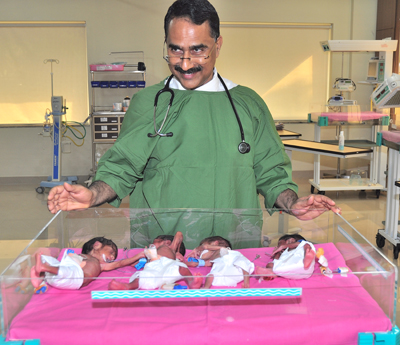
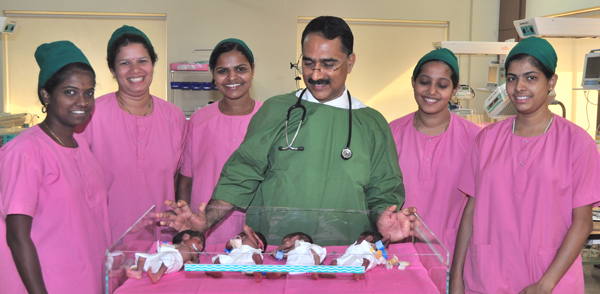
Mangalore, April 3: A very rare case of four babies of same sex in a single birth (quadruplets) succeeded nearly a month of life by the team effort of highly qualified doctors and medical personals led by Dr Ali kumble in tertiary centre, lndiana Hospital, Mangalore.

However, one among the four babies died on Monday, April 2.

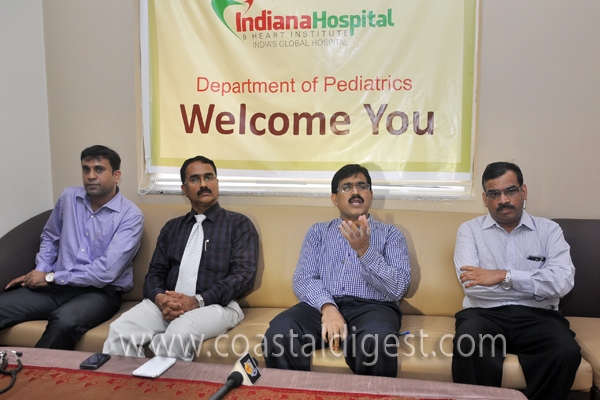
Dr Yusuf kumble Managing Director of the Hospital told media persons that with this Indiana Hospital and Heart Institute's medical team achieved a new milestone in Indian pediatric healthcare.

Aysha Tahira and Latheef hailing from kasargod were not blessed with offspring's for many years. After a prolonged period of waiting they were quite happy to come to know that Aysha has conceived. But the happiness did not last for long time as she delivered prematurely four babies in a single birth. Gynecologist Dr Veena Manjunath was surprised to see new babies one after the other.

The parents were informed that the chance of survival of these babies were extremely rare. Quadruplet incidences occur once in 70 lakh births. These babies survival for more than one week is extremely rare especially if they are very premature. Also it is very expensive and life saving support is required in a high tech care center to make them survive.

Dr Yousuf Kumble said that the four babies got admitted at Indiana hospital's NICU on March 11, this year. Team of doctors led by Dr Ali Kumble took it as a challenge and with their effort babies survived since their admission. Financial support was offered by the hospital management as the father was not in a position to support all the four babies.

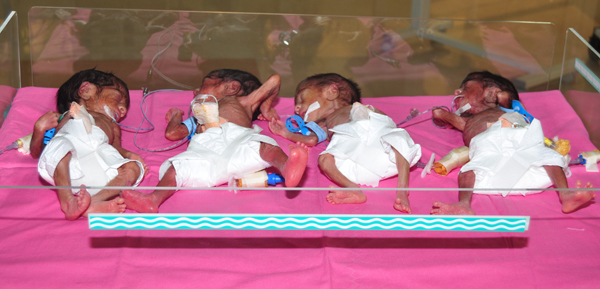
“What makes our case still more fascinating is that babies being treated here are identical quadruplet which occurs once in every 13 million births. There are only 60 such cases on record worldwide and it is extremely challenging to ensure they survive into infancy especially if they are born premature at 26 weeks of pregnancy and weigh between 500 to 900 grams”, he said.

He said multiple pregnancies are high risk pregnancies and are associated with increased neonatal morbidity and mortality. The frequency of multiple pregnancies has increased in the past 2 decades, mostly as a result of assisted reproductive techniques for infertile couples.

The average period of gestation in quadruplet pregnancy is 31.2 weeks and the average weight is 1.362 kg as per the literature available. In this case the period of gestation was only 26 weeks and the weights being 900 grams for the first two and 580 grams for the other two offspring, the average weight being only 740 grams, perhaps the first such case of preterm identical quadruplets that goes on record in India, he said.

Dr Kumble said the babies pose serious challenges to both the pediatricians and the family, right from ensuring their survival to the many complications they may develop during their course of hospital stay. “We need to ensure they maintain a normal breathing pattern and tolerate the feed given ok them. Strict hygiene and sanitation to avoid sepsis is a benchmark for ensuring survival of such extremely low birth weight babies. That is why handling and care is undertaken by skilled and experienced nurses assigned specifically for this role”, he said.

“We have taken utmost caution in providing only the mother's milk to the newborns. They have now entered the fourth week of life when chances of intolerance to feeds are high. Survival of such babies beyond the first four weeks of life greatly improves the clinical outcome”, he said.
1A4C3

1A4C2

hospital1

Comments

Kusuma Kumari G
 - 
Monday, 14 Mar 2016

A VERY GOOD NEWS FOR PARENTS BECAUSE GOD HAS BLESSED THEM WITH FOUR WONDEFUL KIDS.

Add new comment

  • Coastaldigest.com reserves the right to delete or block any comments.
  • Coastaldigset.com is not responsible for its readers’ comments.
  • Comments that are abusive, incendiary or irrelevant are strictly prohibited.
  • Please use a genuine email ID and provide your name to avoid reject.
News Network
May 2,2020

Bengalur, May 2: Two people died of COVID-19 in Karnataka on Saturday taking the toll in the state to 25, whereas nine more tested positive for the virus, pushing the tally to 598, the health department said. Two deaths were reported in Bidar and Bengaluru urban, the health department said in a statement.

An 82-year-old person with a history of Severe Acute Respiratory Illness died in Bidar. While the second fatality was a 62-year-old man with a history of diabetes, hyper-tension, renal failture and was on multiple myeloma on chemotherapy, in Bengaluru. He too had complained of breathlessness on April 30 and died on Saturday at the designated hospital.

Among the nine new cases, two each are from Tumakuru, Vijayapura, one each from Bidar, Chikkaballapura, Belagavi, Bagalkot and Bengaluru urban. Cumulatively, 598 COVID-19 positive cases have been confirmed in the state and it includes 25 deaths.

Comments

Add new comment

  • Coastaldigest.com reserves the right to delete or block any comments.
  • Coastaldigset.com is not responsible for its readers’ comments.
  • Comments that are abusive, incendiary or irrelevant are strictly prohibited.
  • Please use a genuine email ID and provide your name to avoid reject.
News Network
April 21,2020

Bengaluru, Apr 21: Bengaluru Police and administration has issued prohibitory orders in the city, with exemptions to essential and emergency services, to enforce the COVID-19 lockdown.

"In exercise of the powers conferred under Section 144 (1) Code of Criminal Procedure, I, Bhaskar Rao, IPS, Commissioner of Police and Additional District Magistrate, Bengaluru city hereby issue a prohibitory order within the limits of Bengaluru city commissioner on midnight of April 20, 2020, to midnight May 3, 2020," the order issued on Monday said.

Section 144 of the CrPC pertains to the power conferred to a District Magistrate, a sub-divisional Magistrate or any other Executive Magistrate to issue orders in urgent cases of a nuisance of apprehended danger.

"As per the guidelines of the Ministry of Home Affairs, Government of India on the measures for containment of COVID-19 epidemic, it is imperative to take stringent measures in the jurisdiction of Commissioner of Bengaluru city to prevent the spread of the disease," the order said.

As per the order, the offices of the Government of India, its autonomous and subordinate offices and public corporations shall remain closed with the exception of defence, central armed police force, treasury, public utilities, disaster management, power generation, and post office, etc.

Offices to the state government, their autonomous bodies, corporation, etc shall also remain closed except police, home guard, civil defence, fire and emergency services, electricity, water, sanitation and Mandis operated by Agriculture Produce Market Committee, etc, it added.

It said that municipal bodies, with staff required for essential services, will also remain functional during this period. Other essential and emergency services, like hospitals, shops, etc have also been exempted from the prohibitory orders.

Comments

Add new comment

  • Coastaldigest.com reserves the right to delete or block any comments.
  • Coastaldigset.com is not responsible for its readers’ comments.
  • Comments that are abusive, incendiary or irrelevant are strictly prohibited.
  • Please use a genuine email ID and provide your name to avoid reject.
Agencies
July 8,2020

The Central Board of Secondary Education (CBSE) has rationalised by up to 30 per cent the syllabus for classes 9 to 12 for the academic year 2020-21 to reduce course load on students amid the COVID-19 crisis, Union HRD Minister Ramesh Pokhriyal 'Nishank' announced on Tuesday.

The curriculum has been rationalised while retaining the core elements, the Human Resource Development said.

Among the chapters dropped after the rationalisation exercise are lessons on democracy and diversity, demonetisation, nationalism, secularism, India's relations with its neighbours and growth of local governments in India, among others.

"Looking at the extraordinary situation prevailing in the country and the world, CBSE was advised to revise the curriculum and reduce course load for the students of classes 9 to 12.

"To aid the decision, a few weeks back I also invited suggestions from all educationists on the reduction of syllabus for students and I am glad to share that we received more than 1.5K suggestions. Thank you, everyone, for the overwhelming response," Nishank tweeted.

"Considering the importance of learning achievement, it has been decided to rationalise syllabus up to 30 per cent by retaining the core concepts," he added.

The Union minister said the changes made in the syllabi have been finalised by the respective course committees with the approval of the curriculum committee and the Governing Body of the Board.

"The heads of schools and teachers have been advised by the board to ensure that the topics that have been reduced are also explained to the students to the extent required to connect different topics. However, the reduced syllabus will not be part of the topics for internal assessment and year-end board examination.

"Alternative academic calendar and inputs from the NCERT on transacting the curriculum using different strategies shall also be part of the teaching pedagogy in the affiliated schools," a senior official of the HRD ministry said.

For classes 1 to 8, the National Council of Education Research and Training (NCERT) has already notified an alternative calendar and learning outcomes.

According to the updated curriculum, among the chapters deleted from class 10 syllabus are-- democracy and diversity, gender, religion and caste, popular struggles and movement, challenges to democracy

For class 11, the deleted portions included chapters on federalism, citizenship, nationalism, secularism, growth of local governments in India.

Similarly, class 12 students will not be required to study chapters on India's relations with its neighbours, changing nature of India's economic development, social movements in India and demonetisation, among others.

Universities and schools across the country have been closed since March 16 when the central government announced a nationwide classroom shutdown as one of the measures to contain the COVID-19 outbreak.

A nationwide lockdown was announced on March 24, which came into effect the next day. While the government has eased several restrictions, schools and colleges continue to remain closed.

Comments

Add new comment

  • Coastaldigest.com reserves the right to delete or block any comments.
  • Coastaldigset.com is not responsible for its readers’ comments.
  • Comments that are abusive, incendiary or irrelevant are strictly prohibited.
  • Please use a genuine email ID and provide your name to avoid reject.