


Mangalore University approves challenge valuation

News Network
April 6, 2012

muMangalore, April 6: The guidelines for implementing the challenge valuation in the various post graduate courses was approved at the academic council meeting held at Mangalore University on Thursday.


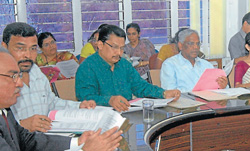
Mangalore University Vice-Chancellor Professor T C Shivashankra Murthy chairing the academic council meeting in Mangalore on Thursday.With this a candidate who has appeared for PG examination conducted by Mangalore University may apply through the Institution/Head of the Department for challenge valuation on payment of the prescribed fee, within 20 days after the publication of the result or 10 days from the date of dispatch of the marks cards by the Registrar (Evaluation) to the Institution/HoD, or within seven days from the date of communication of the result of re-totaling whichever is later.


Addressing the meeting, Mangalore University Vice-Chancellor Professor T C Shivashankra Murthy said that if there is a difference between marks awarded initially and on Challenge Valuation, the final marks shall be the average of the two awards.


In case the difference between the initial award and the final award is more than 10 per cent and is to the advantage of the candidate, then 50 per cent of the fee paid for the challenge valuation shall be refunded to the candidate. Grace marks shall not be taken into consideration for eligibility for refund of the challenge evaluation fee.


“Challenge valuation is permitted for all theory papers only. Answer scripts will be evaluated by a suitable external examiner selected from the panel of examiners approved by the Vice-Chancellor. However, such examiners should not have been valuers for that paper during the examination. The answer scripts for Challenge Valuation can also be sent to examiners or other universities, said VC.


12th Five Year Plan


The UGC had asked the University to submit the 12th Five Year Plan proposal after getting it duly approved by all the statutory bodies of the University.


Since the actual allocation of resources for the 12th Five Year Plan is yet to be finalised by the Government of India, the Universities have been requested to develop two parallel scenarios priority-wise, one with a hike of three times and another with a hike of five times of the 11th Five Year Plan allocation to University under both development of merged schemes.


Accordingly a committee was formed under the chairmanship of the Vice-Chancellor to draft the 12th plan proposals and a document titled “ Inclusive and Qualitative Expansion of Higher Education” is prepared.


The proposals are presented in two scenarios and are further classified under Capital Head, General Head and Salary Head.


Under scenario I the University has proposed Rs 40.5 crores as the required fund.


In scenario II Rs 65.80 crores has been proposed as the required fund.


Committee for PG course


As a college has requested the University to grant permission to start Post Graduate course in Bharathanatyam and Karnatak Music, a committee was formed to frame guidelines of the course and syllabus under the Presidentiship of Sarsa College of Fine Arts and Science Principal Dr Arati Shetty, said Vice-Chancellor Professor T C Shivashankara Murthy.


The regulations governing the choice based credit system (CBCS) for the two years (four semesters) Masters Degree Programmes in Bharathanatyam and Karnatak Music was presented before the academic council.



Comments

Add new comment

  • Coastaldigest.com reserves the right to delete or block any comments.
  • Coastaldigset.com is not responsible for its readers’ comments.
  • Comments that are abusive, incendiary or irrelevant are strictly prohibited.
  • Please use a genuine email ID and provide your name to avoid reject.
Agencies
May 8,2020

Washington D.C., May 8: The prime time for brain development in a child's life is the first year, where the infant spends most of the time asleep. It is the time when neural connections form and sensory memories are encoded.

However, when sleep is disrupted, as occurs more often among children with autism, brain development may be affected, too.

New research led by the University of Washington finds that sleep problems in a baby's first 12 months may not only precede an autism diagnosis but also may be associated with altered growth trajectory in a key part of the brain, the hippocampus.

The study, which was published in the American Journal of Psychiatry, researchers report that in a sample of more than 400 taken of 6- to 12-month-old infants, those who were later diagnosed with autism were more likely to have had difficulty falling asleep.

It also states that this sleep difficulty was associated with altered growth trajectories in the hippocampus.

"The hippocampus is critical for learning and memory, and changes in the size of the hippocampus have been associated with poor sleep in adults and older children.

As many as 80 per cent of the children with autism spectrum disorder have sleep problems," said Annette Estes, director of the UW Autism Center and senior author of the study.

"In our clinical experience, parents have a lot of concerns about their children's sleep, and in our work on early autism intervention, we observed that sleep problems were holding children and families back," added Estes, who is also a UW professor of speech and hearing sciences.

"It could be that altered sleep is part-and-parcel of autism for some children. One clue is that behavioural interventions to improve sleep don't work for all children with autism, even when their parents are doing everything just right. This suggests that there may be a biological component to sleep problems for some children with autism," said Estes.

To consider links among sleep, brain development, and autism, researchers at the IBIS Network looked at MRI scans of 432 infants, surveyed parents about sleep patterns, and measured cognitive functioning using a standardized assessment.

At the outset of the study, infants were classified according to their risk for developing autism: Those who were at higher risk of developing autism -- about two-thirds of the study sample -- had an older sibling who had already been diagnosed.

Infant siblings of children with autism have a 20 per cent chance of developing autism spectrum disorder -- a much higher risk than children in the general population.

In the current study, 127 of the 432 infants were identified as "low risk" at the time the MRI scans were taken because they had no family history of autism.

They later evaluated all the participants at 24 months of age to determine whether they had developed autism. Of the roughly 300 children originally considered "high familial risk," 71 were diagnosed with autism spectrum disorder at that age.

Problems with sleep were more common among the infants later diagnosed with an autism spectrum disorder, as were larger hippocampi. No other subcortical brain structures were affected, including the amygdala, which is responsible for certain emotions and aspects of memory, or the thalamus, a signal transmitter from the spinal cord to the cerebral cortex.

The authors note that while parents reported more sleep difficulties among infants who developed autism compared to those who did not, the differences were very subtle and only observed when looking at group averages across hundreds of infants.

Sleep patterns in the first years of life change rapidly as infants transition from sleeping around the clock to a more adult-like sleep/wake cycle. Until further research is completed, Estes said, it is not possible to interpret challenges with sleep as an early sign of increased risk for autism.

Comments

Add new comment

  • Coastaldigest.com reserves the right to delete or block any comments.
  • Coastaldigset.com is not responsible for its readers’ comments.
  • Comments that are abusive, incendiary or irrelevant are strictly prohibited.
  • Please use a genuine email ID and provide your name to avoid reject.
News Network
July 13,2020

Bengaluru, Jul 13: The Bruhat Bengaluru Mahanagara Palike (BBMP) has initiated the process of recruiting 1,700 medical professionals, doctors, staff nurses and support staff to scale up its workforce to set up 30,000 COVID-19 care beds, an official said on Sunday.

According to the official, to establish and run 30,000 COVID care beds, 1,800 doctors and 3,600 nurses are required. A 10,100-bed facility was set up last week in the Bengaluru International Exhibition centre (BIEC) on Tumkur road.

The Health Department has calculated that one doctor per shift is needed for every 100 patients and one staff nurse for every 50 patients. Similarly, two supporting staff and three Group D employees are needed per shift for every 100 patients. Generally, a day is divided into three shifts of eight hours each.

According to the director of medical education, there are 25,000 nursing students who have completed GNM and BSc Nursing courses and are pursuing higher education.

Likewise, there are 3,231 medical, dental and Aayush interns, while MD and MS postgraduate students have been identified to be 1,613 in Bengaluru colleges.

"The department plans to actively utilise the services of interns and postgraduate students for the COVID Care Centre (CCC) operations," said the official.

Currently, there are 2,100 CCC beds operational under the civic body in Bengaluru with a pool of 503 doctors, 167 ayush doctors, 128 nursing and paramedical staff.

Earlier in May, the civic body also notified the recruitment of 380 microbiologists, technicians and data entry operators for six months. In June, the civic body again notified the recruitment of 637 doctors, nurses, technicians and group d employees to strengthen its fight against the pandemic.

Bengaluru has recently seen a spike in COVID-19 in Karnataka, accounting for 61% of all active cases in the state.

On Saturday, the city reported 1,533 new cases, taking its total tally to 16,862, of which 12,793 are active.

Karnataka recorded 2,798 more coronavirus cases and 70 more casualties on Saturday evening, raising the state's total cases to 36,216 and the death toll to 613.

Comments

Add new comment

  • Coastaldigest.com reserves the right to delete or block any comments.
  • Coastaldigset.com is not responsible for its readers’ comments.
  • Comments that are abusive, incendiary or irrelevant are strictly prohibited.
  • Please use a genuine email ID and provide your name to avoid reject.
News Network
July 10,2020

Bengaluru, Jul 10: With 2,313 more people testing positive for coronavirus in Karnataka in the last 24 hours, its overall tally of patients rose to 33,418 on Friday, health officials said.

57 patients died in Karnataka in the last 24 hours, with majority (27) of them from Bengaluru, taking the state''s death toll to 543, the officials added.

Bengaluru accounted for 1,447 or 63 per cent of the new COVID-19 cases, spiking its tally to 15,329, out of which 11,687 are active cases.

The city alone accounts for 46 per cent of all the cases in the state.

As many as 45 deaths had Severe Acute Respiratory Infection (SARI) as a common symptom.

Among the new cases, excluding Bengaluru, Dakshina Kannada accounted for 139 infections, followed by Vijayapura (89), Ballari (66), Kalaburagi (58), Yadgir and Mysuru (51 each) among others.

On Friday, a record 1,003 patients got discharged, 601 of them in Bengaluru alone with the total number of discharges rising up to 13,836.

Until now, Karnataka has tested 7.79 lakh samples for Covid, out of which 7.28 lakh tested negative.

Despite the record number of discharges, patients in ICU rose to 472.

Of the 33,418 cases, 19,035 are active in the state.

Comments

Add new comment

  • Coastaldigest.com reserves the right to delete or block any comments.
  • Coastaldigset.com is not responsible for its readers’ comments.
  • Comments that are abusive, incendiary or irrelevant are strictly prohibited.
  • Please use a genuine email ID and provide your name to avoid reject.