


Mangalore University approves challenge valuation

News Network
April 6, 2012

muMangalore, April 6: The guidelines for implementing the challenge valuation in the various post graduate courses was approved at the academic council meeting held at Mangalore University on Thursday.


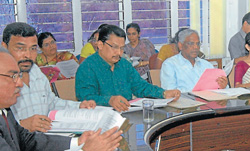
Mangalore University Vice-Chancellor Professor T C Shivashankra Murthy chairing the academic council meeting in Mangalore on Thursday.With this a candidate who has appeared for PG examination conducted by Mangalore University may apply through the Institution/Head of the Department for challenge valuation on payment of the prescribed fee, within 20 days after the publication of the result or 10 days from the date of dispatch of the marks cards by the Registrar (Evaluation) to the Institution/HoD, or within seven days from the date of communication of the result of re-totaling whichever is later.


Addressing the meeting, Mangalore University Vice-Chancellor Professor T C Shivashankra Murthy said that if there is a difference between marks awarded initially and on Challenge Valuation, the final marks shall be the average of the two awards.


In case the difference between the initial award and the final award is more than 10 per cent and is to the advantage of the candidate, then 50 per cent of the fee paid for the challenge valuation shall be refunded to the candidate. Grace marks shall not be taken into consideration for eligibility for refund of the challenge evaluation fee.


“Challenge valuation is permitted for all theory papers only. Answer scripts will be evaluated by a suitable external examiner selected from the panel of examiners approved by the Vice-Chancellor. However, such examiners should not have been valuers for that paper during the examination. The answer scripts for Challenge Valuation can also be sent to examiners or other universities, said VC.


12th Five Year Plan


The UGC had asked the University to submit the 12th Five Year Plan proposal after getting it duly approved by all the statutory bodies of the University.


Since the actual allocation of resources for the 12th Five Year Plan is yet to be finalised by the Government of India, the Universities have been requested to develop two parallel scenarios priority-wise, one with a hike of three times and another with a hike of five times of the 11th Five Year Plan allocation to University under both development of merged schemes.


Accordingly a committee was formed under the chairmanship of the Vice-Chancellor to draft the 12th plan proposals and a document titled “ Inclusive and Qualitative Expansion of Higher Education” is prepared.


The proposals are presented in two scenarios and are further classified under Capital Head, General Head and Salary Head.


Under scenario I the University has proposed Rs 40.5 crores as the required fund.


In scenario II Rs 65.80 crores has been proposed as the required fund.


Committee for PG course


As a college has requested the University to grant permission to start Post Graduate course in Bharathanatyam and Karnatak Music, a committee was formed to frame guidelines of the course and syllabus under the Presidentiship of Sarsa College of Fine Arts and Science Principal Dr Arati Shetty, said Vice-Chancellor Professor T C Shivashankara Murthy.


The regulations governing the choice based credit system (CBCS) for the two years (four semesters) Masters Degree Programmes in Bharathanatyam and Karnatak Music was presented before the academic council.



Comments

Add new comment

  • Coastaldigest.com reserves the right to delete or block any comments.
  • Coastaldigset.com is not responsible for its readers’ comments.
  • Comments that are abusive, incendiary or irrelevant are strictly prohibited.
  • Please use a genuine email ID and provide your name to avoid reject.
Ram Puniyani
February 10,2020

Noam Chomsky is one of the leading peace workers in the world. In the wake of America’s attack on Vietnam, he brought out his classic formulation, ‘manufacturing consent’. The phrase explains the state manipulating public opinion to have the public approve of it policies—in this case, the attack of the American state on Vietnam, which was then struggling to free itself from French colonial rule.

In India, we are witness to manufactured hate against religious minorities. This hatred serves to enhance polarisation in society, which undermines India’s democracy and Constitution and promotes support for a Hindu nation. Hate is being manufactured through multiple mechanisms. For example, it manifests in violence against religious minorities. Some recent ghastly expressions of this manufactured hate was the massive communal violence witnessed in Mumbai (1992-93), Gujarat (2002), Kandhamal (2008) and Muzaffarnagar (2013). Its other manifestation was in the form of lynching of those accused of having killed a cow or consumed beef. A parallel phenomenon is the brutal flogging, often to death, of Dalits who deal with animal carcasses or leather.

Yet another form of this was seen when Shambhulal Regar, indoctrinated by the propaganda of Hindu nationalists, burned alive Afrazul Khan and shot the video of the heinous act. For his brutality, he was praised by many. Regar was incited into the act by the propaganda around love jihad. Lately, we have the same phenomenon of manufactured hate taking on even more dastardly proportions as youth related to Hindu nationalist organisations have been caught using pistols, while police authorities look on.

Anurag Thakur, a BJP minster in the central government recently incited a crowd in Delhi to complete his chant of what should happen to ‘traitors of the country...” with a “they should be shot”. Just two days later, a youth brought a pistol to the site of a protest at Jamia Millia Islamia university and shouted “take Azaadi!” and fired it. One bullet hit a student of Jamia. This happened on 30 January, the day Nathuram Godse had shot Mahatma Gandhi in 1948. A few days later, another youth fired near the site of protests against the CAA and NRC at Shaheen Bagh. Soon after, he said that in India, “only Hindus will rule”.

What is very obvious is that the shootings by those associated with Hindu nationalist organisations are the culmination of a long campaign of spreading hate against religious minorities in India in general and against Muslims in particular. The present phase is the outcome of a long and sustained hate campaign, the beginning of which lies in nationalism in the name of religion; Muslim nationalism and Hindu nationalism. This sectarian nationalism picked up the communal view of history and the communal historiography which the British introduced in order to pursue their ‘divide and rule’ policy.

In India what became part of “social common sense” was that Muslim kings had destroyed Hindu temples, that Islam was spread by force, and that it is a foreign religion, and so on. Campaigns, such as the one for a temple dedicated to the Hindu god Rama to be built at the site where the Babri masjid once stood, further deepened the idea of a Muslim as a “temple-destroyer”. Aurangzeb, Tipu Sultan and other Muslim kings were tarnished as the ones who spread Islam by force in the subcontinent. The tragic Partition, which was primarily due to British policies, and was well-supported by communal streams also, was entirely attributed to Muslims. The Kashmir conflict, which is the outcome of regional, ethnic and other historical issues, coupled with the American policy of supporting Pakistan’s ambitions of regional hegemony, (which also fostered the birth of Al-Qaeda), was also attributed to the Muslims.

With recurring incidents of communal violence, these falsehoods went on going deeper into the social thinking. Violence itself led to ghettoisation of Muslims and further broke inter-community social bonds. On the one hand, a ghettoised community is cut off from others and on the other hand the victims come to be presented as culprits. The percolation of this hate through word-of-mouth propaganda, media and re-writing of school curricula, had a strong impact on social attitudes towards the minorities.

In the last couple of decades, the process of manufacturing hate has been intensified by the social media platforms which are being cleverly used by the communal forces. Swati Chaturvedi’s book, I Am a Troll: Inside the Secret World of the BJP’s Digital Army, tells us how the BJP used social media to spread hate. Whatapp University became the source of understanding for large sections of society and hate for the ‘Other’, went up by leaps and bounds. To add on to this process, the phenomenon of fake news was shrewdly deployed to intensify divisiveness.

Currently, the Shaheen Bagh movement is a big uniting force for the country; but it is being demonised as a gathering of ‘anti-nationals’. Another BJP leader has said that these protesters will indulge in crimes like rape. This has intensified the prevalent hate.

While there is a general dominance of hate, the likes of Shambhulal Regar and the Jamia shooter do get taken in by the incitement and act out the violence that is constantly hinted at. The deeper issue involved is the prevalence of hate, misconceptions and biases, which have become the part of social thinking.

These misconceptions are undoing the amity between different religious communities which was built during the freedom movement. They are undoing the fraternity which emerged with the process of India as a nation in the making. The processes which brought these communities together broadly drew from Gandhi, Bhagat Singh and Ambedkar. It is these values which need to be rooted again in the society. The communal forces have resorted to false propaganda against the minorities, and that needs to be undone with sincerity.

Combating those foundational misconceptions which create hatred is a massive task which needs to be taken up by the social organisations and political parties which have faith in the Indian Constitution and values of freedom movement. It needs to be done right away as a priority issue in with a focus on cultivating Indian fraternity yet again.

Comments

Add new comment

  • Coastaldigest.com reserves the right to delete or block any comments.
  • Coastaldigset.com is not responsible for its readers’ comments.
  • Comments that are abusive, incendiary or irrelevant are strictly prohibited.
  • Please use a genuine email ID and provide your name to avoid reject.
News Network
June 2,2020

Bengaluru, Jun 2: Karnataka Chief Minister B S Yediyurappa on Monday claimed 70 per cent of the people of the country want Narendra Modi to not only complete the current term, but also want him as the Prime Minister for the next term.

He also called PM Modi "iron leader" for scrapping Article 370 that terminated special status to Jammu and Kashmir.

"70 per cent of the people of this nation want Narendra Modiji not only to complete this term, but also want him as the Prime Minister for the next term, so that he can find solution to the problems faced by this country. This is the aspiration of the young India," he said.

Mr Yediyurappa said PM Modi has successfully completed one year of the second term and the country is surging ahead in the path of progress under his "exceptional and far-sighted leadership."

"The Prime Minister is leading the country forward towards development with his Sab Ka Saath, Sab Ka Vikas, Sab Ka Vishwas principle and inclusive schemes," he said, adding that PM Modi is spearheading the cause of building a "strong and self-reliant Bharath."

Speaking to reporters in the backdrop of the one year of the Modi government''s second term in office, the chief minister said Modi is recognised as an exceptional leader not only in India, but also at the global level, through his mantra - Vasudaiva Kutumbakam.

Mr Yediyurappa termed the PM "iron leader" for scrapping Article 370 that terminated special status to Jammu and Kashmir, and formation of Jammu- Kashmir and Ladakh as Union Territories.

He listed the key decisions of the BJP-led central government such as banning the practice of triple talaq among Muslims, the Vande Bharath Mission, the Citizenship Amendment Act, one country-one ration card scheme, new Motor Vehicle Act, besides also "finding solution to Ram Mandir issue" , among others.

Mr Yediyurappa said PM Modi's decision has played a decisive role in dealing with the COVID-19 situation in India. He has competently handled a huge challenge of combating the coronavirus in a country with a population of 130 crore.

"He implemented the most stringent lockdown restrictions in the world to control the spread of COVID-19 and achieved remarkable success," he said, and lauded the Rs 20 lakh crore package that has been announced to revive the economy amid the pandemic.

"Modiji also supported the State during the devastating floods last year.....the state government is determined to develop Karnataka deriving inspiration from our Prime Minister''s efficiency."

Comments

Add new comment

  • Coastaldigest.com reserves the right to delete or block any comments.
  • Coastaldigset.com is not responsible for its readers’ comments.
  • Comments that are abusive, incendiary or irrelevant are strictly prohibited.
  • Please use a genuine email ID and provide your name to avoid reject.
News Network
April 19,2020

Mangaluru, Apr 19: District-in-charge Minister Kota Srinivas Poojary said that Rs 2000 each has been deposited in the bank accounts of 6,122 construction workers, who are registered with the labour department in the Dakshina Kannada district. The amount will be deposited in the accounts of other registered construction workers at the earliest.

The state government had announced Rs 2000 to construction labourers who are registered and have lost their livelihood due to the on-going nationwide lockdown to curb the spread of the coronavirus. The curbs, which were imposed on March 24, have been extended till May 3. "The labourers were reeling under hardship after construction activities came to a halt," said the Minister.

Supply food

Local bodies should make arrangements to supply food for stranded labourers, destitutes and beggars in all the ULBs in Dakshina Kannada district, Poojary said. 

"No one should starve during the lockdown period. All the ULBs should identify destitutes, migrant labourers in their jurisdiction and arrange food for them. In case of necessity, the help of NGOs can also be taken," he added
The minister announced that Asha workers and health workers would collect information on people's health by visiting the houses in the district and submit a report within 10 days.

Comments

Add new comment

  • Coastaldigest.com reserves the right to delete or block any comments.
  • Coastaldigset.com is not responsible for its readers’ comments.
  • Comments that are abusive, incendiary or irrelevant are strictly prohibited.
  • Please use a genuine email ID and provide your name to avoid reject.