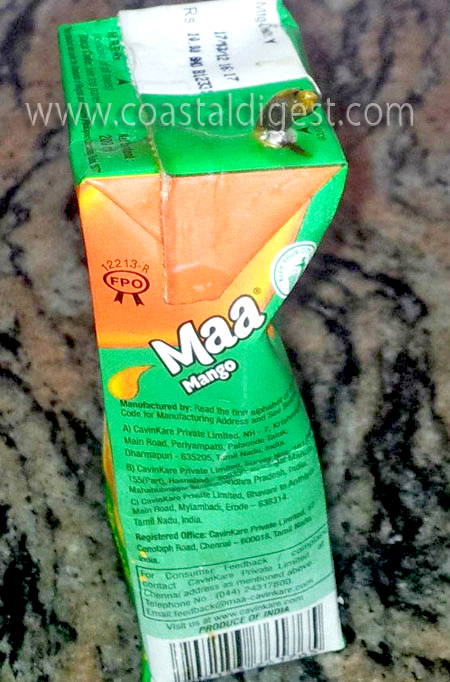
Dead snake in 'Maa' juice pack: Police ask shopkeepers not to sell the product

[email protected] (CD Network)
June 7, 2012

coastaldigest1_snk_ma


Bhatkal, June 7: Police in the town have asked all the soft drink sellers not to sell 'Maa' mango fruit juice after a dead snake was found in a 200 ml tetra pack purchased by a local resident.

One of the two persons, who fell ill after consuming the juice from the snake-filled Maa pack three days ago, has still not recovered and undergoing treatment at a hospital in Kundapur.

Sayyad Mohammad Safwan, a resident of Good Luck road in Bhatkal had bought some tetra packs of the juice for consumption last Monday.

When his sister Saheefa (22) was drinking the juice using a straw, she felt some problem in sipping the juice. Her mother Umme Salma (45) also tried to sip the juice with help of straw. She grew suspicious and opened the packet slightly to witness a six-inch long dead snake inside the pack.

Within minutes both mother and daughter began vomiting and they were shifted to a hospital immediately.

Later, Safwan informed about the snake-filled pack to the owner of 'A-1 Bakery', from where he had bought it and in turn the owner informed the manufacturers.

On Wednesday Bhatkal town police asked all the soft drink sellers not to sell any tetra pack of 'Maa' bearing manufacturing date of March 17, 2012 and batch number B1233.

Shock

Sources said that the mother and daughter who shared the poisonous juice are still under shock. Though the mother has slightly recovered, she is still not taking food properly.

Dr Jalaluddin, who is treating the victims, said that the duo need some time to forget the incident and recover completely. However, he confirmed that both were out of danger.

coastaldigest2_snk_ma


Comments

anon india
 - 
Friday, 3 Nov 2017

u craps i dont want to know about the mother and daughters condition


i need to know about that fruti

is it from the real manufacture

have u tested the fruti in the lab

what is the report or status about that case now

Add new comment

  • Coastaldigest.com reserves the right to delete or block any comments.
  • Coastaldigset.com is not responsible for its readers’ comments.
  • Comments that are abusive, incendiary or irrelevant are strictly prohibited.
  • Please use a genuine email ID and provide your name to avoid reject.
Media Release
February 14,2020

Veteran journalist P. Sainath has said that the nation is in a crisis. And this crisis is not limited to just the rural area. It has become a national crisis at various areas such as agriculture, education, economy, job creation etc.

He was delivering the endowment lecture on the topic ‘Indian democracy at the post-liberalization and post-truth era’ at Media Manthan 2020 organized by the PG department of journalism and mass communication at St Aloysius College (Autonomous). 

Mr Sainath said that the many policies adopted in the 90s led to India becoming unusually unequal. Referring to the speech Ambedkar had made at the Constituent Assembly while handing over the draft of the Constitution, Mr Sainath said, “Ambedkar had warned about the weakness of Indian democracy that liberty without equality allows the supremacy of a few over the multitude. Liberty, equality and fraternity must be kept together as we cannot have one without the other.” 

Mr Sainath stated that the agrarian crisis was no longer about the loss of productivity, employment or about farmer suicide; it was a societal, civilizational crisis. Commenting on the lopsided policies such as cow-slaughter ban, he explained how cow slaughter ban had adversely affected many industries due to their interdependency. While Muslims who slaughtered cows were rendered helpless, the cattle traders who were mostly OBCs lost their earnings as the cattle prices crashed. An important industry like Kolhapur sandals industry in Maharashtra went bankrupt as a result of the cow slaughter ban in Maharashtra. He said the policymakers had no idea how the rural industries were interconnected. Demonetisation too devastated the rural economy as 98 percent of rural transactions happen through cash. 

Mr Sainath also spoke about the crisis of inequality which affects the Dalits and the Adivasis far more than anyone else as 90 percent of the rural households take home less than Rs 10,000/- per month. “Women are yet another group whose labour is never counted in the gross domestic product. Women and girls globally do unpaid work which amounts to about 12.5 billion working hours per year. Monetarily speaking, this is worth 10.8 trillion dollars,” Mr Sainath added. 

Speaking about the crisis of jobs Mr Sainath said that major companies were laying off employees just to create more profits for the investors and the adoption of artificial intelligence in the industry would further destroy millions of jobs.

Rector of St Aloysius College Institutions Fr Dionysius Vaz SJ, Principal Dr (Fr) Praveen Martis SJ, HOD of Journalism and Mass Communication department Dr (Fr) Melwyn Pinto SJ were present.

‘Veerappan and Vijay Mallya’s business models are interesting!’

Addressing the gathering during his endowment lecture on Friday, Mr Sainath made an interesting comment on the so called ‘revenue model’. “Whenever I visit IIMs and IITs for lectures on my PARI project, the students there ask me what my revenue model for my project is. I tell them that I do not have a revenue model. In fact, journalism does not begin with a revenue model. Gandhiji, Ambedkar, Bhagat Singh were all great journalists. But they did not have a revenue model,” Mr Sainath said.

On a lighter note, he said that the best revenue model that he liked was that of forest brigand Veerappan and liquor baron Vijay Mallya. “Veerappan ruled the forest for forty years and from the top ministers to the villagers he could dictate terms and liver royally. Similarly, Mallya’s revenue model was to steal the banks and run away abroad and live like a king,” Mr Sainath added.

Journalism is not and can never be a business. It is a calling, he opined. While newspaper can be a business, television can be a business, journalism per se cannot be reduced to a business. “Unfortunately today, journalists are recruited on a contract basis and they have no bargaining power; and there are no unions to fight for their cause. Hence, they are at the mercy of the corporate media houses for their survival and are made to write stories that cannot be called journalism,” Mr Sainath said.

Answering a question as to the pressures he faced as a journalist, he said that external pressures from the government or others could be very well handled. It is the internal pressures from once own media house that journalists find it difficult to manage.


 

Comments

Add new comment

  • Coastaldigest.com reserves the right to delete or block any comments.
  • Coastaldigset.com is not responsible for its readers’ comments.
  • Comments that are abusive, incendiary or irrelevant are strictly prohibited.
  • Please use a genuine email ID and provide your name to avoid reject.
News Network
March 25,2020

Bengaluru, Mar 25: In what is suspected to be the second COVID-19 death in Karnataka, a 70-year-old woman from Gouribidanuru, who was under house quarantine for the last one week has died at Rajiv Gandhi Hospital for Chest Diseases.

The woman, who had recently returned from the Mecca pilgrimage developed fever on Tuesday afternoon. She was rushed to hospital, where she died on Wednesday morning.

Health and Family Welfare officials said that the throat swab sample of the woman had been sent to the laboratory for testing and the result was expected to come by afternoon.

Since last week, at least three cases of COVID-19 positive had been reported in Gouribidanuru in Chikkaballpura district, about 80 kms from Bengaluru.

Most of the suspects and confirmed cases had returned from Makkah pilgrimage. Even the deceased woman was one of them and had been advised house quarantine.

On Tuesday morning, she developed fever and was shifted to Gouribidanur hospital and later to Chikkaballapura hospital. By evening, she was moved to Rajiv Gandhi hospital, where she died on Wednesday morning.

The Chikkaballapura district administration has proclaimed prohibitory orders in the locality. They have also taken the woman's family members for testing.

Comments

Add new comment

  • Coastaldigest.com reserves the right to delete or block any comments.
  • Coastaldigset.com is not responsible for its readers’ comments.
  • Comments that are abusive, incendiary or irrelevant are strictly prohibited.
  • Please use a genuine email ID and provide your name to avoid reject.
News Network
March 29,2020

Mangaluru, Mar 29: The test report of the man from Uppoor in Udupi district, who committed suicide fearing he had contracted coronavirus infection, has returned negative for the virus.

Health department officials in Udupi said the post- mortem test report had shown that he did not have the virus infection and asked the people in the area not to panic.

Gopalakrishna Madivala (56), had hanged himself on Wednesday suspecting he had the disease, leaving a death note to family members asking them to stay safe.

Comments

Add new comment

  • Coastaldigest.com reserves the right to delete or block any comments.
  • Coastaldigset.com is not responsible for its readers’ comments.
  • Comments that are abusive, incendiary or irrelevant are strictly prohibited.
  • Please use a genuine email ID and provide your name to avoid reject.