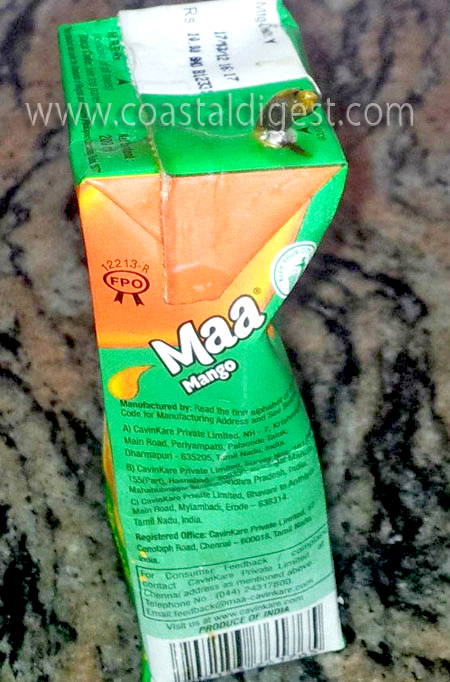
Dead snake in 'Maa' juice pack: Police ask shopkeepers not to sell the product

[email protected] (CD Network)
June 7, 2012

coastaldigest1_snk_ma


Bhatkal, June 7: Police in the town have asked all the soft drink sellers not to sell 'Maa' mango fruit juice after a dead snake was found in a 200 ml tetra pack purchased by a local resident.

One of the two persons, who fell ill after consuming the juice from the snake-filled Maa pack three days ago, has still not recovered and undergoing treatment at a hospital in Kundapur.

Sayyad Mohammad Safwan, a resident of Good Luck road in Bhatkal had bought some tetra packs of the juice for consumption last Monday.

When his sister Saheefa (22) was drinking the juice using a straw, she felt some problem in sipping the juice. Her mother Umme Salma (45) also tried to sip the juice with help of straw. She grew suspicious and opened the packet slightly to witness a six-inch long dead snake inside the pack.

Within minutes both mother and daughter began vomiting and they were shifted to a hospital immediately.

Later, Safwan informed about the snake-filled pack to the owner of 'A-1 Bakery', from where he had bought it and in turn the owner informed the manufacturers.

On Wednesday Bhatkal town police asked all the soft drink sellers not to sell any tetra pack of 'Maa' bearing manufacturing date of March 17, 2012 and batch number B1233.

Shock

Sources said that the mother and daughter who shared the poisonous juice are still under shock. Though the mother has slightly recovered, she is still not taking food properly.

Dr Jalaluddin, who is treating the victims, said that the duo need some time to forget the incident and recover completely. However, he confirmed that both were out of danger.

coastaldigest2_snk_ma


Comments

anon india
 - 
Friday, 3 Nov 2017

u craps i dont want to know about the mother and daughters condition


i need to know about that fruti

is it from the real manufacture

have u tested the fruti in the lab

what is the report or status about that case now

Add new comment

  • Coastaldigest.com reserves the right to delete or block any comments.
  • Coastaldigset.com is not responsible for its readers’ comments.
  • Comments that are abusive, incendiary or irrelevant are strictly prohibited.
  • Please use a genuine email ID and provide your name to avoid reject.
News Network
July 4,2020

Bengaluru, Jul 4: Amid the rising COVID-19 cases in the state, the Karnataka COVID-19 Task Force has decided to set up booth-level committees across the state including 8,800 here for effective monitoring and surveillance.

The task force also released detailed guidelines for home isolation for asymptomatic cases including 17 days ''home isolation'' for patients below 50 years of age. It also warned of legal action against those health workers for disrespect to the bodies.

Briefing reporters after the meeting on Friday, Medical Education Minister Dr K Sudhakar said the local management will be strengthened for effective monitoring and surveillance of COVID-19 cases. "There will be booth-level task force committees throughout the state right from the village to Bengaluru.

These task force committees will act at the ultra local level. The task force will act as a structural and functional unit of COVID-19 dealing with monitoring, surveillance, checking of all the ILI cases, ambulances and hospitals," he added.

He also said the committees will comprise one member each from the Health department, police department, municipalities or Panchayat, volunteers, valveman. The committee will have five to six members.

The principal secretary in the Village Development and Panchayat Raj department L K Ateeq has been appointed as the nodal officer to manage the task force in the rural areas whereas in the urban areas, the Urban Development secretary, the municipal administration directors and the municipal commissioner will form the local task force.

"In Bengaluru alone 8,800 teams will be formed, which will be coterminous with the 8,800 booths in the city. They will provide the real-time data. They will be imparted training," the minister added. Noting that there were about 8,800 electoral booths in Bengaluru city and each booth will have a task force committee, he said a nodal officer has been appointed to oversee this.

The state level task force also came out with a slew of conditions. As far as home isolation is concerned, it would apply for patients who are below 50 years and have no symptoms of any other disease, and their homes should have a toilet and have an attendant.

He also said home isolation duration has been increased from 14 to 17 days. "People should not get fever in the next three days after completing 14 days, else they will be quarantined for another seven days. If they don''t get fever then they will be freed to perform their personal activities," Sudhakar said.

Those who are above 50 years and have comorbidities, will be treated at the COVID care centres only and they will be under medical supervision and be subjected to regular tests. The state is also making arrangements for telecommunication for those who are asymptomatic but wish to speak to a doctor.

It was also decided to have at least two ambulances in each of the 198 wards of Bengaluru. The minister said the additional commissioner of police (traffic) will be the nodal officer to coordinate the movement of ambulances. The task force has also appointed a nodal officer to manage the hospitals based on the availability of beds and ventilators. The officer will provide real time information about beds.

"We want to make sure that no one has to run from one hospital to another," Sudhakar said. On the cremation of the bodies, Sudhakar said guidelines have been issued on how to handle bodies at mortuaries, taking them in the ambulances, human treatment to the deceased while performing the last rites and fumigation of the bed. "Legal action will be taken against those who treat bodies in an inhuman way," Sudhakar said.

The state-level task force has also decided to arrange for test reports within 24 hours. It has also been decided to increase the testing capacity from the existing 15,000 a day to 25,000. In view of the spurt in COVID-19 cases, the task force also recommended antigen tests in crowded areas to check whether there was community spread.

To a question on closing down the border, the minister said there is no question of lockdown. "We cannot hide from this disease. It is not a solution. We have to live with it now, yet maintain a distance from it," he added. Sudhakar, who is a doctor himself, said COVID-19 is not as deadly a virus as those he had seen in the past and asked people not to be scared of it.


Comments

Add new comment

  • Coastaldigest.com reserves the right to delete or block any comments.
  • Coastaldigset.com is not responsible for its readers’ comments.
  • Comments that are abusive, incendiary or irrelevant are strictly prohibited.
  • Please use a genuine email ID and provide your name to avoid reject.
News Network
April 17,2020

Bengaluru, Apr 17: Karnataka on Thursday inked an agreement with the Sri Sri Ravi Shankar-led Art of Living to rejuvenate water sources and improve groundwater recharge in nine districts.

Rural Development & Panchayat Raj (RDPR) Minister KS Eshwarappa held talks with Ravi Shankar on the project. The partnership seeks to take up works through funds available under the Mahatma Gandhi National Rural Employment Guarantee Act (NREGA).

The project proposes to take up works in Shivamogga, Udupi, Uttara Kannada, Chitradurga, Ballari, Kolar, Yadgir, Kodagu and Tumakuru districts. Under NREGA, works such as construction of check dams, construction of contours, bunds and so on will be commissioned.

Comments

Add new comment

  • Coastaldigest.com reserves the right to delete or block any comments.
  • Coastaldigset.com is not responsible for its readers’ comments.
  • Comments that are abusive, incendiary or irrelevant are strictly prohibited.
  • Please use a genuine email ID and provide your name to avoid reject.
News Network
January 29,2020

Newsroom, Jan 29: Karnataka’s capital has earned the unwelcome distinction of global capital of traffic congestion. According to a report by TomTom, the Netherlands-based global provider of navigation, traffic and map products, Bengaluru beat 415 other cities across 57 countries to earn the title of world's most traffic congested city in 2019.

“Bengaluru takes the top spot this year with drivers in the southern Indian city expecting to spend an average of 71% extra travel time stuck in traffic," TomTom said in the ninth edition of its annual Traffic Index.

Three other Indian cities, namely, Mumbai, Pune and New Delhi are also ranked in the 2019 edition of TomTom’s Traffic Index of the world’s most traffic-congested cities. 

The report released on Tuesday ranks cities by the average time added to a trip. TomTom index also includes details on when congestion is heaviest and lightest, how highways compare with surface streets, and how much time drivers wasted waiting for other drivers to get out of their way.

Following closely on the heels of Bengaluru is Manila, Philippines, with the similar 71% traffic congestion. Among the top five worst traffic affected cities are Mumbai and Pune from India at the fourth and fifth place respectively, while Bogota, Colombia is on third spot.

Delhi, the national capital of India is on the 8th spot, while Moscow (Russia), Lima (Peru), Istanbul (Turkey) and Jakarta (Indonesia) are on 6th, 7th, 9th and 10th spot respectively.

Mumbai recorded a 65% traffic congestion with 9th September, 2019 being the worst day. On an average, a Mumbaikar lost 209 hours in traffic congestion. Pune has 59% traffic congestion with 2nd August, 2019 being the worst day. 193 hours are lost due to congestion. Delhi, on the other hand, has 56% traffic congestion. 23rd October, 2019 was the worst day, while 190 hours are lost in traffic congestion.

Interestingly, among all the four Indian cities, Delhi has the most number of cars. Previous studies have concluded that Delhi has the best road conditions among the Metro cities of India.

If you are wondering what exactly the percentages mean, a 53% congestion level in Bangkok, for example, means that a trip will take 53% more time than it would during Bangkok’s baseline uncongested conditions.

TomTom calculates the baseline per city by analyzing free-flow travel times of all vehicles on the entire road network – recorded 24/7, 365 days a year. The report by Dutch navigation and mapping company ranks cities by the average time added to a trip. It also includes details on when congestion is heaviest and lightest, and how much time drivers wasted waiting for other drivers to get out of their way.

Comments

Add new comment

  • Coastaldigest.com reserves the right to delete or block any comments.
  • Coastaldigset.com is not responsible for its readers’ comments.
  • Comments that are abusive, incendiary or irrelevant are strictly prohibited.
  • Please use a genuine email ID and provide your name to avoid reject.