Mass 'Upanayanam' held for Brahmin boys

[email protected] (CD Network)
June 24, 2012

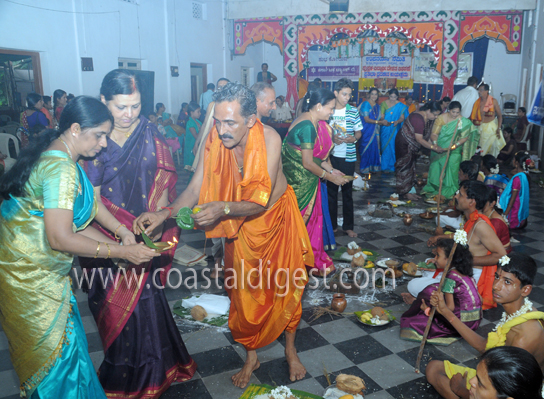
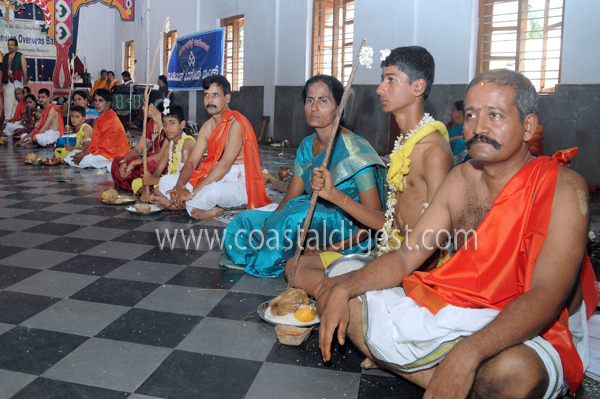
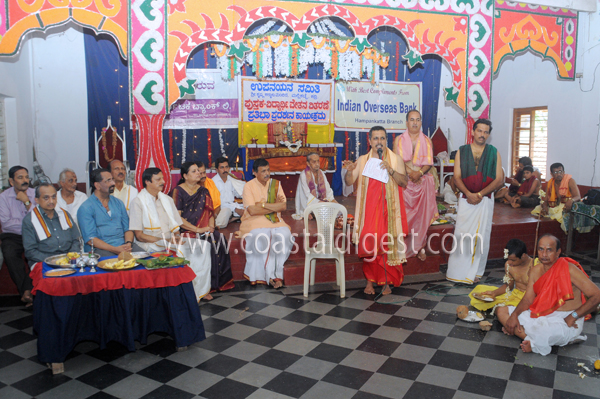
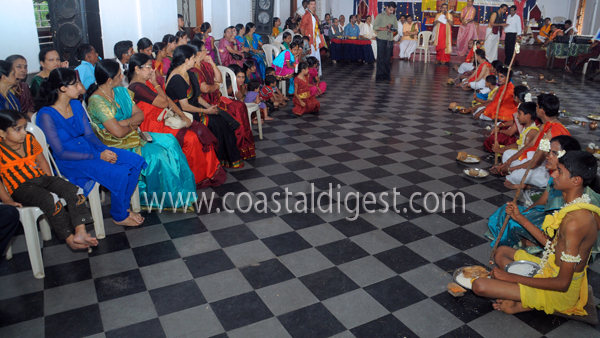
Mangalore, June 24: Several young boys were initiated to chanting of the 'Gayathri Mantra' amid Vedic rituals as part of a 'Samuhika Upanayanam' ceremony organised under the aegis of Shree Krishna Dharmopayana Samithi here on Sunday.

The mass thread ceremony organised at Shree Krishna Kalyana Mandir in the city was the 43rd annual event. The devotees recited Mantra on the occasion.

The 'Samuhika Upanayanam' was conducted mainly for the benefit of young boys hailing from families below the poverty line.

Organisers said that the registered participants took part in the ritual along with their parents. The participants did neither have to bring any items required for the event, nor had to pay the 'Sambhavana' to the 'purohits' conducting the event.

“The young boys were initiated to Gayathri Mantram to enable them explore the spiritual knowledge as per the Vedic tradition for universal well-being,” they said.

The thread ceremony was followed by a religious discourse on 'Gayathri Mahime'.

Vishwa Hindu Parishad leader Prof M B Puranik, former president of Kannada Sahitya Parishad Harikrishna Punaroor, working president of Samithi Aroor Prabhakar Rao, Treasurer Shubhanada Rao and Secretary Sudhakar Rao Pejawar were present among others.

Upanayana_1

Upanayana_2

Upanayana_3

Upanayana_4

Comments

raghu Rupa
 - 
Friday, 17 Aug 2018

Hello Sir,


My son need to take part in upanayanam. pls let me know any dates in this years.


NANDURU VENKAT…
 - 
Sunday, 10 Apr 2016

Sir, my son is 24 years old. We are indian hindu 6-vela niyogulam. I would like to perform his thread cermony in holy places. In april/may-2016. Is it possible to perform at this age to him by pandits. Will you please inform are they any dates in this month to perform. As soon as i hear from you we will come to have function. 9491106257
Thanking you

Add new comment

  • Coastaldigest.com reserves the right to delete or block any comments.
  • Coastaldigset.com is not responsible for its readers’ comments.
  • Comments that are abusive, incendiary or irrelevant are strictly prohibited.
  • Please use a genuine email ID and provide your name to avoid reject.
News Network
August 9,2020

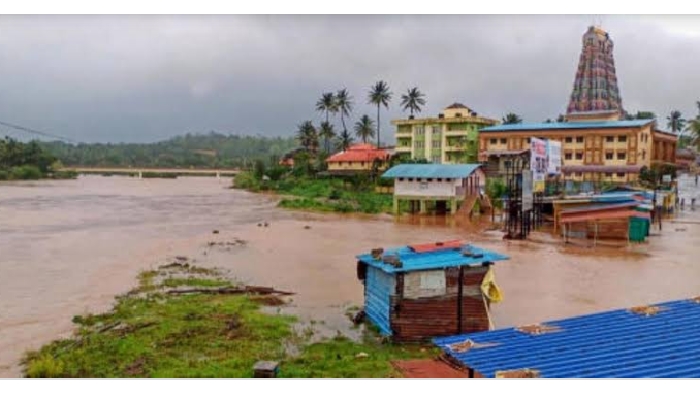
Bengaluru, Aug 9: Swollen rivers and flood-like situation continue to threaten lives and property in several parts of Karnataka that have been ravaged by torrential rains over the last few days.

Though there has been a respite from the downpour in some parts, rivers continue to flow above the danger mark, inundating low lying areas in several parts of Malnad, coastal and interior Karnataka.

There are also reports of continued landslides in hilly areas of Kodagu and Chikkamagaluru.

In Dakshina Kannada, heavy rains have submerged several areas in Bantwala and Belthangady, among others, with the Netravati river overflowing and also water being released from nearby dams.

Officials said incessant rains in Cauvery river catchment areas have led to increased inflow in the Krishna Raja Sagara dam in Mandya district. Water is being released from it and people living in low lying areas have been warned, they said.

There is also a flood-like situation in Najanagudu and nearby areas of Mysuru as the swollen Kapila river has inundated roads connecting Ooty in neighbouring Tamil Nadu, with water being released from Kabini dam.

There has been some respite from heavy rains in certain parts of Kodagu, which has been ravaged by floods and landslides. However, several areas of the district continue to be in deluge with the Cauvery and Lakshmana Tirtha rivers overflowing due to rains in the hilly areas.

There are also reports of landslides in some parts of the district.

Meanwhile, continuing rains are hampering the search operation by NDRF and authorities to locate five people, including the priest at Talacauvery, the origin of the river Cauvery, who had gone missing due to massive landslides at Bramhagiri hills on Wednesday night.

There are also reports of landslides at a few places in Charmadi ghat region of Chikkamagaluru and the road connecting to Dakshina Kannada has been closed temporarily.

Though Belagavi district has had some respite from the heavy rains, flood like situation continues to persist as the Krishna river and its tributaries are swollen due to continued inflows because of rains in neighbouring Maharashtra.

Inflow has also increased to the Tungabhadra dam of Ballari district due to rains in the catchment areas of Shivamogga and Chikkamagaluru.

Authorities have alerted people living in low lying areas about opening dam gates to release water anytime with rising inflow.

There is a similar flood like situation in parts of Yadgir, Raichur and Bagalkote districts with water being released from various dams.

The state government has released ₹ 50 crore for emergency relief and has announced ₹ 10,000 as immediate relief each to affected families.

An amount of ₹ 5 lakh has been announced for completely damaged houses, while in the case of partially damaged ones, relief will be distributed considering the extent of damage.

Comments

Add new comment

  • Coastaldigest.com reserves the right to delete or block any comments.
  • Coastaldigset.com is not responsible for its readers’ comments.
  • Comments that are abusive, incendiary or irrelevant are strictly prohibited.
  • Please use a genuine email ID and provide your name to avoid reject.
Agencies
February 20,2020

India ranked 77th on a sustainability index that takes into account per capita carbon emissions and ability of children in a nation to live healthy lives and secures 131st spot on a flourishing ranking that measures the best chance at survival and well-being for children, according to a UN-backed report.

The report was released on Wednesday by a commission of over 40 child and adolescent health experts from around the world. It was commissioned by the World Health Organization (WHO), UN Children's Fund (UNICEF) and The Lancet medical journal.

In the report assessing the capacity of 180 countries to ensure that their youngsters can survive and thrive, India ranks 77th on the Sustainability Index and 131 on the Flourishing Index, it said.

Flourishing is the geometric mean of Surviving and Thriving. For Surviving, the authors selected maternal survival, survival in children younger than 5 years old, suicide, access to maternal and child health services, basic hygiene and sanitation, and lack of extreme poverty.

For Thriving, the domains were educational achievement, growth and nutrition, reproductive freedom, and protection from violence.

Under the Sustainability Index, the authors noted that promoting today's national conditions for children to survive and thrive must not come at the cost of eroding future global conditions for children's ability to flourish.

The Sustainability Index ranks countries on excess carbon emissions compared with the 2030 target. This provides a convenient and available proxy for a country's contribution to sustainability in future.

The report noted that under realistic assumptions about possible trajectories towards sustainable greenhouse gas emissions, models predict that global carbon emissions need to be reduced from 39·7 giga­ tonnes to 22·8 gigatonnes per year by 2030 to maintain even a 66 per cent chance of keeping global warming below 1·5°C.

It said that the world's survival depended on children being able to flourish, but no country is doing enough to give them a sustainable future.

"No country in the world is currently providing the conditions we need to support every child to grow up and have a healthy future," said Anthony Costello, Professor of Global Health and Sustainability at University College London, one of the lead authors of the report.

"Especially, they're under immediate threat from climate change and from commercial marketing, which has grown hugely in the last decade," said Costello – former WHO Director of Mother, Child and Adolescent health.

Norway leads the table for survival, health, education and nutrition rates - followed by South Korea and the Netherlands. Central African Republic, Chad and Somalia come at the bottom.

However, when taking into account per capita CO2 emissions, these top countries trail behind, with Norway 156th, the Republic of Korea 166th and the Netherlands 160th.

Each of the three emits 210 per cent more CO2 per capita than their 2030 target, the data shows, while the US, Australia, and Saudi Arabia are among the 10 worst emitters. The lowest emitters are Burundi, Chad and Somalia.

According to the report, the only countries on track to beat CO2 emission per capita targets by 2030, while also performing fairly – within the top 70 – on child flourishing measures are: Albania, Armenia, Grenada, Jordan, Moldova, Sri Lanka, Tunisia, Uruguay and Vietnam.

"More than 2 billion people live in countries where development is hampered by humanitarian crises, conflicts, and natural disasters, problems increasingly linked with climate change," said Minister Awa Coll-Seck from Senegal, Co-Chair of the commission.

The report also highlights the distinct threat posed to children from harmful marketing.

Evidence suggests that children in some countries see as many as 30,000 advertisements on television alone in a single year, while youth exposure to vaping (e-cigarettes) advertisements increased by more than 250 per cent in the US over two years, reaching more than 24 million young people.

Studies in Australia, Canada, Mexico, New Zealand and the US – among many others – have shown that self-regulation has not hampered commercial ability to advertise to children.

Children's exposure to commercial marketing of junk food and sugary beverages is associated with purchase of unhealthy foods and overweight and obesity, linking predatory marketing to the alarming rise in childhood obesity, it said.

The number of obese children and adolescents increased from 11 million in 1975 to 124 million in 2016 – an 11-fold increase, with dire individual and societal costs, the report said.

To protect children, the authors call for a new global movement driven by and for children.

Specific recommendations include stopping CO2 emissions with the utmost urgency, to ensure children have a future on this planet; placing children and adolescents at the centre of global efforts to achieve sustainable development, the report said.

New policies and investment in all sectors to work towards child health and rights; incorporating children's voices into policy decisions and tightening national regulation of harmful commercial marketing, supported by a new Optional Protocol to the UN Convention on the Rights of the Child, it said.


Comments

Add new comment

  • Coastaldigest.com reserves the right to delete or block any comments.
  • Coastaldigset.com is not responsible for its readers’ comments.
  • Comments that are abusive, incendiary or irrelevant are strictly prohibited.
  • Please use a genuine email ID and provide your name to avoid reject.
News Network
February 18,2020

Bengaluru, Feb 18: Deputy chief minister Laxman Savadi was elected to the legislative council on Monday and although it was a done deal that he would win, a vote from across the aisle spiced up the election.

Counting was conducted soon after ballots were cast and Savadi polled 113 of the 120 votes cast, including the vote of disgruntled JD(S) legislator GT Devegowda. Seven votes were declared invalid. Members of the two opposition parties — Congress and JD(S) — abstained from voting.

The election was necessitated following the resignation of Rizwan Arshad of the Congress. Rizwan resigned after he was elected to the legislative assembly from the Shivajinagar constituency in the assembly bypolls held for 15 seats in December last year.

BR Anil Kumar, who was initially promised the support of both Congress and JD(S) was supposed to contest as an independent candidate. However, as both parties refused to support him at the last minute, he withdrew, paving the way for Savadi’s victory.

The BJP has 117 members in the 225-member assembly, but N Mahesh of the BSP and two independents, H Nagesh and Sharath Bachchegowda, besides GT Devegowda also voted, taking the total electorate to 120 (including the speaker). BJP’s SA Ramadas did not turn up because of health reasons.

“I would like to thank all those who were responsible for my victory. Special thanks to leaders of my party and chief minister BS Yediyurappa, who gave me the opportunity to be the BJP candidate,” said Savadi.

Winning this council election was crucial for Savadi to retain his ministry as he was not an elected member of either of the houses. Rules mandate that a non-member must get elected either to the assembly or council within six months after taking over as minister. February 20 was the deadline for Savadi, who had lost 2018 assembly polls from Athani, to get elected.

Officials in the assembly secretariat said seven votes were invalid because voters had wrongly marked their choices on ballot paper. According to norms, a voter has to mark numerical one, two and three against the names of the candidates in order of preference. Marking only numerical one is allowed. However, six ballots had a tick mark, while a voter had registered a cross mark. Since it was a secret ballot, it was not known who the MLAs were whose votes were invalid.

“The ballot papers bear serial numbers and they are randomly distributed. It is virtually impossible to say who a voter cast his or her vote for,” said assembly secretary MK Vishalakashi, the retuning officer for the bypoll.

Comments

Add new comment

  • Coastaldigest.com reserves the right to delete or block any comments.
  • Coastaldigset.com is not responsible for its readers’ comments.
  • Comments that are abusive, incendiary or irrelevant are strictly prohibited.
  • Please use a genuine email ID and provide your name to avoid reject.