



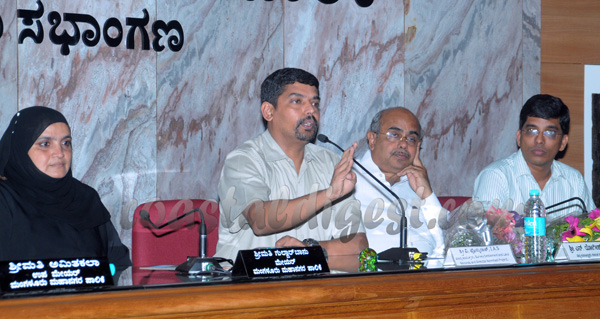
Authentic survey to be carried out prior to issue of PR cards: Ponnuraj

September 3, 2012

PR_1

Mangalore, September 3: The Property Cards (PR Cards) which would be given to owners of properties as part of the implementation of the Urban Property Ownership Records (UPOR) project, would act as a 'mirror' which would reflect the true property status in the city, said V Ponnuraj, Commisioner, Survey Settlement and land records and head of Urban Property Ownership records project.

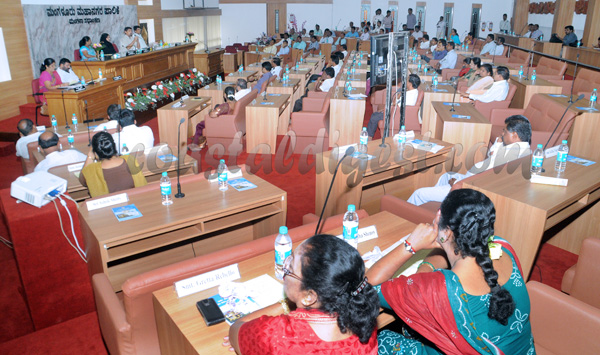
Addressing corporators at a meeting convened at the Mangalore City Corporation to clarify doubts concerning the UPOR project on Monday, Mr. Ponnuraj said that the PR Card would reflect the spatial reality of the property besides explaining its legal status.

The project implementation work has advanced at a good pace at Mysore and Shimoga cities but there were hitches as far as Mangalore was concerned since the work carried out by the private partnering agency was not satisfactory. A different agency has been entrusted with the job of conducting survey and helping in the implementation of the project in the city, Mr. Ponnuraj said. In Mysore and Shimoga, survey work has seen 100% completion, he said, stating that now issuance of PR cards is in the process there. In Hubli-Dharwad, one third of survey work is still pending while Bellary and Mangalore cities are also yet to see completion of survey work, he said.

During the survey, the space dimensions, past record of the property in terms of RTC, municipal documents and other records etc are ascertained and only after a complete information gathering is a property card granted to the owner of the property, Mr. Ponnuraj said. Factors such as lease, loans, river flow over the concerned property etc are also taken into consideration, he reveald. Markings are made after informing the owner of the property as well the owners of the neighbouring properties, he said. A duration of 30 days is allotted to the concerned parties to place before the UPOR authorities any complaints with regard to the survey and after the completion of the said duration, the card is finalled, he said. However, Mr. Ponnuraj added that even after granting a PR card, there is scope for people to challenge its issuance and disprove the survey details false by taking the matter to court, within 3 years of issuance of the card.

Responding to the query of one of the corporators with regard to the fees people would have to pay to get the PR cards, Mr. Ponnuraj said that no money is charged from people for UPOR processes up till the issuance of the card. To obtain the cards, property owners would have to pay charges based on the category that they belong to. Charges would also be determined depending on the size of the concerned property, he said. For the poor and lower middle class, and the minimum plot (about 600 sq. ft) charges would range from Rs. 300-500, he said, while property owners of commercial as well as residential properties measuring more than 1 acre would have to shell out around Rs. 4,500-5,000. The payments would be one-time payments.

When asked about irregularities in the already existing RTC and other records, Mr. Ponuraj said that adjacent lands would also be surveyed and an honest attempt at ascertaining whether some portion of the property had been wrongly encroached would be made before entering data into the Property card. If adjacent land records are also found to be correct, then the existing land record details would be considered for the concerned property, he said.

In case of the land or property being disputed and being sub-judice, a survey would be conducted nevertheless and name of the owner would be mentioned as mentioned in the records but it would be recorded in the PR Card that the matter is in the court of law, he said.

In case of divisions of property, new property numbers would be given and separate cards would be made, Mr. Ponnuraj said. A UPOR Cell would come into existence in the region which would keep track of such updates and developments, he informed. In case of a property being in the name of a person who is no more, it would be seen if his children are willing to divide the property. If they do not, then the PR card for the property will be issued in the name of all children, he said.

About two and a half lakh properties exist in Mangalore and each one has to be given a PR card, he said. The PR card will serve as a legal document for registration and statutory purposes. There is no scope for cheating with PR card, he added, stating that voter ID cards and UID cards would be linked to the PR card.

The project is being implemented on a Public Private Partnership (PPP) basis, Mr. Ponnuraj said, stating that 66% of the funding is being done by the government while 33% of the investement has to come from private agency. The private party has been made to invest so that the quality of work is maintained and that its output is linked to the investment, he said.

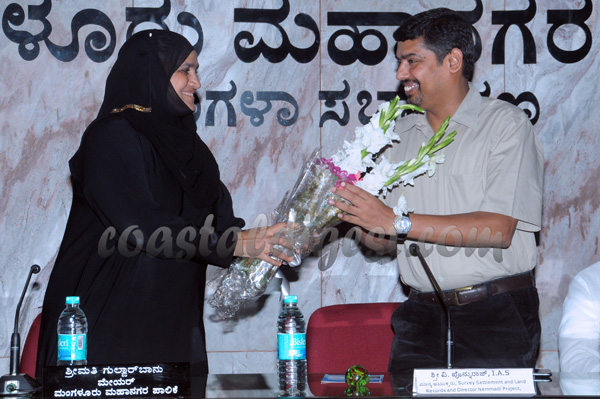
N Yogish Bhat, Deputy Speaker, Karnataka Legislative Assembly, Gulzar Banu, Mayor, Amitha Kala, Deputy Mayor and Dr. Harish Kumar, Commissioner, MCC, were also present.
PR_2

PR_3

Comments

Add new comment

  • Coastaldigest.com reserves the right to delete or block any comments.
  • Coastaldigset.com is not responsible for its readers’ comments.
  • Comments that are abusive, incendiary or irrelevant are strictly prohibited.
  • Please use a genuine email ID and provide your name to avoid reject.
News Network
March 30,2020

Belgaum, Mar 30: As many as 2442 labourers hailing from Karnataka have been brought back in 62 buses by the State government from Maharashtra on Sunday, in the backdrop of nation-wide lockdown following COVID-19 outbreak.

Maharashtra Chief Minister Uddhav Thackeray on Saturday urged migrant labourers not to leave the State owing to the nationwide lockdown and assured that the Maharashtra government will look after their interests.

Hundreds of migrants, a majority of whom are daily wage workers started rushing to their native places from different states amid uncertainty over their livelihood following the announcement of a 21-day nationwide lockdown by Prime Minister Narendra Modi last week in order to contain the spread of novel coronavirus.

Comments

Add new comment

  • Coastaldigest.com reserves the right to delete or block any comments.
  • Coastaldigset.com is not responsible for its readers’ comments.
  • Comments that are abusive, incendiary or irrelevant are strictly prohibited.
  • Please use a genuine email ID and provide your name to avoid reject.
coastaldigest.com news network
May 4,2020

Mangaluru, May 4: As the coronavirus lockdown norms have been relaxed in the coastal district of Dakshina Kannada, people will be able venture out for essential activities from 7 a.m to 7 p.m.

The lockdown was imposed in the coastal district on March 22 midnight to prevent the spread of Covid-19. Initially it did not apply to essential services such as sale of food, groceries, milk, vegetables, fruits, and meat and fish. Gradually the administration had to intensify the lockdown and allow those shops to remain open between 7 a.m. and 12 noon. However, today (May 4) onwards there will be relaxation of lockdown between 7 am to 7 pm. 

Precautionary measures like maintaining social distancing has been urged and use of face masks has been made mandatory.

Permitted activities

• Permission for plying of auto-rickshaws, cabs, private vehicles and bikes has been given. However only three occupants, including the driver will be allowed and no pillion rule is applicable for two-wheelers.

• OPDs, medical clinics are permitted to operate.

• Standalone shops, shops located in neighbourhood colony, residential complex will be allowed to operate.

• Private organisations can function with 33% staff capacity while allowing work from home for rest of staff.

• E-commerce activities only for essential goods permitted.

• In site construction activities in urban areas, rural areas including MNREGA works.

• Permission is only available to open the shop in the market and in the market complex.

Prohibited activities:

• Movement of individuals is not permitted for all non-essential activities.

• Travel by air, rail and inter-State movement by road.

• Functioning of schools, colleges, and other educational and training/ coaching institutions.

• Hospitality services, including hotels and restaurants.

• Cinema halls, malls, gymnasiums, sports complexes, bars, clubs, swimming pool, entertainment parks, assembly halls, etc; barber shops, spas and salons, textile and apparel(clothes) shops.

• Social, political, cultural, academic, entertainment, religious and other kinds of gatherings; and, religious places/ places of worship for public. 

• Shops in urban and rural areas, for non-essential goods not allowed in malls, markets and Market Complexes.

• All types of traffic movements will be prohibited after evening (7 pm to 7 am)

Comments

Add new comment

  • Coastaldigest.com reserves the right to delete or block any comments.
  • Coastaldigset.com is not responsible for its readers’ comments.
  • Comments that are abusive, incendiary or irrelevant are strictly prohibited.
  • Please use a genuine email ID and provide your name to avoid reject.
Ram Puniyani
July 20,2020

As Covid 19 has created havoc all rounds, the rulers of certain countries are using it to further intensify their set agendas. The democratic freedoms are being curtailed in certain forms, the reaction to which has come in America in the form of a campaign, which is opposing “stifling” cultural climate that is imposing “ideological conformity” and weakening “norms of open debate and toleration of differences”. In India similar intimidations have been intensified. In addition the occasion has been used by the sectarian forces first to link the spread of Corona to Muslim community and now in the name of reducing the burden of curriculum certain chapters on core concepts related to Indian nationalism are being deleted from the text books.

It has been reported that chapters on federalism, citizenship, nationalism, secularism, Human Rights, Legal Aid and Local Self Government and the like are being dropped. Education has been an important area for communal forces and they constantly keep saying that leftists have dominated the curriculum content, it suffers from the impact of Macaulay, Marx and Mohammad and so needs to be Indianized. The first such attempt was done when BJP came to power in 1998 as NDA and had Murli Manohar Joshi as the MHRD minister. He brought the changes which were termed as ‘saffronization of education’. Their focus is more on social science. Some of the highlights of this were introduction of subjects like Astrology and Paurohitya, and chapters defending caste system, nationalism of the type of Hitler was praised.

With defeat of NDA in 2004, the UPA did try to rectify some of these distortions. Again after 2014 the RSS affiliates working in the area of education have been active, interacting with MHRD officials to impress upon them the need to change the curriculum matching with their Hindu nationalist agenda. Its ‘Shiksha Sanskriti Utthan Nyas’ has been asking for removal of English, Urdu words in the texts. It has asked for removal of thoughts of Rabindranath Tagore on Nationalism, extracts of autobiography of M F Husain, references to benevolence of Muslim rulers, references to BJP being Hindu party, apology of Dr. Manmohan Singh for anti Sikh pogrom of 1984, the reference to killings of Gujarat carnage in 2002 among others. This they call as Bhartiykaran of syllabus.

As RSS is a multithreaded hydra one of its pracharak Dinanath Batra has set up ‘Shiksha Bachao Abhiyan Samiti’ which has been pressurizing various publishers to drop the books which are not conforming to their ideology. One recalls their pressuring withdrawal of Wendy Doniger’s ‘The Hindus’, as it does present the ancient India through the concerns of dalits and women. Mr. Batra has already come out with a set of nine books for school curriculum, giving the RSS view of the past and RSS understanding of social sciences. These have already been translated into Gujarati and thousands of the sets of these books are being used in Gujarat Schools.

The present step of deleting parts of curriculum which gives the basics of Indian Nationalism, secularism and human rights is a further step in the same direction. These are the topics which have made the Hindu nationalists uncomfortable during last few years. They have been defaming secularism. They removed it from the preamble of Indian constitution, when they put out an ad on the eve of Republic day in 2015. From last few decades since the Ram Temple movement was brought up, simultaneously the secular ethos of India’s freedom movement and secular values of Indian constitution have been constantly criticized. Many an RSS ideologues and BJP leaders have been asking for change of Indian Constitution for this very reason.

Secularism is part of the concept of Indian nationalism. In the name of religious nationalism, sectarian divisive nationalism they have been attacking various student leaders in particular. When we study Nationalism, the very genesis of Indian nationalism tells us the plurality of our freedom movement with its anti colonial roots. The struggle was for Indian nationalism and so the Muslims and Hindu communalists kept aloof from this great struggle against colonial masters, it was this struggle which built the Indian nation with all its diversity.

Similarly as we have equal rights as citizens the chapters on citizenship are being dropped. Federalism has been the core part of India’s administrative and political structure. As the dictatorial tendencies are becoming stronger, federalism is bound to suffer and that explains the dropping of this subject. Democracy is decentralization of power. Power reaching the lowermost part of the system, the villages and average citizens. This got reflected in Local self Government. The power is distributed among villages, cities, state and center. By removing chapters on federalism and local self government, the indications of the ideology of ruling party are on display.

While we are not dealing with all the portents of the planned omissions, one more aspect that related to dropping of chapter on Human rights needs our attention. The concept of Human rights and dignity are interlinked. This concept of Human rights also has international ramifications. India is signatory to many an UN covenants related to Human rights. The indications are clear that now rights will be for the few elite and ‘duties’ for the large deprived sections will be put on the forefront.

In a way this incidental ‘Corona gifted opportunity’ to the ruling Government is being fully used to enhance the agenda of ruling party in the arena of Educational Curriculum. The part of curriculum with which the ruling party is uncomfortable is being removed. This act of omission does supplement their other acts of commission in changing the shape of educational curriculum, which are reflected in RSS affiliates’ suggestions to MHRD regarding Bhartiyakaran of contents of syllabus. As per this the things like regarding the great epics like Ramayana and Mahabharata as History, the things like India having all the stem cell technology, plastic surgery, aviation science etc. will have a place in the changes planned by communal forces!

Comments

Add new comment

  • Coastaldigest.com reserves the right to delete or block any comments.
  • Coastaldigset.com is not responsible for its readers’ comments.
  • Comments that are abusive, incendiary or irrelevant are strictly prohibited.
  • Please use a genuine email ID and provide your name to avoid reject.
