


MCC presents surplus budget; projects Rs 257.66 cr revenue, Rs 257.60 cr expenditure

[email protected] (CD Network, Photos by Suresh Vamanjoor )
February 14, 2013

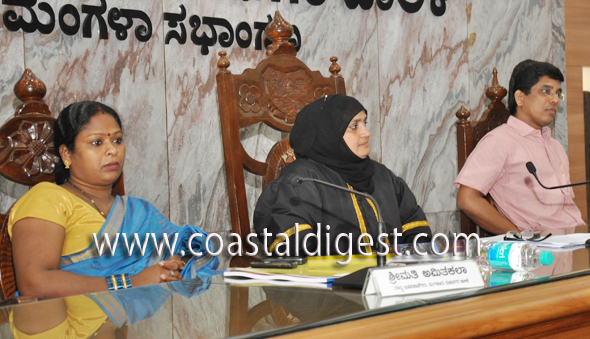
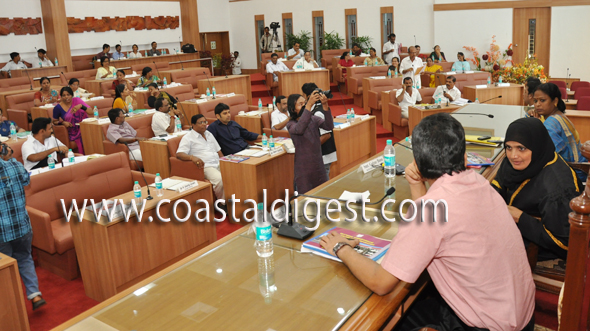
Mangalore, Feb 14: The Council of Mangalore City Corporation (MCC) here on Thursday approved the surplus budget of Rs 6.04 lakh for the 2013-14 fiscal year, in the budget presentation session chaired by Mayor Gulzar Banu.

The annual budget presented by President of Standing Committee on Taxation and Finance Shantha R projects a total revenue of Rs 257.66 crore, and proposes expenditure of Rs 257.60 crore.

Similar to the previous year, the revenue of the MCC for the year 2013-14 includes Rs 35 crore from water tariff, Rs 29 crore from self-assessment of property tax, Rs 1.3 crore from trade licenses, Rs 7.26 from building regulation and development fees, Rs 3.69 from markets, Rs 15 crore in the form of solid waste collection fees and funds from the government and other sources.

Water supply

A sum of Rs 34.17 crore has been earmarked in the budget for the second vented dam at Thumbe, which is expected to meet the drinking water needs of the city till 2026. As the storage capacity of the vented dam is limited to the storage of water required for 45 days, work on a new vented dam has commenced through the grant of Rs 75.50 crore by Karnataka Urban Water Supply and Drainage Board. Almost 30 per cent of the works on the new vented dam have been completed and the remaining works have commenced. The corporation has spent Rs 19.75 crore on the vented dam. Once it is completed in May 2014, efforts will be made to supply water to all areas under the MCC, said Shantha R.

Development programmes

The budget has allocated a total of Rs 17.95 crore for various developmental works, including Rs 13.50 crore for development work, Rs 3.07 crore for SC/ST welfare programmes, Rs 98 lakh for social welfare and eradication of poverty, Rs 40.50 lakh for welfare of disabled persons and Rs 7 crore for payment of other bills.

Computerisation

The corporation expected a sum of Rs 3 crore from the government for the computerisation of all departments of the MCC in order to provide better services to the citizens. Efforts will be made in coming days to provide all the information related to the Corporation departments online to the public.

Kuteera Bhagya

A sum of Rs 70 lakh has been reserved in the budget for the Kuteera Bhagya scheme this year, and Rs 2 lakh for the Kuteera Jyothi scheme to provide electricity connections to BPL beneficiaries.

Awareness for students

The budget has earmarked a sum of Rs 5 lakh for the scheme to conduct awareness programmes among students studying in fifth to seventh standard in government schools, on misuse and storage of water, water purification and sewage treatment plants.

Waste collection

A sum of Rs 25 crore has been reserved for solid-waste management for the fiscal year 2013-14.

The contract of door- to-door collection of solid waste has been provided to eight contractors, who have begun collecting waste from houses. Out of 60 wards under the MCC, waste segregated dry and wet waste is being collected in two separate bins in two wards (Mannagudda and Court wards). Collection of segregated waste will begin in other wards in the coming days.

Bulk waste will be collected from hotels, canteens, juice centres, caterers, marriage halls and meat and chicken stalls and processed separately.

The construction of a market in Bejai and a fish market in Jeppu is going on. The MCC is planning to construct another fish market in Kuloor and a bus stand for commuters.

Reactions

Presenting his views, Corporator Harinath said that that the amount of Rs 10 lakh allocated to victims of natural disasters was insufficient, and so was the sum of Rs 35 crore allocated for construction of houses for the poor. The amount allocated for the construction of the fish market has not been mentioned. There is also a necessity for a market in Kavoor, he said, and added that there was no mention in the budget of allotment of rickshaw parking facilities.

Former Mayor Shankar Bhat pressed for the need to allocate funds for the construction of a railway underbridge at Jeppu-Kutpady.

Corporator James pressed for allocation of Rs 10-15 crore for the construction of a new bus stand at Pumpwell junction, while yet another objected to the non-allotment of funds for laying pavements on the sides of concretised roads in the city.
mcc_3
mcc_6

Comments

Willard
 - 
Saturday, 2 Apr 2016

Thanks Ed! I checked the Ed Session site yesterday too, and it resembles it had not been loaded yet.
I'm trying to find a number of others too so I'll be
in touch with those speakers also. There's a lot of folks here who are getting more interested by SM use, I 'd like to think @therealjoelp and
I are partially to blame/thank!

Have a look at my web page: legal secretary: http://www.google.com

Add new comment

  • Coastaldigest.com reserves the right to delete or block any comments.
  • Coastaldigset.com is not responsible for its readers’ comments.
  • Comments that are abusive, incendiary or irrelevant are strictly prohibited.
  • Please use a genuine email ID and provide your name to avoid reject.
News Network
February 14,2020

Bengaluru, Feb 14: Bengaluru Police on Friday said that it has busted a gang engaged in e-commerce fraud over the online marketplace who were involved in 200 of the 316 cheating cases registered last year.

"We registered 316 cases for cheating through online marketplaces last year. We have busted a gang operating from Rajasthan's Bharatpur and arrested 5 people. They are responsible for 200 out of 316 cases. We are questioning the accused," Bhaskar Rao, Commissioner of Police, Bengaluru told reporters here.

Explaining their modus operandi, the Police Commissioner said, "There were fictitious buyers and sellers on the online marketplace. These people used to call up prospective buyers and sellers. The products that were shown were two-wheelers, four-wheelers, electronic items and furniture."

"People used to send their money to these fraudsters using their QR code. The fraudsters were operating from Bharatpur in Rajasthan. A police team of 15 was sent to the place from where they were operating. Rajasthan police gave us full cooperation and we were able to arrest five persons," he added.

Rao said that these fraudsters had an idea about the loopholes in the e-commerce sector and exploited them.
"Some of those arrested were employed in the e-commerce and banking business and they had an idea about the loopholes in this sector," he said.

"We warn the citizens to ensure that they verify the antecedents of the buyers and sellers in this sector before spending money on these platforms," he added.

Comments

Add new comment

  • Coastaldigest.com reserves the right to delete or block any comments.
  • Coastaldigset.com is not responsible for its readers’ comments.
  • Comments that are abusive, incendiary or irrelevant are strictly prohibited.
  • Please use a genuine email ID and provide your name to avoid reject.
News Network
April 10,2020

Thiruvananthapuram, Apr 10: Eight foreign nationals from Italy and United Kingdom, who were undergoing treatment in Kerala, have recovered fully from COVID-19, Chief Minister Pinarayi Vijayan said on Thursday.

The state reported 12 more positive cases of coronavirus on Thursday taking the total number of confirmed cases to 357, Vijayan said as he cautioned that the strict vigil against the pandemic will continue.

While the northern districts of Kannur and Kasaragod reported four cases each, two cases were reported from Malappuram district and one each from Kollam and Thiruvananthapuram districts, Vijayan told reporters after a COVID-19 review meeting here.

Of the eight foreign nationals, seven were undergoing treatment at the Ernakulam Medical College Hospital and one in Thiruvananthapuram Medical College Hospital, Vijayan said, adding that some of the patients were in a serious condition.

The seven foreigners from UK, admitted in Ernakulam medical college, were part of the group which had on March 15 tried to leave the country without permission while being under observation at Munnar, a hill station in the state.

The Italian tourist in Thiruvananthapuram was staying at a resort at Varkala near here and was admitted to hospital on March 13, Vijayan said.

"The recovery of this UK tourist group, which comprised of 83 and 76-year-olds is a testimony to our robust healthcare system and good treatment extended to these patients," the chief minister said.

It has been 100 days since the first COVID-19 case was reported in the state and since then, a total of 357 cases have been confirmed and currently, 258 patients are under treatment in different hospitals.

Comments

Add new comment

  • Coastaldigest.com reserves the right to delete or block any comments.
  • Coastaldigset.com is not responsible for its readers’ comments.
  • Comments that are abusive, incendiary or irrelevant are strictly prohibited.
  • Please use a genuine email ID and provide your name to avoid reject.
Ram Puniyani
January 14,2020

In the beginning of January 2020 two very disturbing events were reported from Pakistan. One was the attack on Nankana Sahib, the holy shrine where Sant Guru Nanak was born. While one report said that the place has been desecrated, the other stated that it was a fight between two Muslim groups. Prime Minister of Pakistan Imran Khan condemned the incident and the main accused Imran Chisti was arrested. The matter related to abduction and conversion of a Sikh girl Jagjit Kaur, daughter of Pathi (One who reads Holy Guru Granth Sahib in Gurudwara) of the Gurudwara. In another incident one Sikh youth Ravinder Singh, who was out on shopping for his marriage, was shot dead in Peshawar.

While these condemnable attacks took place on the Sikh minority in Pakistan, BJP was quick enough to jump to state that it is events like this which justify the Citizenship Amendment Act (CAA). Incidentally CAA is the Act which is discriminatory and relates to citizenship with Religion, which is not as per the norms of Indian constitution. There are constant debates and propaganda that population of Hindus has come down drastically in Pakistan and Bangla Desh. Amit Shah, the Home minister stated that in Pakistan the population of Hindus has come down from 23% at the time of partition to 3.7% at present. And in Bangla Desh it has come down from 22% to present 8%.

While not denying the fact that the religious minorities are getting a rough deal in both these countries, the figures which are presented are totally off the mark. These figures don’t take into consideration the painful migrations, which took place at the time of partition and formation of Bangla Desh later. Pakistan census figures tell a different tale. Their first census was held in 1951. As per this census the overall percentage of Non Muslim in Pakistan (East and West together) was 14.2%, of this in West Pakistan (Now Pakistan) it was 3.44 and in Eat Pakistan it was 23.2. In the census held in Pakistan 1998 it became 3.72%. As far as Bangla Desh is concerned the share of Non Muslims has gone down from 23.2 (1951) to 9.6% in 2011.

The largest minority of Pakistan is Ahmadis, (https://minorityrights.org/country/pakistan/) who are close to 4 Million and are not recognised as Muslims in Pakistan. In Bangla Desh the major migrations of Hindus from Bangla Desh took place in the backdrop of Pakistan army’s atrocities in the then East Pakistan.

As far as UN data on refugees in India it went up by 17% between 2016-2019 and largest numbers were from Tibet and Sri Lanka.  (https://www.un.org/en/development/desa/population/migration/publication…)

The state of minorities is in a way the index of strength of democracy. Most South Asian Countries have not been able to sustain democratic values properly. In Pakistan, the Republic began with Jinnah’s classic speech where secularism was to be central credo of Pakistan. This 11th August speech was in a way what the state policy should be, as per which people of all faiths are free to practice their religion. Soon enough the logic of ‘Two Nation theory” and formation of Pakistan, a separate state for Muslim took over. Army stepped in and dictatorship was to reign there intermittently. Democratic elements were suppressed and the worst came when Zia Ul Haq Islamized the state in collusion with Maulanas. The army was already a strong presence in Pakistan. The popular formulation for Pakistan was that it is ruled by three A’s, Army, America and Allah (Mullah).

Bangla Desh had a different trajectory. Its very formation was a nail in the coffin of ‘two nation theory’; that religion can be the basis of a state. Bangla Desh did begin as a secular republic but communal forces and secular forces kept struggling for their dominance and in 1988 it also became Islamic republic. At another level Myanmar, in the grip of military dictatorship, with democratic elements trying to retain their presence is also seeing a hard battle. Democracy or not, the army and Sanghas (Buddhist Sang has) are strong, in Myanmar as well. The most visible result is persecution of Rohingya Muslims.

Similar phenomenon is dominating in Sri Lanka also where Budhhist Sanghas and army have strong say in the political affairs, irrespective of which Government is ruling. Muslim and Christian minorities are a big victim there, while Tamils (Hindus, Christians etc.) suffered the biggest damage as ethnic and religious minorities. India had the best prospect of democracy, pluralism and secularism flourishing here. The secular constitution, the outcome of India’s freedom struggle, the leadership of Gandhi and Nehru did ensure the rooting of democracy and secularism in a strong way.

India so far had best democratic credentials amongst all the south Asian countries. Despite that though the population of minorities rose mainly due to poverty and illiteracy, their overall marginalisation was order of the day, it went on worsening with the rise of communal forces, with communal forces resorting to identity issues, and indulging in propaganda against minorities.

While other South Asian countries should had followed India to focus more on infrastructure and political culture of liberalism, today India is following the footsteps of Pakistan. The retrograde march of India is most visible in the issues which have dominated the political space during last few years. Issues like Ram Temple, Ghar Wapasi, Love Jihad, Beef-Cow are now finding their peak in CAA.

India’s reversal towards a polity with religion’s identity dominating the political scene was nicely presented by the late Pakistani poetess Fahmida Riaz in her poem, Tum bhi Hum Jaise Nikle (You also turned out to be like us). While trying to resist communal forces has been an arduous task, it is becoming more difficult by the day. This phenomenon has been variously called, Fundamentalism, Communalism or religious nationalism among others. Surely it has nothing to do with the religion as practiced by the great Saint and Sufi traditions of India; it resorts mainly to political mobilization by using religion as a tool.

Comments

Ashi
 - 
Tuesday, 14 Jan 2020

If Malaysia implement similar NRC/CAA, India and China are the loser.

Add new comment

  • Coastaldigest.com reserves the right to delete or block any comments.
  • Coastaldigset.com is not responsible for its readers’ comments.
  • Comments that are abusive, incendiary or irrelevant are strictly prohibited.
  • Please use a genuine email ID and provide your name to avoid reject.
