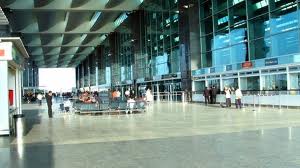
It's official: Bangalore's airport to be named after Kempegowda

July 17, 2013

New Delhi, Jul 17: The Bengaluru international airport will be named after the city's founder Kempegowda.The government today approved a Civil Aviation Ministry proposal to this effect.blore

The proposal was approved by the Union Cabinet at its meeting here, fulfilling a long-pending demand of the people of Karnataka, official sources said here.

Hiriya Kempegowda was a ruler under the Vijayanagar Empire who ruled most parts of Karnataka during the 16th century. Having built the Bengaluru Fort and moved his capital from Yelahanka, he is widely accepted as the founder of Bengaluru.

The airport, run by a private-led consortium, would be renamed Kempegowda International Airport after the founder whose 503rd birth anniversary was observed this year.

The Civil Aviation Ministry had last year approved the proposal of the state government following efforts by then External Affairs Minister S M Krishna.

The state assembly had adopted a unanimous resolution on the matter last December, though there were differences earlier with some sections demanding that it be named after Tipu Sultan (who was born in Devanahalli) or social reformer Basaveshwara or former Mysore Dewan Sir M Visvesvaraya.

The Bengaluru airport, which became operational in May 2008, is one of the busiest in the country. It is owned and operated by a GVK group-led joint venture Bengaluru International Airport Pvt Limited in which KSSIDC (a state government entity, Airports Authority of India, Siemens and Zurich Airport are also the shareholders.

Comments

Add new comment

  • Coastaldigest.com reserves the right to delete or block any comments.
  • Coastaldigset.com is not responsible for its readers’ comments.
  • Comments that are abusive, incendiary or irrelevant are strictly prohibited.
  • Please use a genuine email ID and provide your name to avoid reject.
News Network
January 2,2020

Bengaluru, Jan 2: Accusing Prime Minister Narendra Modi of "neglecting" Karnataka ahead of his visit on Thursday, the state Congress questioned why he did not give adequate relief and pay a visit to the state, when most of its parts were affected by severe floods last year.

Modi will begin his two-day visit to the state on Thursday afternoon.

The Congress' Karnataka unit in a series of tweets also questioned the Prime Minister about not conferring the "Bharat Ratna" on Shivakumara Swamiji of Siddaganga Math, who passed away last year at the age of 111 years.

"Why you did not visit the state, when it was affected by floods? Despite the damage of over Rs 1 lakh crore why you did not declare it as a national disaster? Why you did not give interim relief? When the state government has given a report that the damage caused was to the tune of Rs 35,300 crore why did you sit quiet by giving just Rs 1,200 crore," the state Congress tweeted.

As many as 103 taluks in 22 districts of Karnataka were affected due to unprecedented floods in August, in which over 80 people were killed.

Around seven lakh people were shifted to safe areas during the deluge and thousands of houses were damaged.

In October, various parts of the state faced a deluge for the second time in two months, killing over 13 people and damaging thousands of houses.

Asking as to why the Centre was not giving the state's share of GST amount adequately, the Congress questioned as to why dues under MNREGA programme were not paid so far, and why Karnataka was being neglected while allocating grants.

Questioning Modi as to why he did not visit Tumakuru when Shivakumara Swamiji of Siddaganga Math passed away, the principal opposition party in the state Assembly, also sought to know why the seer was not conferred with the Bharat Ratna yet.

It also pointed out that former Chief Minister Siddaramaiah had written a letter in this regard in January 2018.

The Congress has also hit out at the BJP-led Central government over imposition of Hindi language by neglecting regional languages and mother tongue.

The Prime Minister will kickstart his visit to the state by paying tributes to the late pontiff's 'Gadduge' (final resting place) at the Math premises near Tumakuru.

Later, he will attend an event organised to give away Krishi Karman awards and to distribute fishing equipment at the government college ground in Tumakuru, before leaving for Bengaluru where he will be attending a DRDO event.

On Friday he will be inaugurating 107th Indian Science Congress here.

Comments

Add new comment

  • Coastaldigest.com reserves the right to delete or block any comments.
  • Coastaldigset.com is not responsible for its readers’ comments.
  • Comments that are abusive, incendiary or irrelevant are strictly prohibited.
  • Please use a genuine email ID and provide your name to avoid reject.
News Network
August 6,2020

Chennai, Aug 5: Karnataka on Wednesday crossed the 1.5 lakh mark in respect of COVID-19 cases and Kerala was on the verge of 30,000 while Andhra Pradesh witnessed a five- digit daily caseload after a lull. 

Tamil Nadu saw a small jump in its daily cases as compared to Tuesday while Telangana and union territory Puducherry reported their respective record single-day spikes. 

The five states and the union territory reported a combined 24,415 fresh confirmed coronavirus cases and 316 fatalities on Wednesday. 

A Puducherry Minister tested positive for the deadly virus while an opposition AINRC legislator who contracted the coronavirus earlier was discharged after being cured of it. 

In Karnataka, the coronavirus cases stood at 1,51,449 with the addition of 5,619 fresh cases while 100 deaths were reported, pushing the total fatalities to 2,804, the health department said.

According to a health bulletin, 74,679 persons have been discharged so far, leaving 73,958 active cases. Andhra Pradesh''s COVID-19 surge continued on Wednesday too, with 10,128 cases reported afresh after easing a little in the last four days. 

The overall tally rose to 1,86,461 on Wednesday. The state had last reported its five-figure daily tally on July 31 when it was 10,376. 

The state also saw a record number of 77 coronavirus deaths in a day, pushing the toll to 1,681, the latest bulletin said. 

In the last 24 hours, 8,729 patients had also recovered from the infection and there were 80,426 active cases. 

As many as 1,04,354 patients have been cured and discharged so far. Kerala was on the verge of 30,000 cases, as its tally stood at 29,145 with the addition of 1,195 new COVID-19 cases on Wednesday.

The toll from the virus so far climbed to 94 with seven more deaths. Thiruvananthapuram continued to top the districts in infections with 274 cases on Wednesday, of whom 248 had been infected through contact. 

Malappuram (167), Kasaragod (128), Ernakulam (120) and Alappuzha (108) reported over 100 cases. As many as 112 patients died of COVID-19 in Tamil Nadu, the highest reported in a single day so far, taking the toll to 4,461 on Wednesday while 5,175 more people tested positive, propelling the case count to 2.73 lakh.

Recoveries outnumbered fresh cases with 6,031 people getting discharged from various hospitals, taking the total cured to 2,14,815 as the active cases dropped to 54,184, a government bulletin said. 

In Telangana, 2,012 new cases emerged while 13 related fatalities were reported, taking the total infection tally in the state to 70,958. Out of the new cases, 532 were from the Greater Hyderabad Municipal Corporation (GHMC), followed by Medchal-Malkajgiri 198 and Rangareddy 188, a state government bulletin said on Wednesday, providing data as of 8 PM on August 4. 

The total number of people who recovered from the infectious disease touched 50,814, while 19,568 were under treatment.

The COVID-19 fatality rate in the state was 0.81 per cent, while it was 2.10 per cent at the national level, it said. The recovery rate was 71.6 per cent in the state, while it was 66.31 per cent in the country, it added. 

Puducherry clocked its worst single-day spike of 286 infections, recording seven deaths, even as the overall tally of cases went up to 4,432. 

The deaths during the 24 hours in the Union Territory took the toll to 65 so far since the outbreak of the virus, Health Minister Malladi Krishna Rao told a virtual press conference. 

His cabinet colleague M Kandasamy and his son reported positive for the virus and were admitted to JIPMER.


Comments

Add new comment

  • Coastaldigest.com reserves the right to delete or block any comments.
  • Coastaldigset.com is not responsible for its readers’ comments.
  • Comments that are abusive, incendiary or irrelevant are strictly prohibited.
  • Please use a genuine email ID and provide your name to avoid reject.
Ram Puniyani
February 4,2020

As democracy is seeping in slowly all over the world, there is an organization which is monitoring the degree of democracy in the individual countries, The Economist Intelligence Unit. As such in each country there are diverse factors which on one hand work to deepen it, while others weaken it. Overall there is a march from theoretical democracy to substantive one. The substantive democracy will herald not just the formal equality, freedom and community feeling in the country but will be founded on the substantive quality of these values. In India while the introduction of modern education, transport, communication laid the backdrop of beginning of the process, the direction towards deepening of the process begins with Mahatma Gandhi when he led the non-cooperation movement in 1920, in which average people participated. The movement of freedom for India went on to become the ‘greatest ever mass movement’ in the World.

The approval and standards for democracy were enshrined in Indian Constitution, which begins ‘We the people of India’, and was adopted on 26th January 1950. With this Constitution and the policies adopted by Nehru the process of democratization started seeping further, the dreaded Emergency in 1975, which was lifted later restored democratic freedoms in some degree. This process of democratisation is facing an opposition since the decade of 1990s after the launch of Ram Temple agitation, and has seen the further erosion with BJP led Government coming to power in 2014. The state has been proactively attacking civil liberties, pluralism and participative political culture with democracy becoming flawed in a serious way. And this is what got reflected in the slipping of India by ten places, to 51st, in 2019. On the index of democracy India slipped down from the score of 7.23 to 6.90. The impact of sectarian BJP politics is writ on the state of the nation, country.

Ironically this lowering of score has come at a time when the popular protests, the deepening of democracy has been given a boost and is picking up with the Shaheen Bagh protests. The protest which began in Shaheen Bagh, Delhi in the backdrop of this Government getting the Citizenship amendment Bill getting converted into an act and mercilessly attacking the students of Jamia Milia Islamia, Aligarh Muslim University along with high handed approach in Jamia Nagar and neighbouring areas.  From 15th December 2019, the laudable protest is on.

It is interesting to note that the lead in this protest has been taken by the Muslim women, from the Burqa-Hijab clad to ‘not looking Muslim’ women and was joined by students and youth from all the communities, and later by the people from all the communities. Interestingly this time around this Muslim women initiated protest has contrast from all the protests which earlier had begun by Muslims. The protests opposing Shah Bano Judgment, the protests opposing entry of women in Haji Ali, the protests opposing the Government move to abolish triple Talaq. So far the maulanas from top were initiating the protests, with beard and skull cap dominating the marches and protests. The protests were by and large for protecting Sharia, Islam and were restricted to Muslim community participating.

This time around while Narendra Modi pronounced that ‘protesters can be identified by their clothes’, those who can be identified by their external appearance are greatly outnumbered by all those identified or not identified by their appearance.

The protests are not to save Islam or any other religion but to protect Indian Constitution. The slogans are structured around ‘Defence of democracy and Indian Constitution’. The theme slogans are not Allahu Akbar’ or Nara-E-Tadbeer’ but around preamble of Indian Constitution. The lead songs have come to be Faiz Ahmad Faiz’s ‘Hum Dekhenge’, a protest against Zia Ul Haq’s attempts to crush democracy in the name of religion. Another leading protest song is from Varun Grover, ‘Tanashah Aayenge…Hum Kagaz nahin Dikhayenge’, a call to civil disobedience against the CAA-NRC exercise and characterising the dictatorial nature of the current ruling regime.

While BJP was telling us that primary problem of Muslim women is Triple talaq, the Muslim women led movements has articulated that primary problem is the very threat to Muslim community. All other communities, cutting across religious lines, those below poverty line, those landless and shelter less people also see that if the citizenship of Muslims can be threatened because of lack of some papers, they will be not far behind in the victimization process being unleashed by this Government.

While CAA-NRC has acted as the precipitating factor, the policies of Modi regime, starting from failure to fulfil the tall promises of bringing back black money, the cruel impact of demonetisation, the rising process of commodities, the rising unemployment, the divisive policies of the ruling dispensation are the base on which these protest movements are standing. The spread of the protest movement, spontaneous but having similar message is remarkable. Shaheen Bagh is no more just a physical space; it’s a symbol of resistance against the divisive policies, against the policies which are increasing the sufferings of poor workers, the farmers and the average sections of society.

What is clear is that as identity issues, emotive issues like Ram Temple, Cow Beef, Love Jihad and Ghar Wapasi aimed to divide the society, Shaheen Bagh is uniting the society like never before. The democratisation process which faced erosion is getting a boost through people coming together around the Preamble of Indian Constitution, singing of Jan Gan Man, waving of tricolour and upholding the national icons like Gandhi, Bhagat Singh, Ambedkar and Maulana Azad. One can feel the sentiments which built India; one can see the courage of people to protect what India’s freedom movement and Indian Constitution gave them.

Surely the communal forces are spreading canards and falsehood against the protests. As such these protests which is a solid foundation of our democracy. The spontaneity of the movement is a strength which needs to be channelized to uphold Indian Constitution and democratic ethos of our beloved country.

Comments

Add new comment

  • Coastaldigest.com reserves the right to delete or block any comments.
  • Coastaldigset.com is not responsible for its readers’ comments.
  • Comments that are abusive, incendiary or irrelevant are strictly prohibited.
  • Please use a genuine email ID and provide your name to avoid reject.