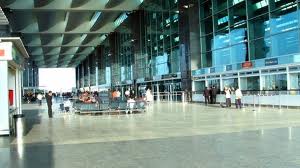
It's official: Bangalore's airport to be named after Kempegowda

July 17, 2013

New Delhi, Jul 17: The Bengaluru international airport will be named after the city's founder Kempegowda.The government today approved a Civil Aviation Ministry proposal to this effect.blore

The proposal was approved by the Union Cabinet at its meeting here, fulfilling a long-pending demand of the people of Karnataka, official sources said here.

Hiriya Kempegowda was a ruler under the Vijayanagar Empire who ruled most parts of Karnataka during the 16th century. Having built the Bengaluru Fort and moved his capital from Yelahanka, he is widely accepted as the founder of Bengaluru.

The airport, run by a private-led consortium, would be renamed Kempegowda International Airport after the founder whose 503rd birth anniversary was observed this year.

The Civil Aviation Ministry had last year approved the proposal of the state government following efforts by then External Affairs Minister S M Krishna.

The state assembly had adopted a unanimous resolution on the matter last December, though there were differences earlier with some sections demanding that it be named after Tipu Sultan (who was born in Devanahalli) or social reformer Basaveshwara or former Mysore Dewan Sir M Visvesvaraya.

The Bengaluru airport, which became operational in May 2008, is one of the busiest in the country. It is owned and operated by a GVK group-led joint venture Bengaluru International Airport Pvt Limited in which KSSIDC (a state government entity, Airports Authority of India, Siemens and Zurich Airport are also the shareholders.

Comments

Add new comment

  • Coastaldigest.com reserves the right to delete or block any comments.
  • Coastaldigset.com is not responsible for its readers’ comments.
  • Comments that are abusive, incendiary or irrelevant are strictly prohibited.
  • Please use a genuine email ID and provide your name to avoid reject.
News Network
July 16,2020

Bengaluru, Jul 16: Karnataka Medical Education Minister K Sudhakar on Thursday paid a surprise visit to the C V Raman Hospital in Bengaluru and urged the administration to follow COVID-19 guidelines properly. He also took stock of the hospital's preparedness to fight the deadly virus.

The minister noticed a number of flaws and warned the hospital to go strictly by the guidelines. He saw that despite 15 high-flow oxygen beds lay vacant, only two patients were admitted. He then asked the hospital to send asymptomatic and mildly symptomatic patients to COVID-19 care centres so that beds were available to those who need these.

"Doctors' profession is a noble one and in a situation like this everyone should perform their duty with utmost humanity and compassion. During this crisis, we should all be kind and empathetic," the minister said. He also ordered the suspension of two officials for not following the guidelines and not giving the right treatment to patients.

He noticed that the hospital lab collected less number of swabs and instructed them to collect a minimum of 500 swabs per day. Pointing out the under-utilised beds and ICUs, he observed that because of such negligence by officials, the government is being blamed despite working day and night for the past four-five months.
During this visit, the minister also interacted with the patients through video call and enquired about the services provided to them by the hospital.

"Surprise visits will continue. I will be in touch with every lab and get the right number of tests done on a daily basis," the minister said while speaking to the media.

He also urged the people who have recovered from COVID-19 to donate their plasma to save other lives, adding that donors will receive a reward of Rs 5000 as a token of appreciation.

Comments

Add new comment

  • Coastaldigest.com reserves the right to delete or block any comments.
  • Coastaldigset.com is not responsible for its readers’ comments.
  • Comments that are abusive, incendiary or irrelevant are strictly prohibited.
  • Please use a genuine email ID and provide your name to avoid reject.
News Network
April 4,2020

New Delhi, Apr 4: The Supreme Court on Friday urged Karnataka and Kerala to amicably resolve their issues concerning a border blockade that has choked the free flow of vehicles carrying essential items and patients in the midst of the COVID-19 outbreak.

Karnataka, which imposed the blockade, justified that its border was sealed to “combat the spread of the pandemic by preventing the movement of people from the bordering districts of Kerala to Karnataka”.

The State had moved the Supreme Court, challenging a Kerala High Court order on April 1 to open the border. Kerala has countered that patients from the State cannot be denied access to health care. Besides, the blockade has severely affected the supply of essential items, from medicines to food, to Kerala.

On Friday, a Supreme Court Bench of Justices L. Nageswara Rao and Deepak Gupta urged the States to not confront each other in the midst of an unprecedented public health crisis. Instead, it asked the Chief Secretaries of both States to sit with the Union Health Secretary and iron out a solution. Meanwhile, the apex court urged Kerala not to take any precipitative action based on the High Court order.

The court issued notice to Kerala on the appeal filed by Karnataka, represented by advocate Shubhranshu Padhi. It listed the case for further hearing on April 7.

Karnataka, in its appeal against the High Court order, said the blockade was put in place in the interest of public health. The situation regarding Coronavirus was “really dire”, it said. It warned that opening the blockade would cause a law and order issue as its local population wanted the border to remain sealed.

Karnataka argued that Kerala was the “worst-affected” State in the country with nearly 194 coronavirus cases. In this, Kasaragod, adjoining Karnataka, was the “worst affected” district of Kerala with over a 100 positive cases.

MP’s plea

The court also separately considered a writ petition by Kasaragod MP Rajmohan Unnithan for an order to forthwith open the State border.

The parliamentarian, represented by advocates Haris Beeran and Pallavi Pratap, urged the court to issue an ex-parte stay on the operation of the blockade imposed by Karnataka with its border States.

Mr. Unnithan said Karnataka’s blockade was “ill-planned and dangerous” and had led to loss of lives. Two patients from Kerala, in need of urgent medical care, died after their ambulances were denied entry at the border by the Karnataka authorities. 

Comments

Add new comment

  • Coastaldigest.com reserves the right to delete or block any comments.
  • Coastaldigset.com is not responsible for its readers’ comments.
  • Comments that are abusive, incendiary or irrelevant are strictly prohibited.
  • Please use a genuine email ID and provide your name to avoid reject.
Ram Puniyani
March 14,2020

In the wake of Citizenship Amendment Act (CAA) UN High Commissioner, Michele Bachelet, has filed an intervention in the Supreme Court petition challenging the constitutionality of the Citizenship Amendment Act, as she is critical of CAA. Responding to her, India’s Foreign Minister S. Jai Shanker strongly rebutted her criticism, saying that the body (UNHCR) has been wrong and is blind to the problem of cross border terrorism. The issue on hand is the possibility of scores of people, mainly Muslims, being declared as stateless. The problem at hand is the massive exercise of going through the responses/documents from over 120 crore of Indian population and screening documents, which as seen in Assam, yield result which are far from truthful or necessary.

The issue of CAA has been extensively debated and despite heavy critique of the same by large number of groups and despite the biggest mass opposition ever to any move in Independent India, the Government is determined on going ahead with an exercise which is reminiscent of the dreaded regimes which are sectarian and heartless to its citizens, which have indulged in extinction of large mass of people on grounds of citizenship, race etc. The Foreign minister’s assertion is that it is a matter internal to India, where India’s sovereignty is all that matters! As far as sovereignty is concerned we should be clear that in current times any sovereign power has to consider the need to uphold the citizenship as per the principle of non-discrimination which is stipulated in Art.26 of the International Covenant on Civil and Political (ICCPR) rights.

Can such policies, which affect large number of people and are likely to affect their citizenship be purely regarded as ‘internal’? With the World turning into a global village, some global norms have been formulated during last few decades. The norms relate to Human rights and migrations have been codified. India is also signatory to many such covenants in including ICCPR, which deals with the norms for dealing with refugees from other countries. One is not talking of Chicago speech of Swami Vivekanand, which said that India’s greatness has been in giving shelter to people from different parts of the World; one is also not talking of the Tattariaya Upanishad’s ‘Atithi Devovhav’ or ‘Vasudhaiva Kutumbkam’ from Mahaupanishad today.

What are being talked about are the values and opinions of organizations which want to ensure to preserve of Human rights of all people Worldwide. In this matter India is calling United Nations body as ‘foreign party’; having no locus standi in the case as it pertains to India’s sovereignty. The truth is that since various countries are signatories to UN covenants, UN bodies have been monitoring the moves of different states and intervening at legal level as Amicus (Friend of the Court) to the courts in different countries and different global bodies. Just to mention some of these, UN and High Commissioner for Human Rights has often submitted amicus briefs in different judicial platforms. Some examples are their intervention in US Supreme Court, European Court of Human Rights, International Criminal Court, and the Inter-American Court of Human Rights. These are meant to help the Courts in areas where UN bodies have expertise.

 Expertise on this has been jointly formulated by various nations. These interventions also remind the nations as to what global norms have been evolved and what are the obligations of individual states to the values which have evolved over a period of time. Arvind Narrain draws our attention to the fact that, “commission has intervened in the European Court of Human Rights in cases involving Spain and Italy to underscore the principle of non-refoulement, which bars compulsory expulsion of illegal migrants… Similarly, the UN has intervened in the International Criminal Court in a case against the Central African Republic to explicate on the international jurisprudence on rape as a war crime.”

From time to time organizations like Amnesty International and Human Rights Watch have been monitoring the status of Human rights of different countries. This puts those countries in uncomfortable situation and is not welcome by those establishments. How should this contradiction between ‘internal matter’, ‘sovereignty’ and the norms for Human rights be resolved? This is a tough question at the time when the freedom indices and democratic ethos are sliding downwards all over the world. In India too has slid down on the scale of these norms.

In India we can look at the intervention of UN body from the angle of equality and non discrimination. Democratic spirit should encourage us to have a rethink on the matters which have been decided by the state. In the face of the greatest mass movement of Shaheen bagh, the state does need to look inwards and give a thought to international morality, the spirit of global family to state the least.

The popular perception is that when Christians were being persecuted in Kandhmal the global Christian community’s voice was not strong enough. Currently in the face of Delhi carnage many a Muslim majority countries have spoken. While Mr. Modi claims that his good relations with Muslim countries are a matter of heartburn to the parties like Congress, he needs to relook at his self gloating. Currently Iran, Malaysia, Indonesia and many Muslim majority countries have spoken against what Modi regime is unleashing in India. Bangladesh, our neighbor, has also seen various protests against the plight of Muslims in India. More than the ‘internal matter’ etc. what needs to be thought out is the moral aspect of the whole issue. We pride ourselves in treading the path of morality. What does that say in present context when while large section of local media is servile to the state, section of global media has strongly brought forward what is happening to minorities in India.   

The hope is that Indian Government wakes up to its International obligations, to the worsening of India’s image in the World due to CAA and the horrific violence witnessed in Delhi.


Comments

Add new comment

  • Coastaldigest.com reserves the right to delete or block any comments.
  • Coastaldigset.com is not responsible for its readers’ comments.
  • Comments that are abusive, incendiary or irrelevant are strictly prohibited.
  • Please use a genuine email ID and provide your name to avoid reject.