


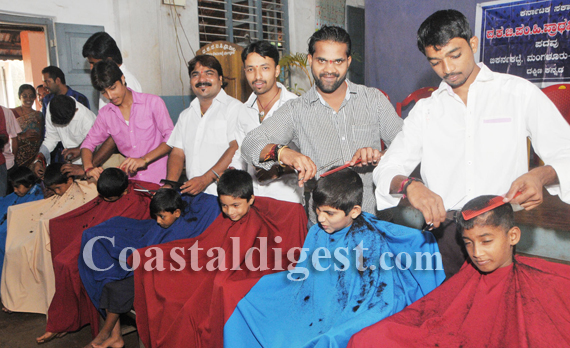
School children get free haircuts as I-Day gift

August 14, 2013
hair_cutting_1

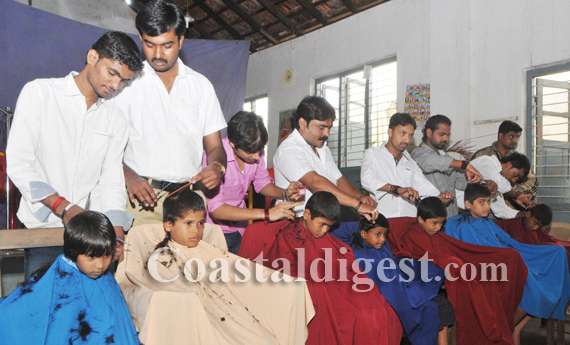
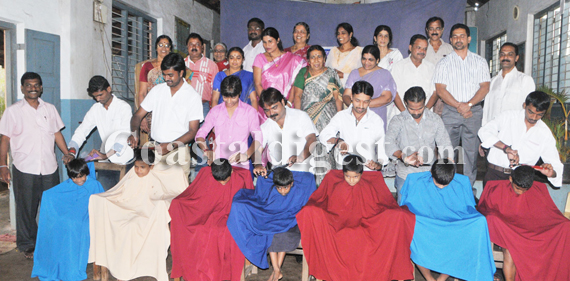
Mangalore, Aug 14: As an Independence Day gift, a total of 38 students of Government Primary School, Bikarnakatte got clean hair cut in few minutes on Tuesday evening.

All the children came from a financially poor background. It was a unique idea of Old Students Association and Kudla Men's Beauty parlour to mark 67th Independence Day at the school in Bikarnakatte.

The seven barbers helped in grooming young children with clean haircuts.

It is learnt that barber Sanjay Majhale who runs Kudla Men's Beauty parlour opposite to the school from the past two years wanted to help poor children by organising a charity event.

With the initiative step of the Old Students Association, he joined other barbers and helped 38 poor students of the school in getting a groomed look.

Former principal of St Aloysius Evening College D Vedavathi, councillor Sabitha Misquith, association secretary Ramesh K and others were present during the occasion.
hair_cutting_2
hair_cutting_3

Comments

Russell
 - 
Friday, 15 Apr 2016

Simply desire to say your article is as surprising.
The clarity in your post is simply great and
i can assume you're an expert on this subject.
Well with your permission allow me to grab your feed to keep updated with
forthcoming post. Thanks a million and please
continue the enjoyable work.

Feel free to surf to my homepage psychics: http://Giadinhnazarethvietnam.com/video/profile.php?u=FCKBell727

Beulah
 - 
Tuesday, 16 Feb 2016

I was curious if you ever considered changing the structure of your
website? Its very well written; I love what youve got to say.

But maybe you could a little more in the way of content so people could connect
with it better. Youve got an awful lot of text for only having 1 or 2
images. Maybe you could space it out better?

my web-site - psychics: http://Www.isuruvimana.net/profile.php?u=YaniraMarti

Amado
 - 
Monday, 15 Feb 2016

I am extremely impressed with your writing skills as well as with the layout on your
weblog. Is this a paid theme or did you customize it yourself?
Either way keep up the excellent quality writing, it
is rare to see a great blog like this one these days.

my blog; psychic ratings: http://www.Partypillsforum.com/index.php?a=member&m=2808217

Faye
 - 
Saturday, 30 Jan 2016

Howdy just wanted to give you a brief heads up and let you know a few of the images
aren't loading correctly. I'm not sure why but I think its a
linking issue. I've tried it in two different internet browsers
and both show the same results.

Review my blog ... Psychic Reviews: http://chicagorehab.net/userinfo.php?uid=2839729

Lanora
 - 
Tuesday, 26 Jan 2016

I seriously love your blog.. Great colors & theme. Did you develop this site yourself?
Please reply back as I'm trying to create my very own website
and would like to learn where you got this from or just
what the theme is named. Many thanks!

Feel free to surf to my site :: Psychics Feedback: http://Shorl.com/drirustavestyna

Add new comment

  • Coastaldigest.com reserves the right to delete or block any comments.
  • Coastaldigset.com is not responsible for its readers’ comments.
  • Comments that are abusive, incendiary or irrelevant are strictly prohibited.
  • Please use a genuine email ID and provide your name to avoid reject.
News Network
January 1,2020

Thiruvananthapuram, Jan 1: Kerala chief minister Pinarayi Vijayan on Wednesday said that the resolution passed by the Kerala Assembly is against the "unconstitutional Act passed by the Centre".

"The resolution passed by Kerala Assembly is against the unconstitutional Act passed by the Centre. It has been noticed by the whole country," Vijayan said.

The Kerala Assembly had on Tuesday passed a resolution seeking withdrawal of the Citizenship (Amendment) Act, 2019.

Before the resolution was passed against the Act, Vijayan in a special Assembly session targeted RSS and said that citizenship law is part of an agenda.

"The CAA is part of an agenda. Muslims are being considered as internal enemies by RSS, who is controlling the ruling dispensation at the Centre," he alleged.

The new law grants citizenship to Hindus, Sikhs, Jains, Parsis, Buddhists and Christians fleeing religious persecution in Pakistan, Afghanistan and Bangladesh who came to India on or before December 31, 2014.

Meanwhile, on Wednesday while talking about women safety, the Chief Minister said, "Those women, who are traveling face many problems, particularly regarding accommodation. To address this, government will start accommodation facilities in all towns. This project will be implemented with the help of local bodies."

Reacting to the development in the Kerala Assembly, BJP leader Mukhtar Abbas Naqvi said that Assembly has insulted the Constitution and parliament by passing a resolution seeking withdrawal of the Citizenship Amendment Act (CAA).

"The Constitution has delineated clearly the roles of parliament and state legislatures. When people who have taken an oath of the constitution, destroy it, it is a most irresponsible act. Both the houses of parliament have passed CAA and if a state assembly tries to hijack the Act it is an insult not only of the constitution but the parliament as well," Naqvi told news agency.

Comments

abdulla
 - 
Thursday, 2 Jan 2020

Dear scape goat Naqvi, dont try to fool us.   I know you are a liar as you are int he company of liars.  MPs are taking oath to respect and safeguard indian constitution and not to disrespect it and go agaisnt the teachings of constitution.  What Central Govt has done is 100 perent agaisnt the constitution and every citizen has the right to oppose this.   You are definately go with the Govt as you are paid for it.   But dont force other too to follow you.  What Kerala Govt has done is according to will of people and Central Govtr should respect it.   

Add new comment

  • Coastaldigest.com reserves the right to delete or block any comments.
  • Coastaldigset.com is not responsible for its readers’ comments.
  • Comments that are abusive, incendiary or irrelevant are strictly prohibited.
  • Please use a genuine email ID and provide your name to avoid reject.
Ram Puniyani
February 10,2020

Noam Chomsky is one of the leading peace workers in the world. In the wake of America’s attack on Vietnam, he brought out his classic formulation, ‘manufacturing consent’. The phrase explains the state manipulating public opinion to have the public approve of it policies—in this case, the attack of the American state on Vietnam, which was then struggling to free itself from French colonial rule.

In India, we are witness to manufactured hate against religious minorities. This hatred serves to enhance polarisation in society, which undermines India’s democracy and Constitution and promotes support for a Hindu nation. Hate is being manufactured through multiple mechanisms. For example, it manifests in violence against religious minorities. Some recent ghastly expressions of this manufactured hate was the massive communal violence witnessed in Mumbai (1992-93), Gujarat (2002), Kandhamal (2008) and Muzaffarnagar (2013). Its other manifestation was in the form of lynching of those accused of having killed a cow or consumed beef. A parallel phenomenon is the brutal flogging, often to death, of Dalits who deal with animal carcasses or leather.

Yet another form of this was seen when Shambhulal Regar, indoctrinated by the propaganda of Hindu nationalists, burned alive Afrazul Khan and shot the video of the heinous act. For his brutality, he was praised by many. Regar was incited into the act by the propaganda around love jihad. Lately, we have the same phenomenon of manufactured hate taking on even more dastardly proportions as youth related to Hindu nationalist organisations have been caught using pistols, while police authorities look on.

Anurag Thakur, a BJP minster in the central government recently incited a crowd in Delhi to complete his chant of what should happen to ‘traitors of the country...” with a “they should be shot”. Just two days later, a youth brought a pistol to the site of a protest at Jamia Millia Islamia university and shouted “take Azaadi!” and fired it. One bullet hit a student of Jamia. This happened on 30 January, the day Nathuram Godse had shot Mahatma Gandhi in 1948. A few days later, another youth fired near the site of protests against the CAA and NRC at Shaheen Bagh. Soon after, he said that in India, “only Hindus will rule”.

What is very obvious is that the shootings by those associated with Hindu nationalist organisations are the culmination of a long campaign of spreading hate against religious minorities in India in general and against Muslims in particular. The present phase is the outcome of a long and sustained hate campaign, the beginning of which lies in nationalism in the name of religion; Muslim nationalism and Hindu nationalism. This sectarian nationalism picked up the communal view of history and the communal historiography which the British introduced in order to pursue their ‘divide and rule’ policy.

In India what became part of “social common sense” was that Muslim kings had destroyed Hindu temples, that Islam was spread by force, and that it is a foreign religion, and so on. Campaigns, such as the one for a temple dedicated to the Hindu god Rama to be built at the site where the Babri masjid once stood, further deepened the idea of a Muslim as a “temple-destroyer”. Aurangzeb, Tipu Sultan and other Muslim kings were tarnished as the ones who spread Islam by force in the subcontinent. The tragic Partition, which was primarily due to British policies, and was well-supported by communal streams also, was entirely attributed to Muslims. The Kashmir conflict, which is the outcome of regional, ethnic and other historical issues, coupled with the American policy of supporting Pakistan’s ambitions of regional hegemony, (which also fostered the birth of Al-Qaeda), was also attributed to the Muslims.

With recurring incidents of communal violence, these falsehoods went on going deeper into the social thinking. Violence itself led to ghettoisation of Muslims and further broke inter-community social bonds. On the one hand, a ghettoised community is cut off from others and on the other hand the victims come to be presented as culprits. The percolation of this hate through word-of-mouth propaganda, media and re-writing of school curricula, had a strong impact on social attitudes towards the minorities.

In the last couple of decades, the process of manufacturing hate has been intensified by the social media platforms which are being cleverly used by the communal forces. Swati Chaturvedi’s book, I Am a Troll: Inside the Secret World of the BJP’s Digital Army, tells us how the BJP used social media to spread hate. Whatapp University became the source of understanding for large sections of society and hate for the ‘Other’, went up by leaps and bounds. To add on to this process, the phenomenon of fake news was shrewdly deployed to intensify divisiveness.

Currently, the Shaheen Bagh movement is a big uniting force for the country; but it is being demonised as a gathering of ‘anti-nationals’. Another BJP leader has said that these protesters will indulge in crimes like rape. This has intensified the prevalent hate.

While there is a general dominance of hate, the likes of Shambhulal Regar and the Jamia shooter do get taken in by the incitement and act out the violence that is constantly hinted at. The deeper issue involved is the prevalence of hate, misconceptions and biases, which have become the part of social thinking.

These misconceptions are undoing the amity between different religious communities which was built during the freedom movement. They are undoing the fraternity which emerged with the process of India as a nation in the making. The processes which brought these communities together broadly drew from Gandhi, Bhagat Singh and Ambedkar. It is these values which need to be rooted again in the society. The communal forces have resorted to false propaganda against the minorities, and that needs to be undone with sincerity.

Combating those foundational misconceptions which create hatred is a massive task which needs to be taken up by the social organisations and political parties which have faith in the Indian Constitution and values of freedom movement. It needs to be done right away as a priority issue in with a focus on cultivating Indian fraternity yet again.

Comments

Add new comment

  • Coastaldigest.com reserves the right to delete or block any comments.
  • Coastaldigset.com is not responsible for its readers’ comments.
  • Comments that are abusive, incendiary or irrelevant are strictly prohibited.
  • Please use a genuine email ID and provide your name to avoid reject.
News Network
April 5,2020

Bengaluru, Apr 5: The COVID-19 related lockdown has substantially improved the air quality of Bengaluru, taking it from satisfactory level to good, a senior state pollution control board offcial said here on Sunday.

"During the course of the lockdown 19 problem, we reached good position from satisfactory.

It is between zero to 50 AQI (Air Quality Index) now. We have good quality air," the Karnataka State Pollution Control Board member secretary Basavaraj Patil told PTI.

He said the indicator for knowing the air quality in

"If the AQI is zero to 50 then it is good. If it is 50 to 100 then it is satisfactory. 101 to 150 is moderate and if it is 151 to 200, then it is poor, he explained.

Patil said as per available recrods, there has been a 60 to 65 per cent reduction in pollution during the lockdown.

The city railway station and Peenya industrial area, which used to be among the areas with highest AQI, has seen pollution levels come down significantly, he said.

Another major contributor of pollution was construction activities, which too had ground to a halt due to the lockdown, resulting in zero dust emission.

Patil opined that the improved air quality would boost the immune system of the people.

"It will improve the immune system of people, including those who have breathing problems like asthma," he said.

He asked the public to learn lessons from the lockdown and later switch to sustainable means of transport such as public transport, walking and cycling,.

"We can still reduce the pollution load even after the lockdown is over," Patil said.

Comments

Add new comment

  • Coastaldigest.com reserves the right to delete or block any comments.
  • Coastaldigset.com is not responsible for its readers’ comments.
  • Comments that are abusive, incendiary or irrelevant are strictly prohibited.
  • Please use a genuine email ID and provide your name to avoid reject.
