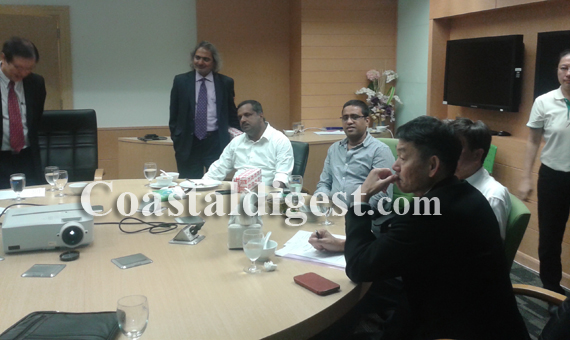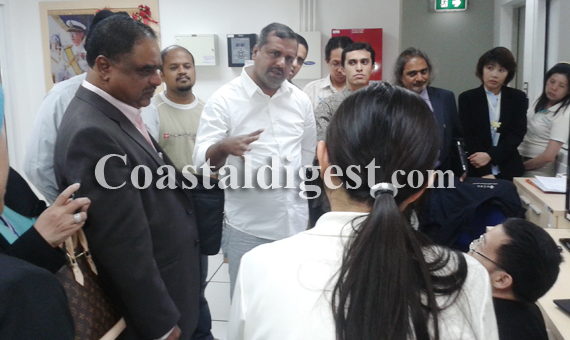
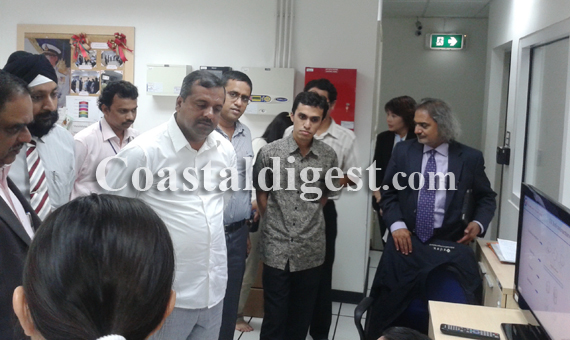
Khader attends workshop conference on health in Thailand

[email protected] (CD Network)
August 21, 2013
COASTAL_1
Bangkok, Aug 21: Karnataka Health Minister U T Khader visited Thailand for a workshop conference led by the Thailand National Health Security office.

The seminar is a part of the World Bank project on achieving Universal Health Coverage (VAP UHC).

The Karnataka Health Minister U T Khader is a special invitee by the World Bank Office Bangkok Thailand.

The main objective of the programs are to share experience of policy formulation, implementation, outcomes and remaining challenges of the UHC focusing on UC scheme and to develop information system to support UHC, to understand basic information systems supporting the main sources which are routine administrative dataset of health care providers, household survey and civil registration.

The seminar was facilitated Dr Winai Sawasdivon Secretary General Thailand National Health Security Thailand. Dr Suphon explained the implications of Thai UC scheme.

Dr. Phisit presented overview of UHC and experiences of Thai UHC. Dr. Samrit highlighted management of UC scheme by National Health Security Office (NHSO) focusing on governance structure, provider payment mechanisms, auditing system.

U T Khader is accompanied by the former president of Karnataka Balaga in Thailand Vincy Daniel Pinto, M Madan Gopal, IAS, principal secretary Karnataka Government and Dr P Boregowda PhD Executive Director of Suvarna Arogya Surakhsha Trust.

The Minister highlighted the recent developments in Karnataka Health Department and also explained the health schemes under process for the BPL and non-BPL category.

COASTAL_2
COSTAL_3
COSTAL_4

Comments

Tyree
 - 
Sunday, 6 Mar 2016

Podchodze Jakie sa przetworniki w podszybiu wzorem sie donich
zyskac plus jako sie zapasc do glosników na zadniej pólce Automobil biezace chrysler
stratus sedan sposród 98r Sposród góry odmawia pro gospodyni megafonów na ubocznej
pólce ,potrzebujesz wywlec aktualna pólke ,a wczesniej
oparcie partyjki ,zapewne oslabic wypada ja do muldy

Here is my blog post - glosniki szerokopasmowe: http://www.xhdzb.com/comment/html/?3251.html

Add new comment

  • Coastaldigest.com reserves the right to delete or block any comments.
  • Coastaldigset.com is not responsible for its readers’ comments.
  • Comments that are abusive, incendiary or irrelevant are strictly prohibited.
  • Please use a genuine email ID and provide your name to avoid reject.
News Network
March 30,2020

Mangaluru, Mar 30: In continuing cases of tipplers in the southern states ending their lives due to non-availability of liquor during the lockdown, two men committed suicide in Karnataka's Dakshina Kannada district.

The two suicides were reported in Kadaba taluk on Saturday, police said.

Tomy Thomas (50), a rubber tapping labourer in an estate at Kutrupadi village of the taluk, was found hanging at his rented house on Saturday. Thomas, a native of Kottayam in Kerala, had joined at the estate here a month ago.

Local people said he was desperately moving around in the last few days asking about places where he can get liquor. He had also not reported to work in these days. The body has been kept at the mortuary of a hospital at Deralakatte.

In another incident, a 70-year old man, belonging to Kodimbala village in the taluk, allegedly hanged himself from the branch of a tree near his house at Nakur.

The deceased has been identified as Thomas, who had left his family here 30 years ago and had been working in Kerala. He had returned here only a few years back.

Sources said Thomas, an alcohol addict, was having health problems related to withdrawal. He has been living on pavements at Kadaba without going home.

Kadaba police has registered cases in connection with the two incidents.

Incidents of tipplers committing suicide have been reported in Kerala and Telangana in the past few days. Two men ended their lives in Kerala today while a 50-year old daily wage worker jumped to death from a building in Hyderabad on Friday.

Comments

Add new comment

  • Coastaldigest.com reserves the right to delete or block any comments.
  • Coastaldigset.com is not responsible for its readers’ comments.
  • Comments that are abusive, incendiary or irrelevant are strictly prohibited.
  • Please use a genuine email ID and provide your name to avoid reject.
News Network
March 28,2020

Bengaluru, Mar 28: Sun Tsu, in 'The Art of War' speaks of a skilful general who can subdue his enemy without any fighting. This constitutes the ultimate triumph which is referred to as stratagem. Today, we would need one such when we are faced with the '21-day corona challenge' for India.
Nearly four weeks back, Dr Jyothsna Rao, Dr Gururaj Rao and I sat across the OPD in the afternoon at HCG Bengaluru discussing our ongoing cancer immunology research. While on this topic, we drifted into the discussion on the coronavirus. During this engaging discussion, we wondered the similarity of the enigma between the virus and cancer. I paused to ask Dr Jyothsna and Dr Guru - how we wish we could do something against this virus.
Dr Jyothsna is a PhD from NCBS and had worked under Dr Ralph Steinman, physician and researcher from Rockefeller University, who won the Nobel Prize for his discovery of the dendritic cell and its role in adaptive immunity in 2011. Dr Gururaj is a molecular and cell biologist who did his PhD at the Chapel Hill, University of North Carolina and is the Director of iCrest.
Jyothsna while hearing our perplexing conversation on the covid intervened, "Yes, surely. I think we should take a break from cancer and focus on the innate and adaptive immunity role in COVID-19."
Thus began this sincere attempt to relook the human immune system from the eyes of the COVID-19.
We have 10 types of immune cells at the least which are widely dispersed in millions across the body. When our body is invaded by a foreign organism (bacteria, fungi or virus), these cells work with each other to destroy the invader.
Now, the question is - how do the immune cells talk to each other? They use small-molecule substances called cytokines (cyto means cells; kine means movement). There are many cytokines that are involved in work on the immune system. The most relevant for viruses are interferons.
Interferons (IFN) as the name reflects have an ability to interfere with the viral activity and stop their multiplication. These specialised signal proteins are released by our cells in response to a viral attack to forewarn other cells. They help build the antiviral proteins within the cells to kill the virus as it tries to invade the new cells.
Historically, interferons are a group of cytokines known to be potent antiviral agents against viruses and a hallmark cytokine induced by the host upon viral infections. Interferons possess unique immunoregulatory activities and are signature cytokines released by (TH1) T immune cells, which are crucial in viral infections.
As the outbreak of COVID-19 grapples us, an urgent need for finding strategies to combat the virus is growing. Coronaviruses (CoVs) are a group of RNA viruses. In patients infected with coronavirus, it was indicated that the activation of the IFN does not occur until 48 hours post-infection. Thus the delayed IFN-related antiviral response by the healthy cells leads to coronavirus evade the immune response.
Numerous studies have presented the success in defeating CoVs by the direct administration of IFNs. In a combination as a concoction, it was shown to synergistically inhibit the virus replication in vitro.
Moreover, it is understood that the earlier induction of IFNs in children although they have a less developed immune system could be the reason behind the children being least affected.
The key to success in reducing the disease fatality might be the stimulation of the immune responses to trigger IFN production at the very early stages of the disease, which might be done through the administration of IFN. Despite the evidence for the efficacy of IFNs in treating CoV-induced infections, the proper dosing and ideal timing for such interventions needs to be verified in clinical trials.
For the later stages of the diseases in advance stages where patients are on ventilator and have developed respiratory distress, we propose to utilise the mesenchymal cells derived from donor bone marrow that have been known to treat acute respiratory syndrome. Mesenchymal cells are known to possess anti-inflammatory activity and thus used often in autoimmune diseases.
With this scientific background, we have activated T cells from healthy donors, in a cGMP facility at iCrest - HCG hospital with an enriched cocktail of cytokines rich in Interferons. Injections of this cocktail we believe will result in a surge of cytokines in the body of the infected person and will boost his ability to fight the virus in the early phases. We are in the initial phases of this study and hope to be ready in the coming weeks with meaningful data on its potential utility.
Currently, it awaits government approvals (Union and state) and we have applied to central drugs authority for their initial evaluation and further directions.
As my Guru often expounded the philosophy of 'Seva' - the goal of education is knowledge, the end goal of knowledge is service. In this attempt to serve our fellow humans at this brink of unprecedented crisis, medical fraternity stands with you and promises to do our best for your safety.
We assure to exhaust every bit of our spirit in this fight against coronavirus. We have lost the sight of shores and travelled thus far, but that is the mandatory first step to cross the ocean. Are we going to succeed in this battle, is something only time will answer. 

Comments

Add new comment

  • Coastaldigest.com reserves the right to delete or block any comments.
  • Coastaldigset.com is not responsible for its readers’ comments.
  • Comments that are abusive, incendiary or irrelevant are strictly prohibited.
  • Please use a genuine email ID and provide your name to avoid reject.
News Network
May 2,2020

Hubli, May 2: Around 1400 migrant workers from neighbouring districts, working at brick manufacturing factories in Hubli were sent to their respective districts on buses, amid coronavirus lockdown on Friday.

Dr Purushottam, Nodal Officer, COVID-19 task force said, "Total 1473 labourers from eight neighbouring districts, working in the brick manufacturing units of our district were sent by 74 buses. 876 labourers are from Kalburgi where we are sending 44 buses, 350 labourers are from Vijaypura where we are sending 27 buses."

He continued saying that 20 persons will be accommodated in a bus while maintaining social distancing.

"Before the labourers boarded, the buses were disinfected. NWKRTC officials took a special interest in doing so. The District Collector has written letters to the concerned DCs regarding shifting of labourers in every bus, one Nodal Officer will handover them to the local officials," Dr Purushottam added.

On Friday, the buses were sent to seven districts and one bus will be sent today.

Comments

Add new comment

  • Coastaldigest.com reserves the right to delete or block any comments.
  • Coastaldigset.com is not responsible for its readers’ comments.
  • Comments that are abusive, incendiary or irrelevant are strictly prohibited.
  • Please use a genuine email ID and provide your name to avoid reject.