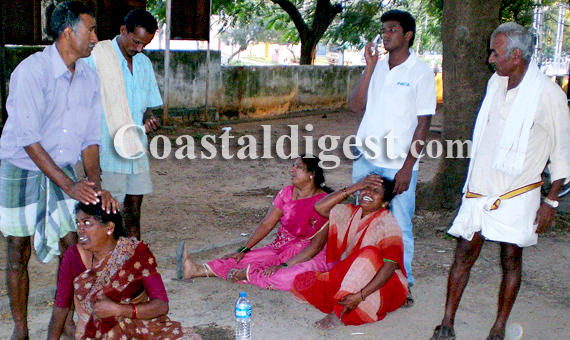
Car falls from bridge, five of family killed

September 23, 2013

Car_falls_from_bridge

Tumkur, Sep 23: : Five members of a family, including two children, were killed on Sunday when their car careened off National Highway 48, near Gavimatha, Kunigal in Tumkur district, and fell off a bridge.

The dead are Manjunath, 36, his wife Anitha, 28, Pushpalatha, 24, Preetham, 4, and an eight-month-old infant. All are from Bagalagunte in Bangalore.

The family, travelling in a Maruti Swift car, were returning after attending a relative's marriage in Chennarayapatna on Saturday. The car was speeding when its tyre burst and the driver lost control over the vehicle when it was moving on the bridge. The car hit the parapet wall of the bridge and fell into the 12-foot-deep ditch.

Pushpalatha, Preetham and the infant died on the spot. Manjunath and Anitha succumbed to injuries later in a nearby hospital.

Car_falls_from_bridge1

Comments

Ramiro
 - 
Wednesday, 8 Jun 2016

Superb blog you have here but I was curious about if you knew of any user discussion forums that cover the same topics talked about in this article?
I'd really like to be a part of online community where I can get opinions from other knowledgeable people that share the same
interest. If you have any recommendations, please let me know.
Bless you!

Take a look at my homepage - art show and sale: http://allureluxurycondominiums.com/

Add new comment

  • Coastaldigest.com reserves the right to delete or block any comments.
  • Coastaldigset.com is not responsible for its readers’ comments.
  • Comments that are abusive, incendiary or irrelevant are strictly prohibited.
  • Please use a genuine email ID and provide your name to avoid reject.
Agencies
February 20,2020

India ranked 77th on a sustainability index that takes into account per capita carbon emissions and ability of children in a nation to live healthy lives and secures 131st spot on a flourishing ranking that measures the best chance at survival and well-being for children, according to a UN-backed report.

The report was released on Wednesday by a commission of over 40 child and adolescent health experts from around the world. It was commissioned by the World Health Organization (WHO), UN Children's Fund (UNICEF) and The Lancet medical journal.

In the report assessing the capacity of 180 countries to ensure that their youngsters can survive and thrive, India ranks 77th on the Sustainability Index and 131 on the Flourishing Index, it said.

Flourishing is the geometric mean of Surviving and Thriving. For Surviving, the authors selected maternal survival, survival in children younger than 5 years old, suicide, access to maternal and child health services, basic hygiene and sanitation, and lack of extreme poverty.

For Thriving, the domains were educational achievement, growth and nutrition, reproductive freedom, and protection from violence.

Under the Sustainability Index, the authors noted that promoting today's national conditions for children to survive and thrive must not come at the cost of eroding future global conditions for children's ability to flourish.

The Sustainability Index ranks countries on excess carbon emissions compared with the 2030 target. This provides a convenient and available proxy for a country's contribution to sustainability in future.

The report noted that under realistic assumptions about possible trajectories towards sustainable greenhouse gas emissions, models predict that global carbon emissions need to be reduced from 39·7 giga­ tonnes to 22·8 gigatonnes per year by 2030 to maintain even a 66 per cent chance of keeping global warming below 1·5°C.

It said that the world's survival depended on children being able to flourish, but no country is doing enough to give them a sustainable future.

"No country in the world is currently providing the conditions we need to support every child to grow up and have a healthy future," said Anthony Costello, Professor of Global Health and Sustainability at University College London, one of the lead authors of the report.

"Especially, they're under immediate threat from climate change and from commercial marketing, which has grown hugely in the last decade," said Costello – former WHO Director of Mother, Child and Adolescent health.

Norway leads the table for survival, health, education and nutrition rates - followed by South Korea and the Netherlands. Central African Republic, Chad and Somalia come at the bottom.

However, when taking into account per capita CO2 emissions, these top countries trail behind, with Norway 156th, the Republic of Korea 166th and the Netherlands 160th.

Each of the three emits 210 per cent more CO2 per capita than their 2030 target, the data shows, while the US, Australia, and Saudi Arabia are among the 10 worst emitters. The lowest emitters are Burundi, Chad and Somalia.

According to the report, the only countries on track to beat CO2 emission per capita targets by 2030, while also performing fairly – within the top 70 – on child flourishing measures are: Albania, Armenia, Grenada, Jordan, Moldova, Sri Lanka, Tunisia, Uruguay and Vietnam.

"More than 2 billion people live in countries where development is hampered by humanitarian crises, conflicts, and natural disasters, problems increasingly linked with climate change," said Minister Awa Coll-Seck from Senegal, Co-Chair of the commission.

The report also highlights the distinct threat posed to children from harmful marketing.

Evidence suggests that children in some countries see as many as 30,000 advertisements on television alone in a single year, while youth exposure to vaping (e-cigarettes) advertisements increased by more than 250 per cent in the US over two years, reaching more than 24 million young people.

Studies in Australia, Canada, Mexico, New Zealand and the US – among many others – have shown that self-regulation has not hampered commercial ability to advertise to children.

Children's exposure to commercial marketing of junk food and sugary beverages is associated with purchase of unhealthy foods and overweight and obesity, linking predatory marketing to the alarming rise in childhood obesity, it said.

The number of obese children and adolescents increased from 11 million in 1975 to 124 million in 2016 – an 11-fold increase, with dire individual and societal costs, the report said.

To protect children, the authors call for a new global movement driven by and for children.

Specific recommendations include stopping CO2 emissions with the utmost urgency, to ensure children have a future on this planet; placing children and adolescents at the centre of global efforts to achieve sustainable development, the report said.

New policies and investment in all sectors to work towards child health and rights; incorporating children's voices into policy decisions and tightening national regulation of harmful commercial marketing, supported by a new Optional Protocol to the UN Convention on the Rights of the Child, it said.


Comments

Add new comment

  • Coastaldigest.com reserves the right to delete or block any comments.
  • Coastaldigset.com is not responsible for its readers’ comments.
  • Comments that are abusive, incendiary or irrelevant are strictly prohibited.
  • Please use a genuine email ID and provide your name to avoid reject.
News Network
January 14,2020

Bengaluru, Jan 14: Assuring depositors that their money was "100 per cent safe" with the bank, Sri Guru Raghavendra Sahakara Bank Chairman K Ramakrishna in Bengaluru on Monday said 62 loans had locked up Rs 300 crore of deposit.

"Your money is 100 per cent safe with Sri Guru Raghavendra Sahakara Bank. It's my responsibility," Ramakrishna said at Sri Guru Narasimha Kalyanamandira auditorium, to assure depositors.

He was addressing angry customers of the bank at a public hearing. Due to the 62 dud loans, the Reserve Bank of India (RBI) had restricted the lender from executing business, Ramakrishna said amid shouting by depositors. The RBI has limited withdrawals by depositors to Rs 35,000.

"The bank is saying I can't withdraw more than Rs 35,000. In case of our fixed deposit maturing, we will have to renew it as we can't encash it, " said Nagaraj M, 49, who has been dealing with the bank for the past six years.

To assuage customers, the call to an assistant commissioner of police by Bengaluru South MP Tejaswi Surya -- not present -- was relayed on loudspeaker live and the MP claimed that he had spoken to Finance Minister Nirmala Sitharaman to help the customers.

Ramakrishna said he would meet customers again on January 19 with all the details and numbers. Dramatic scenes and pandemonium ruled the auditorium before his arrival. Thousands of bank customers threatened to go en masse to the police station and file a case against Ramakrishna.

As he addressed the gathering in Kannada, hundreds of depositors shouted back at him seeking clarifications. At the auditorium, thousands of depositors earlier demanded the bank chairman's presence to clarify the matter.

The lender had invited depositors to the auditorium at 6 p.m. to update them on the bank's status, following a RBI directive restricting the bank from doing business with immediate effect.

"We want the bank's directors here," shouted a depositor from the stage. A handful of policemen were trying to control the crowd and bring order to the assembly. Many elderly and retired persons had arrived to know the fate of their savings. Several women were also present at the meeting.

"It was a good bank with only 0.5 per cent NPAs. Now we can't trust any bank. See what happened with the PMC Bank," said another customer.

Shankar Sharma, 38, an employee of a private company, said majority of depositors were senior citizens and retirees. "I don't have an account with the bank, but my mother, uncle, aunt have deposited money in it. I came for them, " said Sharma. He said many of the bank's 35,000 clientele deposited more than Rs 5 lakh, which had total deposits of Rs 1,600 crore. The bank started operations in 1999.

Ramakrishna was escorted away to safety by the police after his speech even as the depositors were screaming and agitating for justice.

Comments

Add new comment

  • Coastaldigest.com reserves the right to delete or block any comments.
  • Coastaldigset.com is not responsible for its readers’ comments.
  • Comments that are abusive, incendiary or irrelevant are strictly prohibited.
  • Please use a genuine email ID and provide your name to avoid reject.
News Network
June 4,2020

Bengaluru, Jun 4: The Karnataka government has tweaked quarantine requirements for people arriving from Maharashtra, raising the isolation time from a fortnight to three weeks, an official said on Wednesday.

"Returnees from Maharashtra will be sent to institutional quarantine for seven days, followed by 14 days strict home quarantine, total 21 days," tweeted Health Commissioner Pankaj Kumar Pandey.

The 21-day quarantine regimen is for all asymptomatic people returning from Maharashtra, considering most of the Covid cases in Karnataka are having domestic travel history to that state.

If any of the asymptomatic people develop symptoms during the isolation, they will be subjected to a Covid test.

However, some asymptomatic individuals from Maharashtra have been provided some exceptions from the three-week quarantine and designated as special category passengers.

Special category passengers include people who suffered a death in family, pregnant women, children below 10, elderly people above 60, individuals suffering from serious illness and human distress.

Similarly, the department has also made some provisions for business travellers from Maharashtra.

"To establish that one is a business visitor, (that) person should show confirmed return flight or train ticket which should not be more than seven days later from the date of arrival," ordered Chief Secretary T.M. Vijay Bhaskar.

Similarly, if a business visitor is arriving on road, he should provide the address proof of the person in Karnataka he intends to meet.

Additionally, such a person should also produce a Covid negative test certificate which is not more than two days old.

"One does not have a Covid negative test certificate such a person should go for institutional quarantine for two days within which Covid test should be conducted at his own cost. After the test result is negative, that person is exempted from quarantine," he said.

However, business travellers have been exempted from hand stamping.

Amending the Sunday orders, Bhaskar, has enhanced the quarantine requirements for Maharashtra returnees.

Many conditions for visitors from other states remain mostly unchanged as notified on Sunday.

Comments

Add new comment

  • Coastaldigest.com reserves the right to delete or block any comments.
  • Coastaldigset.com is not responsible for its readers’ comments.
  • Comments that are abusive, incendiary or irrelevant are strictly prohibited.
  • Please use a genuine email ID and provide your name to avoid reject.