


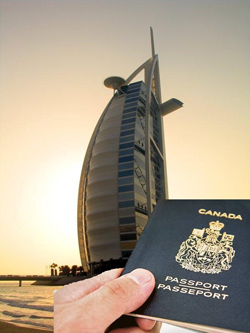
Expats advised to carry re-entry visa printouts

[email protected] (Arab News)
October 27, 2013

Expats_advisedRiyadh, Oct 27: Foreign airlines based in Riyadh have advised travel agents in the Kingdom to tell their customers to carry a re-entry visa printout with their passports when they travel abroad.

The announcement was made following complaints by expatriate workers returning to the Kingdom after the Eid holidays who were denied boarding by airline officials for not having re-entry visa information on their passports.

Officials of foreign airlines said Saturday that they have already advised their agents to inform travelers about the new requirements expected from passengers at the embarkation points.

In September, the Passport Department began issuing multiple entry visas to the Kingdom with an official stamp on the passport. However, many airline officials have demanded visa printouts or other forms of authentication to certify that passengers are in possession of valid visas to enter the Kingdom.

A printout can be obtained only when a single entry visa is issued electronically, but multiple entry visas are issued at the Passport Department. The visa is recorded in the system and an official stamp is placed with only the visa number.

Ruwan Wijekone, Sri Lankan Airlines manager for the central province, said the airline has advised agents in the Kingdom that passengers should carry the visa printout with them. He pointed out that if an airline allows a passenger to board without a valid visa, it has to incur unwanted expenditures such as return fare for the passenger, fine and allied expenses for his stay in the Kingdom till he is deported home.

“We are only taking a precautionary measure, which is carried out in the interests of the passenger as well as the airline,” he said, adding that checking the veracity of the visa online is impossible when the airline has to check in over 300 passengers of a Saudi Arabia-bound flight.

Speaking to Arab News, Sri Lankan Ambassador Vadivel Kirshnamoorthy said that he would advise the Sri Lankan Bureau of Foreign Employment (SLBFE) to make arrangements to help people who come to the airport without the entry visa printout. He said the SLBFE, which has a special help desk at the airport for incoming and outgoing workers, could handle this matter smoothly.

Currently, officials at the Sri Lanka Bureau of Foreign Employment (SLBFE) do not have a system to track the Saudi entry visas of workers who leave the country. All Lankan foreign workers are expected to register with the SLBFE on a nominal registration fee for which a wide range of services are offered to its foreign workers.

Speaking from Colombo, an official of the Saudi Arabian Airlines said that it has deployed a special officer at the Colombo International Airport to assist such cases. The officer concerned goes online to check the visa status and acts accordingly.

“We also have an Arabic translator at our ticketing office to check the visa status of passengers,” he added.

Mohammed, a passenger who came from Dubai said the Saudi Arabian Airlines officials at Dubai airport were kind enough to check his visa status through the MOI online service and allowed him to board the flight although he did not have a visa slip.

To find out the visa status in the official website of the Ministry of Interior, one must either have the visa number or the sponsor's number.

Comments

mohammad minhat khan
 - 
Wednesday, 7 Sep 2016

need re Entry Visa
in the saudia Arabia

Add new comment

  • Coastaldigest.com reserves the right to delete or block any comments.
  • Coastaldigset.com is not responsible for its readers’ comments.
  • Comments that are abusive, incendiary or irrelevant are strictly prohibited.
  • Please use a genuine email ID and provide your name to avoid reject.
News Network
April 21,2020

Global oil markets remained under intense pressure on Tuesday, with Brent crude dropping below $20 per barrel for the first time in 18 years while other major benchmarks across the world tumbled. 

Brent, the international crude marker, slipped to $18.10, indicating that markets see no immediate let-up to the collapse in oil demand that sent some US oil benchmarks plunging under $0 for the first time on Monday, leaving producers paying for buyers to take their oil away while available storage is scarce.

Coronavirus has sent the oil sector into a state of crisis, with lockdowns implemented by authorities to smother the outbreak slashing demand for crude by as much as a third.

Contracts for the US benchmark West Texas Intermediate for delivery next month tumbled as low as minus $40 a barrel on Monday. Analysts at Citi warned that “if global storage worsens more quickly, Brent could chase WTI down to the bottom”.

The collapse in the May WTI contract was partly a technical product of the fact that it expires on Tuesday, meaning trading volumes were low and making the contract for June delivery more noteworthy, analysts said. That contract held above $20 a barrel on Monday but slid as much as 42 per cent on Tuesday to trade at lows of $11.79, suggesting the blowout in the May contract was more than a blip and that the entire global oil market faced challenges.

Goldman Sachs analysts said the June contact was likely to face downward pressure in the coming weeks, pointing to the “still unresolved market surplus”.

“As storage becomes saturated, price volatility will remain exceptionally high in coming weeks,” they said. “But with ultimately a finite amount of storage left to fill, production will soon need to fall sizeably to bring the market into balance, finally setting the stage for higher prices once demand gradually recovers.”

Warren Patterson, head of commodities strategy at ING, said it was likely that “storage this time next month will be even more of an issue, given the surplus environment”.

“And so in the absence of a meaningful demand recovery, negative prices could return for June,” he added.

European equities traded lower, partly dragged down by weaker energy stocks. The continent-wide Stoxx 600 was down 1.9 per cent, with its oil and gas sub-index dropping 3.3 per cent. In London the FTSE shed 1.7 per cent, while Frankfurt’s Dax slid 2.3 per cent. 

Equities were also broadly lower in Asia, with futures tipping US stocks to fall 1 per cent when trading in New York begins later.

On Wall Street overnight, the S&P 500 closed down 1.8 per cent, partly because of weakness in energy shares, but also due to increased pessimism over the time it will take for countries to emerge from lockdowns.

In fixed income, the yield on the 10-year US Treasury fell 0.03 percentage points to 0.585 per cent as investors retreated to the safety of the debt.

Comments

Add new comment

  • Coastaldigest.com reserves the right to delete or block any comments.
  • Coastaldigset.com is not responsible for its readers’ comments.
  • Comments that are abusive, incendiary or irrelevant are strictly prohibited.
  • Please use a genuine email ID and provide your name to avoid reject.
Ram Puniyani
January 14,2020

In the beginning of January 2020 two very disturbing events were reported from Pakistan. One was the attack on Nankana Sahib, the holy shrine where Sant Guru Nanak was born. While one report said that the place has been desecrated, the other stated that it was a fight between two Muslim groups. Prime Minister of Pakistan Imran Khan condemned the incident and the main accused Imran Chisti was arrested. The matter related to abduction and conversion of a Sikh girl Jagjit Kaur, daughter of Pathi (One who reads Holy Guru Granth Sahib in Gurudwara) of the Gurudwara. In another incident one Sikh youth Ravinder Singh, who was out on shopping for his marriage, was shot dead in Peshawar.

While these condemnable attacks took place on the Sikh minority in Pakistan, BJP was quick enough to jump to state that it is events like this which justify the Citizenship Amendment Act (CAA). Incidentally CAA is the Act which is discriminatory and relates to citizenship with Religion, which is not as per the norms of Indian constitution. There are constant debates and propaganda that population of Hindus has come down drastically in Pakistan and Bangla Desh. Amit Shah, the Home minister stated that in Pakistan the population of Hindus has come down from 23% at the time of partition to 3.7% at present. And in Bangla Desh it has come down from 22% to present 8%.

While not denying the fact that the religious minorities are getting a rough deal in both these countries, the figures which are presented are totally off the mark. These figures don’t take into consideration the painful migrations, which took place at the time of partition and formation of Bangla Desh later. Pakistan census figures tell a different tale. Their first census was held in 1951. As per this census the overall percentage of Non Muslim in Pakistan (East and West together) was 14.2%, of this in West Pakistan (Now Pakistan) it was 3.44 and in Eat Pakistan it was 23.2. In the census held in Pakistan 1998 it became 3.72%. As far as Bangla Desh is concerned the share of Non Muslims has gone down from 23.2 (1951) to 9.6% in 2011.

The largest minority of Pakistan is Ahmadis, (https://minorityrights.org/country/pakistan/) who are close to 4 Million and are not recognised as Muslims in Pakistan. In Bangla Desh the major migrations of Hindus from Bangla Desh took place in the backdrop of Pakistan army’s atrocities in the then East Pakistan.

As far as UN data on refugees in India it went up by 17% between 2016-2019 and largest numbers were from Tibet and Sri Lanka.  (https://www.un.org/en/development/desa/population/migration/publication…)

The state of minorities is in a way the index of strength of democracy. Most South Asian Countries have not been able to sustain democratic values properly. In Pakistan, the Republic began with Jinnah’s classic speech where secularism was to be central credo of Pakistan. This 11th August speech was in a way what the state policy should be, as per which people of all faiths are free to practice their religion. Soon enough the logic of ‘Two Nation theory” and formation of Pakistan, a separate state for Muslim took over. Army stepped in and dictatorship was to reign there intermittently. Democratic elements were suppressed and the worst came when Zia Ul Haq Islamized the state in collusion with Maulanas. The army was already a strong presence in Pakistan. The popular formulation for Pakistan was that it is ruled by three A’s, Army, America and Allah (Mullah).

Bangla Desh had a different trajectory. Its very formation was a nail in the coffin of ‘two nation theory’; that religion can be the basis of a state. Bangla Desh did begin as a secular republic but communal forces and secular forces kept struggling for their dominance and in 1988 it also became Islamic republic. At another level Myanmar, in the grip of military dictatorship, with democratic elements trying to retain their presence is also seeing a hard battle. Democracy or not, the army and Sanghas (Buddhist Sang has) are strong, in Myanmar as well. The most visible result is persecution of Rohingya Muslims.

Similar phenomenon is dominating in Sri Lanka also where Budhhist Sanghas and army have strong say in the political affairs, irrespective of which Government is ruling. Muslim and Christian minorities are a big victim there, while Tamils (Hindus, Christians etc.) suffered the biggest damage as ethnic and religious minorities. India had the best prospect of democracy, pluralism and secularism flourishing here. The secular constitution, the outcome of India’s freedom struggle, the leadership of Gandhi and Nehru did ensure the rooting of democracy and secularism in a strong way.

India so far had best democratic credentials amongst all the south Asian countries. Despite that though the population of minorities rose mainly due to poverty and illiteracy, their overall marginalisation was order of the day, it went on worsening with the rise of communal forces, with communal forces resorting to identity issues, and indulging in propaganda against minorities.

While other South Asian countries should had followed India to focus more on infrastructure and political culture of liberalism, today India is following the footsteps of Pakistan. The retrograde march of India is most visible in the issues which have dominated the political space during last few years. Issues like Ram Temple, Ghar Wapasi, Love Jihad, Beef-Cow are now finding their peak in CAA.

India’s reversal towards a polity with religion’s identity dominating the political scene was nicely presented by the late Pakistani poetess Fahmida Riaz in her poem, Tum bhi Hum Jaise Nikle (You also turned out to be like us). While trying to resist communal forces has been an arduous task, it is becoming more difficult by the day. This phenomenon has been variously called, Fundamentalism, Communalism or religious nationalism among others. Surely it has nothing to do with the religion as practiced by the great Saint and Sufi traditions of India; it resorts mainly to political mobilization by using religion as a tool.

Comments

Ashi
 - 
Tuesday, 14 Jan 2020

If Malaysia implement similar NRC/CAA, India and China are the loser.

Add new comment

  • Coastaldigest.com reserves the right to delete or block any comments.
  • Coastaldigset.com is not responsible for its readers’ comments.
  • Comments that are abusive, incendiary or irrelevant are strictly prohibited.
  • Please use a genuine email ID and provide your name to avoid reject.
coastaldigest.com news network
January 16,2020

Madikeri, Jan 16: Income Tax Department officials on Thursday raided the residence of Kannada actress Rashmika Mandanna at Virajpet in Kodagu District on Thursday.

About 10 IT officials arrived at the residence on Thursday at about 1930 hrs and started searching. The officials have been busy conducting the raid for more than three hours now.

I-T sources said that the search and seizure operations were conducted on suspicion that Rashmika Mandanna had evaded taxes.

Mandanna, 23, is a leading heroine and has acted in several Kannada and Telugu films over the last four years. Her most recent film Sarileru Neekevvaru opposite Mahesh Babu is in the theatres now.

She made her debut in Sandalwood with the film Kirik Party, which was a huge success at the box office. She went on to act in several Kannada and Telugu films in the last two years and has become a huge success in the industry. She has acted in Dear Comrade, Sarileru Neekevvaru, Chalo, Geeta Govindam, Chamak, Yajamana, Anjani Putra and Vritra.

She is currently working in the film Pogaru alongside Dhruva Sarja. She has acted in nine movies in the last two years and has also signed several advertising contracts.

Comments

Add new comment

  • Coastaldigest.com reserves the right to delete or block any comments.
  • Coastaldigset.com is not responsible for its readers’ comments.
  • Comments that are abusive, incendiary or irrelevant are strictly prohibited.
  • Please use a genuine email ID and provide your name to avoid reject.