


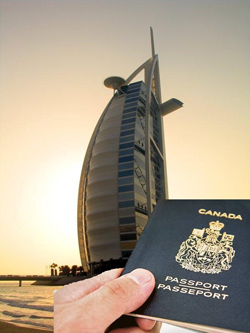
Expats advised to carry re-entry visa printouts

[email protected] (Arab News)
October 27, 2013

Expats_advisedRiyadh, Oct 27: Foreign airlines based in Riyadh have advised travel agents in the Kingdom to tell their customers to carry a re-entry visa printout with their passports when they travel abroad.

The announcement was made following complaints by expatriate workers returning to the Kingdom after the Eid holidays who were denied boarding by airline officials for not having re-entry visa information on their passports.

Officials of foreign airlines said Saturday that they have already advised their agents to inform travelers about the new requirements expected from passengers at the embarkation points.

In September, the Passport Department began issuing multiple entry visas to the Kingdom with an official stamp on the passport. However, many airline officials have demanded visa printouts or other forms of authentication to certify that passengers are in possession of valid visas to enter the Kingdom.

A printout can be obtained only when a single entry visa is issued electronically, but multiple entry visas are issued at the Passport Department. The visa is recorded in the system and an official stamp is placed with only the visa number.

Ruwan Wijekone, Sri Lankan Airlines manager for the central province, said the airline has advised agents in the Kingdom that passengers should carry the visa printout with them. He pointed out that if an airline allows a passenger to board without a valid visa, it has to incur unwanted expenditures such as return fare for the passenger, fine and allied expenses for his stay in the Kingdom till he is deported home.

“We are only taking a precautionary measure, which is carried out in the interests of the passenger as well as the airline,” he said, adding that checking the veracity of the visa online is impossible when the airline has to check in over 300 passengers of a Saudi Arabia-bound flight.

Speaking to Arab News, Sri Lankan Ambassador Vadivel Kirshnamoorthy said that he would advise the Sri Lankan Bureau of Foreign Employment (SLBFE) to make arrangements to help people who come to the airport without the entry visa printout. He said the SLBFE, which has a special help desk at the airport for incoming and outgoing workers, could handle this matter smoothly.

Currently, officials at the Sri Lanka Bureau of Foreign Employment (SLBFE) do not have a system to track the Saudi entry visas of workers who leave the country. All Lankan foreign workers are expected to register with the SLBFE on a nominal registration fee for which a wide range of services are offered to its foreign workers.

Speaking from Colombo, an official of the Saudi Arabian Airlines said that it has deployed a special officer at the Colombo International Airport to assist such cases. The officer concerned goes online to check the visa status and acts accordingly.

“We also have an Arabic translator at our ticketing office to check the visa status of passengers,” he added.

Mohammed, a passenger who came from Dubai said the Saudi Arabian Airlines officials at Dubai airport were kind enough to check his visa status through the MOI online service and allowed him to board the flight although he did not have a visa slip.

To find out the visa status in the official website of the Ministry of Interior, one must either have the visa number or the sponsor's number.

Comments

mohammad minhat khan
 - 
Wednesday, 7 Sep 2016

need re Entry Visa
in the saudia Arabia

Add new comment

  • Coastaldigest.com reserves the right to delete or block any comments.
  • Coastaldigset.com is not responsible for its readers’ comments.
  • Comments that are abusive, incendiary or irrelevant are strictly prohibited.
  • Please use a genuine email ID and provide your name to avoid reject.
News Network
July 12,2020

Bengaluru,  Jul 12: In view of the rising COVID-19 cases in Bengaluru, a complete lockdown will be implemented in Bengaluru City and Bengaluru Rural areas from 8 pm on July 14 to 5 am on July 22.

"Essentials such as hospitals, groceries, milk, fruit, vegetables, medicines will be available during this period. In addition, medical and postgraduate examinations will happen as already scheduled," the Karnataka CMO informed.

Chief Minister BS Yediyurappa appealed: "Co-operate with all social security policies, wear masks, and abide by government-issued lock-down guidelines for buying everyday items. Your collaboration is essential to controlling the spread of COVID-19 infection."

"I would like to congratulate all Asha activists, medical and police personnel, officers, volunteers, journalists and all those who work directly and indirectly to control the spread of COVID-19 infection," he added.

Comments

Add new comment

  • Coastaldigest.com reserves the right to delete or block any comments.
  • Coastaldigset.com is not responsible for its readers’ comments.
  • Comments that are abusive, incendiary or irrelevant are strictly prohibited.
  • Please use a genuine email ID and provide your name to avoid reject.
News Network
May 7,2020

Mangaluru, May 7: The Dakshina Kannada District Muslim Okkoota has strongly condemned permit for opening of textile and footwear shops across the district at a time when the number of Covid-19 positive cases are on the rise.

In a press note here on Thursday, former Mayor and Okoota President Ashraf alleged that the permission to open the shops at a time when Eid-ul-Fitr was nearing would lead to rush in the shops in turn bringing in fear of spread of Covid-19. 

He expressed his resentment over the fact that the administration has neglected the appeal made by the Okkoota as well as the Qazi of Udupi against permitting textile shops during the lockdown period.

He warned that the administration, district in-charge Minister, MLA and MP themselves will be responsible in case of increased infection cases due to this decision.

The district in-charge minister Kota Srinivas Poojary yesterday had announced that textile shops in the district can be opened from May 7.

Comments

Add new comment

  • Coastaldigest.com reserves the right to delete or block any comments.
  • Coastaldigset.com is not responsible for its readers’ comments.
  • Comments that are abusive, incendiary or irrelevant are strictly prohibited.
  • Please use a genuine email ID and provide your name to avoid reject.
Ram Puniyani
February 10,2020

Noam Chomsky is one of the leading peace workers in the world. In the wake of America’s attack on Vietnam, he brought out his classic formulation, ‘manufacturing consent’. The phrase explains the state manipulating public opinion to have the public approve of it policies—in this case, the attack of the American state on Vietnam, which was then struggling to free itself from French colonial rule.

In India, we are witness to manufactured hate against religious minorities. This hatred serves to enhance polarisation in society, which undermines India’s democracy and Constitution and promotes support for a Hindu nation. Hate is being manufactured through multiple mechanisms. For example, it manifests in violence against religious minorities. Some recent ghastly expressions of this manufactured hate was the massive communal violence witnessed in Mumbai (1992-93), Gujarat (2002), Kandhamal (2008) and Muzaffarnagar (2013). Its other manifestation was in the form of lynching of those accused of having killed a cow or consumed beef. A parallel phenomenon is the brutal flogging, often to death, of Dalits who deal with animal carcasses or leather.

Yet another form of this was seen when Shambhulal Regar, indoctrinated by the propaganda of Hindu nationalists, burned alive Afrazul Khan and shot the video of the heinous act. For his brutality, he was praised by many. Regar was incited into the act by the propaganda around love jihad. Lately, we have the same phenomenon of manufactured hate taking on even more dastardly proportions as youth related to Hindu nationalist organisations have been caught using pistols, while police authorities look on.

Anurag Thakur, a BJP minster in the central government recently incited a crowd in Delhi to complete his chant of what should happen to ‘traitors of the country...” with a “they should be shot”. Just two days later, a youth brought a pistol to the site of a protest at Jamia Millia Islamia university and shouted “take Azaadi!” and fired it. One bullet hit a student of Jamia. This happened on 30 January, the day Nathuram Godse had shot Mahatma Gandhi in 1948. A few days later, another youth fired near the site of protests against the CAA and NRC at Shaheen Bagh. Soon after, he said that in India, “only Hindus will rule”.

What is very obvious is that the shootings by those associated with Hindu nationalist organisations are the culmination of a long campaign of spreading hate against religious minorities in India in general and against Muslims in particular. The present phase is the outcome of a long and sustained hate campaign, the beginning of which lies in nationalism in the name of religion; Muslim nationalism and Hindu nationalism. This sectarian nationalism picked up the communal view of history and the communal historiography which the British introduced in order to pursue their ‘divide and rule’ policy.

In India what became part of “social common sense” was that Muslim kings had destroyed Hindu temples, that Islam was spread by force, and that it is a foreign religion, and so on. Campaigns, such as the one for a temple dedicated to the Hindu god Rama to be built at the site where the Babri masjid once stood, further deepened the idea of a Muslim as a “temple-destroyer”. Aurangzeb, Tipu Sultan and other Muslim kings were tarnished as the ones who spread Islam by force in the subcontinent. The tragic Partition, which was primarily due to British policies, and was well-supported by communal streams also, was entirely attributed to Muslims. The Kashmir conflict, which is the outcome of regional, ethnic and other historical issues, coupled with the American policy of supporting Pakistan’s ambitions of regional hegemony, (which also fostered the birth of Al-Qaeda), was also attributed to the Muslims.

With recurring incidents of communal violence, these falsehoods went on going deeper into the social thinking. Violence itself led to ghettoisation of Muslims and further broke inter-community social bonds. On the one hand, a ghettoised community is cut off from others and on the other hand the victims come to be presented as culprits. The percolation of this hate through word-of-mouth propaganda, media and re-writing of school curricula, had a strong impact on social attitudes towards the minorities.

In the last couple of decades, the process of manufacturing hate has been intensified by the social media platforms which are being cleverly used by the communal forces. Swati Chaturvedi’s book, I Am a Troll: Inside the Secret World of the BJP’s Digital Army, tells us how the BJP used social media to spread hate. Whatapp University became the source of understanding for large sections of society and hate for the ‘Other’, went up by leaps and bounds. To add on to this process, the phenomenon of fake news was shrewdly deployed to intensify divisiveness.

Currently, the Shaheen Bagh movement is a big uniting force for the country; but it is being demonised as a gathering of ‘anti-nationals’. Another BJP leader has said that these protesters will indulge in crimes like rape. This has intensified the prevalent hate.

While there is a general dominance of hate, the likes of Shambhulal Regar and the Jamia shooter do get taken in by the incitement and act out the violence that is constantly hinted at. The deeper issue involved is the prevalence of hate, misconceptions and biases, which have become the part of social thinking.

These misconceptions are undoing the amity between different religious communities which was built during the freedom movement. They are undoing the fraternity which emerged with the process of India as a nation in the making. The processes which brought these communities together broadly drew from Gandhi, Bhagat Singh and Ambedkar. It is these values which need to be rooted again in the society. The communal forces have resorted to false propaganda against the minorities, and that needs to be undone with sincerity.

Combating those foundational misconceptions which create hatred is a massive task which needs to be taken up by the social organisations and political parties which have faith in the Indian Constitution and values of freedom movement. It needs to be done right away as a priority issue in with a focus on cultivating Indian fraternity yet again.

Comments

Add new comment

  • Coastaldigest.com reserves the right to delete or block any comments.
  • Coastaldigset.com is not responsible for its readers’ comments.
  • Comments that are abusive, incendiary or irrelevant are strictly prohibited.
  • Please use a genuine email ID and provide your name to avoid reject.