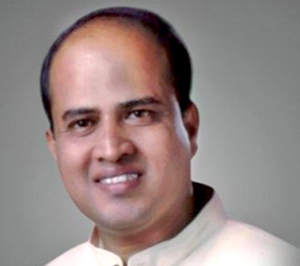
Karnataka BJP MLC Mahantesh posts porn photos on media WhatsApp group

[email protected] (News Network)
May 3, 2017

Belagavi, May 3: BJP leader and MLC Mahantesh M Kavatagimath has caused a fresh embarrassment to the saffron party by posting nude pictures of women on the Belagavi Media Force WhatsApp group formed for sharing news and intimations.Mahantesh

The senior legislator shared over 50 pictures, much to the embarrassment of the group members. The WhatsApp group comprises senior officials including deputy commissioner, police officials of various ranks, the Belagavi police commissioner, Belagavi district superintendent of police, police inspectors, member of parliament, Zilla Panchayat members, city councillors, women officials of various departments, social activists and representatives of media houses.

Kavatagimath, around 4.20 pm, posted over 56 PDF files that comprised over 50 pictures of nude women from his official mobile phone. Sharing objectionable contents on social media platforms is a serious offence and violation of cyber laws.

Even as the group members noticed the obnoxious postings, there was brisk activity in the group. Admins of the WhatsApp group started quitting from the group, senior officials remained tightlipped, while women officers who were embarrassed, left with serious remarks condemning the postings.

Most of the group members were stunned and expressed shock. Kavatagimath, who even failed to regret the postings, was removed from the group by the group admin. The MLC was not available for comments as he had switched off his mobile phone.

Comments

Add new comment

  • Coastaldigest.com reserves the right to delete or block any comments.
  • Coastaldigset.com is not responsible for its readers’ comments.
  • Comments that are abusive, incendiary or irrelevant are strictly prohibited.
  • Please use a genuine email ID and provide your name to avoid reject.
News Network
April 19,2020

Kasaragod, Apr 19: Kasaragod, Kerala's COVID-19 hotspot, is the only district in the southern state lacking adequate health infrastructure.

In spite of treating the highest number of COVID-19 patients in the state with meagre infrastructural facilities and even without the support of a medical college in the north Kerala district, no deaths have been reported due to coronavirus.

The state health department views the performance of M Kunhiraman and his team, consisting of Janardhana Naik and Krishna Naik, at the General hospital in Kasaragod as a success story.

"Not only did they control the situation quickly with minimum infrastructure, they also started turning out a large number of negative cases within a few weeks and creditably ensured zero mortality.

This can be showcased as a best global model," Chairman of the Information Education and Communication (IEC) Committee and Project Director Kerala State Aids Control Society, R Ramesh said.

Recalling the ordeal, Janardhana Naik said his first major challenge was the physical examination of a patient with suspected COVID-19.

"Even with the PPE kit, nobody knew how effective they were and it took a whole 30 minutes to wear them properly.

But as time passed, we got accustomed to it," he said.

The traditional method of dealing with a patient involved knowing his or her history, observation and physical examination.

For hundreds of years, the hands-on body approach has been the soul of the doctor-patient relationship -- taking the pulse, tapping on and listening to the chest, feeling lumps.

With the onset of COVID-19 all that has changed.

"In fact, the whole exercise was fraught with grave risks because everything connected with COVID-19 was new.

Doctors have to keep a distance even though the physical examination wearing a Personal Protective Equipment (PPE) is difficult.

Sounds from the body are inaudible, vision is blurred through the smog-covered goggles and a stethoscope seldom has any use," Janardhana Naik said.

It was from March 15 that the hospital started receiving COVID-19 patients, primarily from Dubai.

By the time the first person came, the hospital was ready for him.

Soon, patient numbers began to swell and in a couple of weeks they reached about 91.

From then on, it was teamwork.

Committees were formed for each and every task, including the help desk, IT, treatment, medical board, training, food, waste disposal and data maintenance.

Initially, patients had many misgivings about the hospital.

"Some were disillusioned and even aggressive. Some were not happy with the facilities the hospital had to offer.

But gradually through good treatment and counselling by a psychiatrist, who visited the hospital on alternate days, the confidence and mood of the patients changed and they became friendly with the staff," Naik elaborated.

Counselling was also given to the concerned family members of the patients.

Besides treatment, the medical staff had to spend a considerable amount of time clearing the doubts of patients.

When they got discharged some patients insisted on seeing the faces of the medical staff, who till then were anonymous entities covered from head to toe.

Some even wanted to take selfies with them.

However, the medical team politely turned down their requests and preferred to remain hidden in their work attires.

The mood of the patients also rubbed off on the doctors and hospital staff.

All the physicians and hospital staff are now more confident of dealing with contagious diseases after treating COVID-19 patients.

"Our previous experience of treating H1N1, Chikungunya and Dengue cases helped us a lot.

Words of encouragement from the Health Minister K K Shailaja, Health Principal Secretary Dr Rajan N Khobragade and Health Services Director Dr Sarita R L gave us the impetus to build up confidence.

Moreover, the field health workers did a wonderful job in containing the viral spread," Naik added.

As the number of coronavirus cases rose, the state government on April 5 deputed a 26-member medical team from Thiruvananthapuram to set up a COVID-19 hospital in the district.

They turned a block of the under construction Government Medical College as a hospital-like facility, setting up a 200 bed facility to treat coronavirus patients.

Comments

Add new comment

  • Coastaldigest.com reserves the right to delete or block any comments.
  • Coastaldigset.com is not responsible for its readers’ comments.
  • Comments that are abusive, incendiary or irrelevant are strictly prohibited.
  • Please use a genuine email ID and provide your name to avoid reject.
News Network
July 1,2020

Bengaluru, Jul 1: Karnataka Primary and Secondary Education Minister S Suresh Kumar on Wednesday played down reports about confusion regarding valuation of Second Pre- University and the Secondary School Leaving Certificate exam papers.

"Creating confusion has become a habit. There was confusion before the exam, during the exam and now confusion about the valuation of the exam papers," Kumar told reporters in Ramanagara when asked about the confusion over the valuation of answer sheets.

He had gone there to inspect a few centres where the SSLC or the 10th standard exams are underway.

The minister reminded people not to speak about the abilities of the students with contempt.

"Our students have toiled hard and are enthusiastically appearing for the examination. They are eligible for the marks they will score. So we should not speak about our children with disrespect," Kumar said.

The Education Minister said he had spoken to many leaders including former chief ministers Siddaramaiah and H D Kumaraswamy on conducting the examinations.

"Kumaraswamy had insisted on postponing the examination. I personally spoke to him and apprised him about the steps taken by us. I told him that we will work with more sincerity to ensure the safety of the children," Kumar said.

The SSLC exam was scheduled to take place from March 27 but due to the coronavirus-induced lockdown, it was postponed.

While the CBSE and a few other states either decided to give marks based on the students' performance in the previous examinations such as quarterly and half-yearly exams or gave general promotion to the students, Karnataka went ahead to hold the exam.

According to Karnataka Secondary Education Examination Board officials, around 8.5 lakh students have enrolled this year for the SSLC examination.

The exams are being held at 2,879 exam centres across the state.

Prior to the SSLC examination, the last exam of the Second PUC was also conducted on June 18, which was also put on hold due to the lockdown.

Comments

Add new comment

  • Coastaldigest.com reserves the right to delete or block any comments.
  • Coastaldigset.com is not responsible for its readers’ comments.
  • Comments that are abusive, incendiary or irrelevant are strictly prohibited.
  • Please use a genuine email ID and provide your name to avoid reject.
News Network
June 1,2020

Bengaluru, Jun 1: Karnataka's Department of Health and Family Welfare on Sunday released the protocol for inter-state travellers to the State during phased reopening --#Unlock1.

Five points protocol in this regard are: 1. Mandatory Self- Registration on Seva Sindhu Portal by all travellers before entering Karnataka:

a. Name, Address and Mobile Number to be provided

b. No approval required

c. Use of same Mobile number for multiple registrations not allowed except in the case of a family.

d. Business visitors to give details (name, mobile and address of persons in Karnataka they intend to meet).

e. Transit travellers to provide an address in destination state and indicate exit check post from Karnataka.

2. Health Screening of all incoming persons at entry points.

a. Border Check-posts, Airports, Railway stations and Bus stand

b. Home Quarantine hand-stamping on hand for 14-days period as per quarantine norms

3. Quarantine norms are based on three parameters

I. Symptomatic on arrival from any State: 7 days of Hospital isolation at COVID Care Centre(CCC)/Dedicated COVID Health Centre (DCHC) followed by 7 days of home quarantine or manage as per symptoms.

II. Test immediately on arrival: If positive, shift to Dedicated COVID-19 Hospital (DCH). If negative, no further test required

III. Asymptomatic on arrival:

* For persons coming from Maharashtra

a) 7 days of institutional quarantine followed by 7 days of home quarantine

b) Test if they develop symptoms during the quarantine period

c) Exceptions for Special Category Asymptomatic persons--14-days home quarantine (one attendant to be permitted) and Special category passengers--Death in the family, Pregnant Women, Children aged below 10 years, Elderly aged above 60 years, Serious illness, Human Distress

d) Business travellers from Maharashtra: To establish that one is a business traveller, a person should show confirmed return flight/train ticket which should not be more than 7 days later from the date of arrival.

In case one is coming by road, he/she should provide the address proof of person in Karnataka he intends to meet. In addition, the person should produce -- one having COVID-19 negative test certificate, which is not more than two days old -- exempted from quarantine.

One does not have a COVID-19 negative test certificate, such a person should go for institutional quarantine of two days within which COVID-19 test should be conducted at his/her own cost. After the test result is negative, the person is exempted from quarantine. No hand stamping of the business visitor is required.

e) All travellers from Maharashtra who come with COVID-19 negative test certificate from an ICMR approved lab, which is not more than two days old from the date of arrival, are exempted from seven days of institution quarantine. They can be asked to go for 14 days of home quarantine.

f) Transit traveller from Maharashtra: To establish that one is a transit traveller, a person should show flight/ train ticket for the onward journey which should not be more than 1 day later from the date of arrival. In case one is travelling by road, he/she should provide the identity proof and address proof in the destination state. Such traveller should be hand stamped if travelling by road as "Transit Traveller."

*For persons coming from other States

a) 14 days of home quarantine

b) Test if they develop symptoms during the home quarantine period

c) For persons where home quarantine is not possible, then institutional quarantine should be done, especially when we have a large family or no separate room for home quarantine, slum or overcrowded areas where home quarantine can not be followed.

d) Business visitors from the Other States: To establish that one is a business traveller, a person should show confirmed return flight/train ticket which should not be more than 7 days later from the date of arrival. In case one is coming by road, he/she should provide the address proof of the native State. No quarantine, and no hand stamping for business visitors from other states.

e) Transit traveller from the other States: To establish that one is a transit traveller, the person should show flight/train ticket for the onward journey which should not be more than one day later from the date of arrival. In case one is travelling by road, he/she should provide the identity proof and address proof in the destination state. Such traveller should be hand stamped if travelling by road as "Transit Traveller."

4. Home Quarantine: Home quarantine follow-up for all incoming persons except business visitors and transit travellers

A. For Rural Areas--

* Home quarantine poster on the home door.

* Information to two neighbours

* Gram Panchayat Task Force to carry an overall responsibility of Home Quarantine

* 3-Member team in every village to monitor

* Flying Squad: FIR against violation of home quarantine and shift to institutional quarantine

* IVRS Call-centre outbound calls

* Quarantine watch App-daily self-monitoring upload-Temperature, Finger-tip pulse-oximetry for elderly and persons with co-morbidity

B. For BBMP and other Urban Areas--

* Home Quarantine Poster on the home door.

* Information to two neighbours and resident welfare/apartment owner's association.

* Ward level team to carry an overall responsibility of home quarantine

* 3-member team at booth level to monitor along with the involvement of Resident Welfare/Apartment Owners' Associations

* Flying Squad: FIR against violation of home quarantine and shift to institutional quarantine

* IVRS Call-centre outbound calls

* Quarantine watch App: Daily self-monitoring upload- temperature, finger-tip pulse-oximetry for elderly and persons with co-morbidity

Karnataka government on Sunday issued guidelines, which will come into force from June 1 and continue till June 30.

According to the new guidelines, religious places and places of worship for the public, hotels, restaurants and other hospitality services, and shopping malls will be permitted to open from June 8.

Union Ministry of Home Affairs (MHA) on Saturday announced new guidelines for phased re-opening of "all activities outside containment zones for the next one month beginning June 1.

In an order, Karnataka government said that phased re-opening of areas outside the containment zones, all activities will be permitted, except the following, which will be allowed, with the stipulation of following Standard Operating Procedures (SOPs) to be prescribed by the Ministry of Health and Family Welfare (MoHFW).

According to the Union Health Ministry, there are 2,922 confirmed COVID-19 cases in the State including 1,877 active cases, 997 recovered and 48 deaths.


Comments

Add new comment

  • Coastaldigest.com reserves the right to delete or block any comments.
  • Coastaldigset.com is not responsible for its readers’ comments.
  • Comments that are abusive, incendiary or irrelevant are strictly prohibited.
  • Please use a genuine email ID and provide your name to avoid reject.